 Add to Chrome
 Add to Firefox
 Add to Edge
ProsoCodec: Prosody-Oriented Speech Codec for Voice Conversion
Jun 20, 2026
Neural speech codecs efficiently compress speech and have become a foundation for speech generation, but they are typically learned as holistic representations that intertwine linguistic content, speaker identity, and prosody. While this design is effective for zero-shot voice cloning, it hinders downstream tasks that require prosody preservation or transfer, such as voice conversion. To address this, we introduce ProsoCodec, a prosody-oriented speech codec that models prosody as a conditional residual rather than as a disentangled stream. Specifically, by conditioning both the encoder and decoder on text and speaker embeddings as prefix tokens, the discrete bottleneck is encouraged to capture prosodic variation not explained by content and speaker. To further preserve prosody, we use the low-frequency mel band and train the model on paired same-speaker utterances. Experiments on voice conversion show improved prosody preservation and reduced source-timbre leakage.

Probing Cross-modal Information Hubs in Audio-Visual LLMs
May 11, 2026Audio-visual large language models (AVLLMs) have recently emerged as a powerful architecture capable of jointly reasoning over audio, visual, and textual modalities. In AVLLMs, the bidirectional interaction between audio and video modalities introduces intricate processing dynamics, necessitating a deeper understanding of their internal mechanisms. However, unlike extensively studied text-only or large vision language models, the internal workings of AVLLMs remain largely unexplored. In this paper, we focus on cross-modal information flow between audio and visual modalities in AVLLMs, investigating where information derived from one modality is encoded within the token representations of the other modality. Through an analysis of multiple recent AVLLMs, we uncover two common findings. First, AVLLMs primarily encode integrated audio-visual information in sink tokens. Second, sink tokens do not uniformly hold cross-modal information. Instead, a distinct subset of sink tokens, which we term cross-modal sink tokens, specializes in storing such information. Based on these findings, we further propose a simple training-free hallucination mitigation method by encouraging reliance on integrated cross-modal information within cross-modal sink tokens. Our code is available at https://github.com/kaistmm/crossmodal-hub.
Hardware-Efficient Softmax and Layer Normalization with Guaranteed Normalization for Edge Devices
Apr 26, 2026In Transformer models, non-GEMM (non-General Matrix Multiplication) operations -- especially Softmax and Layer Normalization (LayerNorm) -- often dominate hardware cost due to their nonlinear nature. To address this, previous approximation studies mainly target rank-oriented tasks, which is acceptable for classification. However, edge Natural Language Processing (NLP) applications and edge generative AI are largely evaluated based on score-oriented tasks, so normalization-guaranteed non-GEMM operations are essential. We propose a hardware-efficient Softmax and LayerNorm with Guaranteed Normalization for Edge devices. Our design employs hardware-efficient approximation methods while preserving the normalization (Softmax: $\sum p = 1$, LayerNorm: $σ= 1$). Our architecture is described in Verilog HDL and synthesized using the Samsung 28nm CMOS process. In accuracy evaluation, we achieve high accuracy with minimal degradation: GLUE +0.07%, SQuAD -0.01%, perplexity -0.09%. Implementation results show that our architecture is small: $942\,μm^2$ for Softmax, $1199\,μm^2$ for LayerNorm. Compared to the state of the art, we achieve up to 11x and 14x reduction in area, respectively.
MamTra: A Hybrid Mamba-Transformer Backbone for Speech Synthesis
Mar 12, 2026Despite the remarkable quality of LLM-based text-to-speech systems, their reliance on autoregressive Transformers leads to quadratic computational complexity, which severely limits practical applications. Linear-time alternatives, notably Mamba, offer a potential remedy; however, they often sacrifice the global context essential for expressive synthesis. In this paper, we propose MamTra, an interleaved Mamba-Transformer framework designed to leverage the advantages of Mamba's efficiency and Transformers' modeling capability. We also introduce novel knowledge transfer strategies to distill insights from a pretrained Transformer into our hybrid architecture, thereby bypassing the prohibitive costs of training from scratch. Systematic experiments identify the optimal hybrid configuration, and demonstrate that MamTra reduces inference VRAM usage by up to 34% without compromising speech fidelity - even trained on only 2% of the original training dataset. Audio samples are available at https://mamtratts.github.io.
Learning Where It Matters: Geometric Anchoring for Robust Preference Alignment
Feb 04, 2026Direct Preference Optimization (DPO) and related methods align large language models from pairwise preferences by regularizing updates against a fixed reference policy. As the policy drifts, a static reference, however, can become increasingly miscalibrated, leading to distributional mismatch and amplifying spurious preference signals under noisy supervision. Conversely, reference-free variants avoid mismatch but often suffer from unconstrained reward drift. We propose Geometric Anchor Preference Optimization (GAPO), which replaces the fixed reference with a dynamic, geometry-aware anchor: an adversarial local perturbation of the current policy within a small radius that serves as a pessimistic baseline. This anchor enables an adaptive reweighting mechanism, modulating the importance of each preference pair based on its local sensitivity. We further introduce the Anchor Gap, the reward discrepancy between the policy and its anchor, and show under smoothness conditions that it approximates worst-case local margin degradation. Optimizing a logistic objective weighted by this gap downweights geometrically brittle instances while emphasizing robust preference signals. Across diverse noise settings, GAPO consistently improves robustness while matching or improving performance on standard LLM alignment and reasoning benchmarks.
UNMIXX: Untangling Highly Correlated Singing Voices Mixtures
Jan 19, 2026We introduce UNMIXX, a novel framework for multiple singing voices separation (MSVS). While related to speech separation, MSVS faces unique challenges: data scarcity and the highly correlated nature of singing voices mixture. To address these issues, we propose UNMIXX with three key components: (1) musically informed mixing strategy to construct highly correlated, music-like mixtures, (2) cross-source attention that drives representations of two singers apart via reverse attention, and (3) magnitude penalty loss penalizing erroneously assigned interfering energy. UNMIXX not only addresses data scarcity by simulating realistic training data, but also excels at separating highly correlated mixtures through cross-source interactions at both the architectural and loss levels. Our extensive experiments demonstrate that UNMIXX greatly enhances performance, with SDRi gains exceeding 2.2 dB over prior work.
TAVID: Text-Driven Audio-Visual Interactive Dialogue Generation
Dec 23, 2025The objective of this paper is to jointly synthesize interactive videos and conversational speech from text and reference images. With the ultimate goal of building human-like conversational systems, recent studies have explored talking or listening head generation as well as conversational speech generation. However, these works are typically studied in isolation, overlooking the multimodal nature of human conversation, which involves tightly coupled audio-visual interactions. In this paper, we introduce TAVID, a unified framework that generates both interactive faces and conversational speech in a synchronized manner. TAVID integrates face and speech generation pipelines through two cross-modal mappers (i.e., a motion mapper and a speaker mapper), which enable bidirectional exchange of complementary information between the audio and visual modalities. We evaluate our system across four dimensions: talking face realism, listening head responsiveness, dyadic interaction fluency, and speech quality. Extensive experiments demonstrate the effectiveness of our approach across all these aspects.
Accelerating Diffusion-based Text-to-Speech Model Training with Dual Modality Alignment
May 26, 2025The goal of this paper is to optimize the training process of diffusion-based text-to-speech models. While recent studies have achieved remarkable advancements, their training demands substantial time and computational costs, largely due to the implicit guidance of diffusion models in learning complex intermediate representations. To address this, we propose A-DMA, an effective strategy for Accelerating training with Dual Modality Alignment. Our method introduces a novel alignment pipeline leveraging both text and speech modalities: text-guided alignment, which incorporates contextual representations, and speech-guided alignment, which refines semantic representations. By aligning hidden states with discriminative features, our training scheme reduces the reliance on diffusion models for learning complex representations. Extensive experiments demonstrate that A-DMA doubles the convergence speed while achieving superior performance over baselines. Code and demo samples are available at: https://github.com/ZhikangNiu/A-DMA
AlignDiT: Multimodal Aligned Diffusion Transformer for Synchronized Speech Generation
Apr 29, 2025In this paper, we address the task of multimodal-to-speech generation, which aims to synthesize high-quality speech from multiple input modalities: text, video, and reference audio. This task has gained increasing attention due to its wide range of applications, such as film production, dubbing, and virtual avatars. Despite recent progress, existing methods still suffer from limitations in speech intelligibility, audio-video synchronization, speech naturalness, and voice similarity to the reference speaker. To address these challenges, we propose AlignDiT, a multimodal Aligned Diffusion Transformer that generates accurate, synchronized, and natural-sounding speech from aligned multimodal inputs. Built upon the in-context learning capability of the DiT architecture, AlignDiT explores three effective strategies to align multimodal representations. Furthermore, we introduce a novel multimodal classifier-free guidance mechanism that allows the model to adaptively balance information from each modality during speech synthesis. Extensive experiments demonstrate that AlignDiT significantly outperforms existing methods across multiple benchmarks in terms of quality, synchronization, and speaker similarity. Moreover, AlignDiT exhibits strong generalization capability across various multimodal tasks, such as video-to-speech synthesis and visual forced alignment, consistently achieving state-of-the-art performance. The demo page is available at https://mm.kaist.ac.kr/projects/AlignDiT .
SCRec: A Scalable Computational Storage System with Statistical Sharding and Tensor-train Decomposition for Recommendation Models
Apr 01, 2025
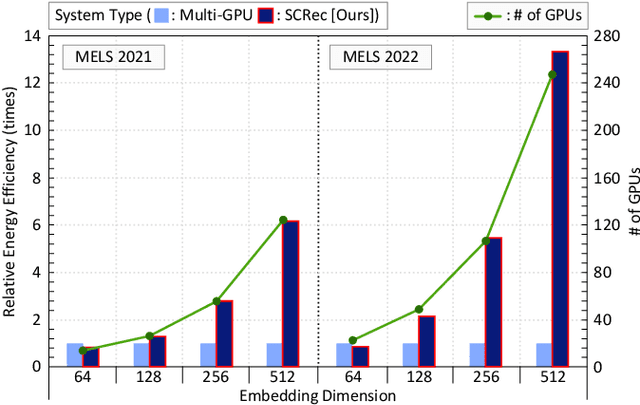
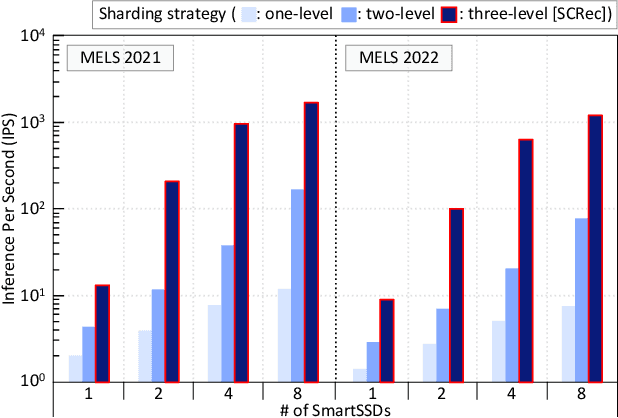

Deep Learning Recommendation Models (DLRMs) play a crucial role in delivering personalized content across web applications such as social networking and video streaming. However, with improvements in performance, the parameter size of DLRMs has grown to terabyte (TB) scales, accompanied by memory bandwidth demands exceeding TB/s levels. Furthermore, the workload intensity within the model varies based on the target mechanism, making it difficult to build an optimized recommendation system. In this paper, we propose SCRec, a scalable computational storage recommendation system that can handle TB-scale industrial DLRMs while guaranteeing high bandwidth requirements. SCRec utilizes a software framework that features a mixed-integer programming (MIP)-based cost model, efficiently fetching data based on data access patterns and adaptively configuring memory-centric and compute-centric cores. Additionally, SCRec integrates hardware acceleration cores to enhance DLRM computations, particularly allowing for the high-performance reconstruction of approximated embedding vectors from extremely compressed tensor-train (TT) format. By combining its software framework and hardware accelerators, while eliminating data communication overhead by being implemented on a single server, SCRec achieves substantial improvements in DLRM inference performance. It delivers up to 55.77$\times$ speedup compared to a CPU-DRAM system with no loss in accuracy and up to 13.35$\times$ energy efficiency gains over a multi-GPU system.