 Add to Chrome
 Add to Firefox
 Add to Edge
Benchmarking Speech-to-Speech Translation Models
Jun 02, 2026
Speech-to-speech translation (S2ST) has advanced rapidly, but offline evaluation lacks a unified protocol: studies report non-overlapping metric subsets, preventing direct comparisons. We introduce COMPASS, a unified and reproducible benchmarking framework integrating 46 metrics across eight dimensions, and deploy it on 1,248 model-language configurations from FLEURS and CVSS, spanning cascaded and end-to-end architectures over ten language pairs. Architectures exhibit complementary strengths: best-vs-worst gaps exceed 30\% on naturalness and speaker preservation but remain within a few points on translation quality, so single-metric rankings systematically misrepresent system quality. Correlation filtering reduces 46 metrics to 10 per direction, with three axes requiring different metrics across X$\to$EN and EN$\to$X (e.g., TER/UTMOS vs. ChrF++/NISQA-MOS); these subsets preserve rankings (Spearman's $ρ>0.80$) while cutting evaluation time by $\approx 2.5\times$. Human validation across dubbing, podcasts, and medical domains shows standalone MOS predictors fail to predict listener preference, while top domain-specific metrics correlate with human judgment ($ρ\geq 0.90$). We release COMPASS as a foundation for domain-aware S2ST evaluation.

Annotation-Free MIDI-to-Audio Synthesis via Concatenative Synthesis and Generative Refinement
Oct 22, 2024
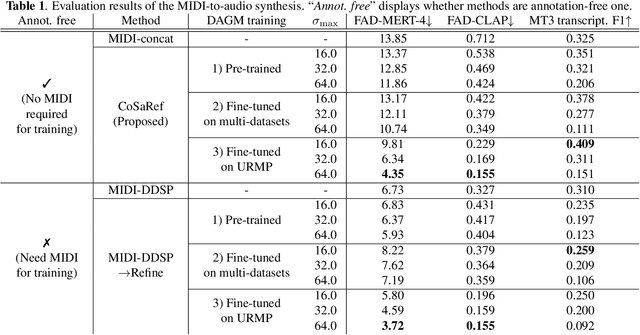
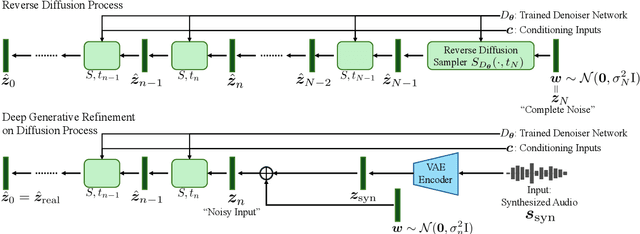
Recent MIDI-to-audio synthesis methods have employed deep neural networks to successfully generate high-quality and expressive instrumental tracks. However, these methods require MIDI annotations for supervised training, limiting the diversity of the output audio in terms of instrument timbres, and expression styles. We propose CoSaRef, a MIDI-to-audio synthesis method that can be developed without MIDI-audio paired datasets. CoSaRef first performs concatenative synthesis based on MIDI inputs and then refines the resulting audio into realistic tracks using a diffusion-based deep generative model trained on audio-only datasets. This approach enhances the diversity of audio timbres and expression styles. It also allows for control over the output timbre based on audio sample selection, similar to traditional functions in digital audio workstations. Experiments show that while inherently capable of generating general tracks with high control over timbre, CoSaRef can also perform comparably to conventional methods in generating realistic audio.
SaSLaW: Dialogue Speech Corpus with Audio-visual Egocentric Information Toward Environment-adaptive Dialogue Speech Synthesis
Aug 13, 2024This paper presents SaSLaW, a spontaneous dialogue speech corpus containing synchronous recordings of what speakers speak, listen to, and watch. Humans consider the diverse environmental factors and then control the features of their utterances in face-to-face voice communications. Spoken dialogue systems capable of this adaptation to these audio environments enable natural and seamless communications. SaSLaW was developed to model human-speech adjustment for audio environments via first-person audio-visual perceptions in spontaneous dialogues. We propose the construction methodology of SaSLaW and display the analysis result of the corpus. We additionally conducted an experiment to develop text-to-speech models using SaSLaW and evaluate their performance of adaptations to audio environments. The results indicate that models incorporating hearing-audio data output more plausible speech tailored to diverse audio environments than the vanilla text-to-speech model.