 Add to Chrome
 Add to Firefox
 Add to Edge
Guidance Breaks the Fitted Operator: A Terminal-Fitted Repair for Classifier-Free Guidance
Jul 08, 2026
Classifier-free guidance (CFG) is the standard way to strengthen class-conditioning in diffusion and flow-matching samplers, yet at large guidance it oversaturates and destabilizes, symptoms practitioners suppress with more steps or limited-interval schedules. We analyze CFG through an asymptotic-preserving, numerical-analysis lens. Building on a recent result that the deterministic DDIM step is the unique fitted operator for the unguided terminal layer, exact on the final small-sigma stretch of sampling, we show that guidance re-stiffens exactly the discriminative subspace to an anomalous exponent 1+w. DDIM is therefore no longer fitted there, and on coarse meshes its guided residual diverges as sigma_min goes to zero. We prove a guided clock barrier with three ordered step-size thresholds, and read one-step oversaturation as its endpoint: a solver artifact on the calibration model rather than the continuous guided law. The same analysis yields a one-coefficient, zero-extra-NFE repair: replace CFG's w(r-1) by r^(1+w)-r on the guidance direction. On the calibration model's discriminative crossover, this removes CFG's sigma_min-divergent blow-up and is first-order accurate against the exact guided flow as sigma_min goes to zero. On learned CIFAR-10 checkpoints, and as a cross-domain smoke test on Stable Diffusion 1.5 DDIM, it acts as a high-guidance stabilizer at no extra cost rather than a universal quality knob: it cuts residual amplification and saturation, gives 9/9 point-FID wins over CFG on the tested grid, and preserves classifier-proxy target accuracy in the hard-cell blocks. We report the limits alongside: it is not a universal image-quality win, and against a dense vanilla-CFG reference it is not a uniformly better integrator of that field.

Asymptotic-Preserving A Posteriori Analysis of Diffusion and Flow-Matching Samplers
Jul 05, 2026Diffusion and flow-matching samplers integrate a learned probability-flow ODE from a large noise scale down to a small terminal floor $σ_{\min}$, at which the score is stiff and the flow develops a boundary layer. We treat $σ_{\min}$ as a singular-perturbation parameter and determine which fixed-step samplers are asymptotic-preserving (AP), that is, stable and uniformly accurate as $σ_{\min}\to0$, casting the criteria as an a posteriori audit: residual functionals with $σ_{\min}$-uniform coefficients, computable on a pretrained checkpoint without ground-truth scores or exact trajectories. On the terminal layer, Euler in the $σ$-clock, the deterministic DDIM update, is the unique layer-exact discretization up to affine reparameterization, with rectified flow its flow-matching counterpart; the $λ$-clock is stable only for steps $h\le h_\star=1+W(1/e)$, and the uniform-$σ^2$ heat clock stalls a $σ_{\min}$-independent distance from the data. On two solvable models (rank-deficient Gaussian, symmetric two-point mixture), deterministic samplers remain first-order uniformly accurate with no $\log(1/σ_{\min})$ factor, even across a symmetric posterior-switching interface whose distributional budget is a universal constant; the logarithm is charged entirely to the Itô term of stochastic samplers, whose path-KL scales as $Λ^2/N$ against the ODE's $O(Λ^2/N^2)$ budget, with $Λ=\log(σ_{\max}/σ_{\min})$. On the EDM CIFAR-10 checkpoint, spectra measured once predict held-out residual budgets across step count, schedule, and noise level against pre-specified gates with no per-configuration refitting, and calibrate the Itô coefficient at $M_1=1.00\pm0.01$. The clock decides stability; the noise, not the geometry, charges the logarithm.
Planner-Admissible Graph-PDE Value Extensions for Sparse Goal-Conditioned Planning
May 18, 2026Sparse goal-conditioned planning with few cost-to-go labels can be viewed as a graph-PDE Dirichlet extension problem: extend sparse labels on a goal-dependent boundary to unlabelled graph vertices so that greedy rollouts reach the goal. We study which graph value extensions are planner-admissible under the operational argmin-Q planner. Our main result is a local action-gap certificate: if the surrogate value error along the rollout stays below half the true action gap, then the greedy rollout reaches the goal. Absolutely Minimal Lipschitz Extension (AMLE), the p=infinity endpoint of the graph p-Laplacian family, instantiates this certificate through a comparison-principle fill-distance bound. Harmonic extension, by contrast, can mis-rank local actions because its values reflect boundary hitting probabilities rather than shortest-path greedy order. On 120 AntMaze layout-derived graph configurations, harmonic extension achieves 0.584 aggregate rollout success, while AMLE reaches 0.970. Finite high-p methods also enter a high-success regime, with success 0.903 for p=4, 0.973 for p=8, and 0.982 for a fixed-budget p=16 solver, though the p=16 row is not used as a converged endpoint ranking due to incomplete solver certification. Mechanism audits show that many rollout decisions occur in AMLE-compatible but harmonic-incompatible local geometry, and that AMLE corrects most harmonic inversions on the rollout-weighted decision scope.
Dual-level Progressive Hardness-Aware Reweighting for Cross-View Geo-Localization
Nov 03, 2025Cross-view geo-localization (CVGL) between drone and satellite imagery remains challenging due to severe viewpoint gaps and the presence of hard negatives, which are visually similar but geographically mismatched samples. Existing mining or reweighting strategies often use static weighting, which is sensitive to distribution shifts and prone to overemphasizing difficult samples too early, leading to noisy gradients and unstable convergence. In this paper, we present a Dual-level Progressive Hardness-aware Reweighting (DPHR) strategy. At the sample level, a Ratio-based Difficulty-Aware (RDA) module evaluates relative difficulty and assigns fine-grained weights to negatives. At the batch level, a Progressive Adaptive Loss Weighting (PALW) mechanism exploits a training-progress signal to attenuate noisy gradients during early optimization and progressively enhance hard-negative mining as training matures. Experiments on the University-1652 and SUES-200 benchmarks demonstrate the effectiveness and robustness of the proposed DPHR, achieving consistent improvements over state-of-the-art methods.
Spectral-Temporal Fusion Representation for Person-in-Bed Detection
Dec 27, 2024This study is based on the ICASSP 2025 Signal Processing Grand Challenge's Accelerometer-Based Person-in-Bed Detection Challenge, which aims to determine bed occupancy using accelerometer signals. The task is divided into two tracks: "in bed" and "not in bed" segmented detection, and streaming detection, facing challenges such as individual differences, posture variations, and external disturbances. We propose a spectral-temporal fusion-based feature representation method with mixup data augmentation, and adopt Intersection over Union (IoU) loss to optimize detection accuracy. In the two tracks, our method achieved outstanding results of 100.00% and 95.55% in detection scores, securing first place and third place, respectively.
Independent Feature Enhanced Crossmodal Fusion for Match-Mismatch Classification of Speech Stimulus and EEG Response
Oct 19, 2024


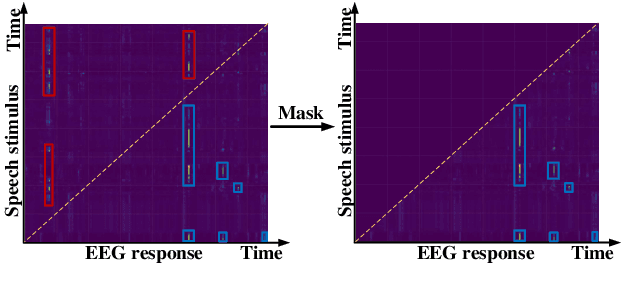
It is crucial for auditory attention decoding to classify matched and mismatched speech stimuli with corresponding EEG responses by exploring their relationship. However, existing methods often adopt two independent networks to encode speech stimulus and EEG response, which neglect the relationship between these signals from the two modalities. In this paper, we propose an independent feature enhanced crossmodal fusion model (IFE-CF) for match-mismatch classification, which leverages the fusion feature of the speech stimulus and the EEG response to achieve auditory EEG decoding. Specifically, our IFE-CF contains a crossmodal encoder to encode the speech stimulus and the EEG response with a two-branch structure connected via crossmodal attention mechanism in the encoding process, a multi-channel fusion module to fuse features of two modalities by aggregating the interaction feature obtained from the crossmodal encoder and the independent feature obtained from the speech stimulus and EEG response, and a predictor to give the matching result. In addition, the causal mask is introduced to consider the time delay of the speech-EEG pair in the crossmodal encoder, which further enhances the feature representation for match-mismatch classification. Experiments demonstrate our method's effectiveness with better classification accuracy, as compared with the baseline of the Auditory EEG Decoding Challenge 2023.
An Element-wise RSAV Algorithm for Unconstrained Optimization Problems
Sep 07, 2023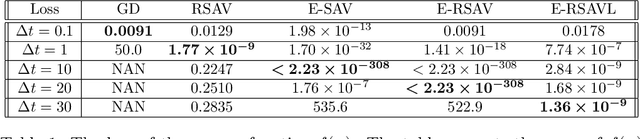
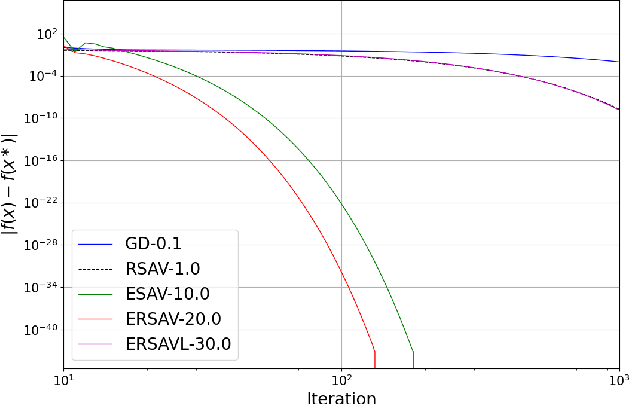

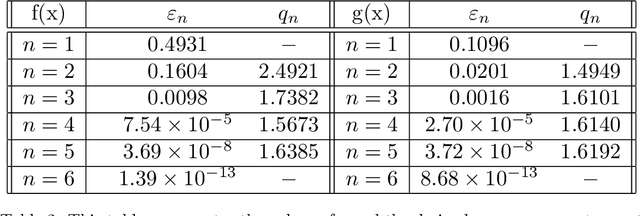
We present a novel optimization algorithm, element-wise relaxed scalar auxiliary variable (E-RSAV), that satisfies an unconditional energy dissipation law and exhibits improved alignment between the modified and the original energy. Our algorithm features rigorous proofs of linear convergence in the convex setting. Furthermore, we present a simple accelerated algorithm that improves the linear convergence rate to super-linear in the univariate case. We also propose an adaptive version of E-RSAV with Steffensen step size. We validate the robustness and fast convergence of our algorithm through ample numerical experiments.
Energy-Dissipative Evolutionary Deep Operator Neural Networks
Jun 09, 2023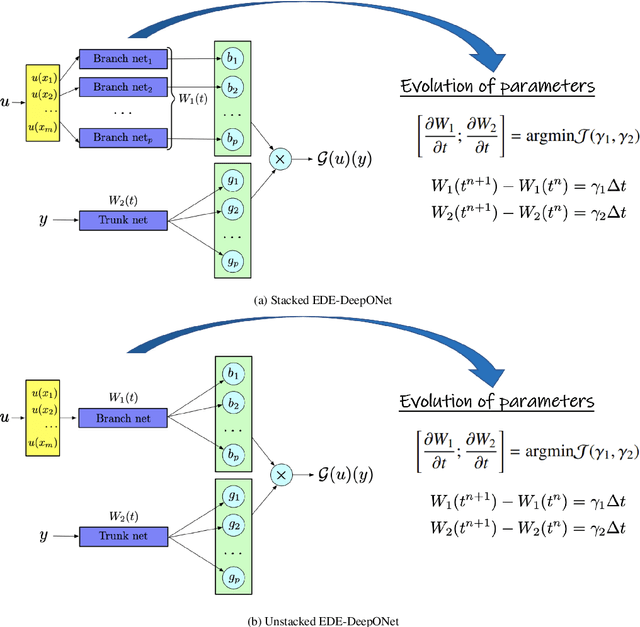


Energy-Dissipative Evolutionary Deep Operator Neural Network is an operator learning neural network. It is designed to seed numerical solutions for a class of partial differential equations instead of a single partial differential equation, such as partial differential equations with different parameters or different initial conditions. The network consists of two sub-networks, the Branch net and the Trunk net. For an objective operator G, the Branch net encodes different input functions u at the same number of sensors, and the Trunk net evaluates the output function at any location. By minimizing the error between the evaluated output q and the expected output G(u)(y), DeepONet generates a good approximation of the operator G. In order to preserve essential physical properties of PDEs, such as the Energy Dissipation Law, we adopt a scalar auxiliary variable approach to generate the minimization problem. It introduces a modified energy and enables unconditional energy dissipation law at the discrete level. By taking the parameter as a function of time t, this network can predict the accurate solution at any further time with feeding data only at the initial state. The data needed can be generated by the initial conditions, which are readily available. In order to validate the accuracy and efficiency of our neural networks, we provide numerical simulations of several partial differential equations, including heat equations, parametric heat equations and Allen-Cahn equations.