 Add to Chrome
 Add to Firefox
 Add to Edge
LegalCiteTrust: Benchmarking Citation Trustworthiness in Chinese Long-Form Legal Research Reports
Jul 23, 2026
Long-form legal research reports increasingly rely on LLMs and agentic research systems, but their reliability depends not only on answering the task, but also on whether cited legal authorities are trustworthy. A citation can be risky even when it points to a real source: the report may omit limiting conditions, misdescribe the authority, or use it to support a stronger claim than the source allows. We introduce LegalCiteTrust, a benchmark for evaluating citation trustworthiness in Chinese long-form legal research reports. It contains 72 densely annotated report-level tasks and evaluates reports along three dimensions: Coverage, Support, and Citation Trustworthiness. Citation Trustworthiness is operationalized through citation-level Existence, Fidelity, and Applicability (E/F/A). Experiments on general-purpose LLMs, deep-research systems, and legal-specific systems show that task completion, evidence richness, citation density, and citation reliability expose different system behaviors. Retrieval tools can improve evidence support without reliably improving the Trust score, while E/F/A-based revision improves Trust and Final score more clearly than existence-only filtering. These results suggest that trustworthy legal research generation requires citation-aware evidence governance after retrieval: systems must not only retrieve legal authorities, but also select, describe, and apply them reliably.

SynCLIP: Synonym-Coherent Language-Image Pretraining for Robust Open-Vocabulary Dense Perception
Jul 13, 2026Open-vocabulary dense perception (OVDP) aims to localize objects unseen during training by leveraging textual knowledge. Despite the remarkable progress of recent CLIP-based approaches, we identify a critical limitation: synonym-induced grounding inconsistency, where semantically equivalent expressions yield disparate spatial attention patterns. This inconsistency undermines the robustness and performance of existing methods in real-world OVDP applications. To address this issue, we propose SynCLIP, a Synonym-Coherent Language-Image Pretraining framework that enhances synonym-robust grounding for OVDP. SynCLIP introduces a Semantic-consistent Spatial Attention alignment (SSA) module to enhance spatial attention consistency by minimizing discrepancies between attention maps of original and synonymous expressions. Furthermore, a Spatial Attention Refinement (SAR) module selectively strengthens the most semantically relevant spatial regions within aligned maps for more precise and stable grounding. To support synonym-coherent pretraining, we also construct a Synonym-Enriched Visual Corpus (SEViC), which augments each category with multiple synonyms and textual definitions. Extensive experiments on multiple benchmarks demonstrate that SynCLIP substantially improves grounding consistency under diverse linguistic variants and achieves state-of-the-art performance among CLIP-based OVDP methods. Code is available at https://github.com/Justlovesmile/SynCLIP.
Optimizing Retrieval Components for a Shared Backbone via Component-Wise Multi-Stage Training
Jan 31, 2026Recent advances in embedding-based retrieval have enabled dense retrievers to serve as core infrastructure in many industrial systems, where a single retrieval backbone is often shared across multiple downstream applications. In such settings, retrieval quality directly constrains system performance and extensibility, while coupling model selection, deployment, and rollback decisions across applications. In this paper, we present empirical findings and a system-level solution for optimizing retrieval components deployed as a shared backbone in production legal retrieval systems. We adopt a multi-stage optimization framework for dense retrievers and rerankers, and show that different retrieval components exhibit stage-dependent trade-offs. These observations motivate a component-wise, mixed-stage configuration rather than relying on a single uniformly optimal checkpoint. The resulting backbone is validated through end-to-end evaluation and deployed as a shared retrieval service supporting multiple industrial applications.
LegalMALR:Multi-Agent Query Understanding and LLM-Based Reranking for Chinese Statute Retrieval
Jan 25, 2026Statute retrieval is essential for legal assistance and judicial decision support, yet real-world legal queries are often implicit, multi-issue, and expressed in colloquial or underspecified forms. These characteristics make it difficult for conventional retrieval-augmented generation pipelines to recover the statutory elements required for accurate retrieval. Dense retrievers focus primarily on the literal surface form of the query, whereas lightweight rerankers lack the legal-reasoning capacity needed to assess statutory applicability. We present LegalMALR, a retrieval framework that integrates a Multi-Agent Query Understanding System (MAS) with a zero-shot large-language-model-based reranking module (LLM Reranker). MAS generates diverse, legally grounded reformulations and conducts iterative dense retrieval to broaden candidate coverage. To stabilise the stochastic behaviour of LLM-generated rewrites, we optimise a unified MAS policy using Generalized Reinforcement Policy Optimization(GRPO). The accumulated candidate set is subsequently evaluated by the LLM Reranker, which performs natural-language legal reasoning to produce the final ranking. We further construct CSAID, a dataset of 118 difficult Chinese legal queries annotated with multiple statutory labels, and evaluate LegalMALR on both CSAID and the public STARD benchmark. Experiments show that LegalMALR substantially outperforms strong Retrieval-augmented generation(RAG) baselines in both in-distribution and out-of-distribution settings, demonstrating the effectiveness of combining multi-perspective query interpretation, reinforcement-based policy optimisation, and large-model reranking for statute retrieval.
Dual-level Progressive Hardness-Aware Reweighting for Cross-View Geo-Localization
Nov 03, 2025Cross-view geo-localization (CVGL) between drone and satellite imagery remains challenging due to severe viewpoint gaps and the presence of hard negatives, which are visually similar but geographically mismatched samples. Existing mining or reweighting strategies often use static weighting, which is sensitive to distribution shifts and prone to overemphasizing difficult samples too early, leading to noisy gradients and unstable convergence. In this paper, we present a Dual-level Progressive Hardness-aware Reweighting (DPHR) strategy. At the sample level, a Ratio-based Difficulty-Aware (RDA) module evaluates relative difficulty and assigns fine-grained weights to negatives. At the batch level, a Progressive Adaptive Loss Weighting (PALW) mechanism exploits a training-progress signal to attenuate noisy gradients during early optimization and progressively enhance hard-negative mining as training matures. Experiments on the University-1652 and SUES-200 benchmarks demonstrate the effectiveness and robustness of the proposed DPHR, achieving consistent improvements over state-of-the-art methods.
Band Prompting Aided SAR and Multi-Spectral Data Fusion Framework for Local Climate Zone Classification
Dec 24, 2024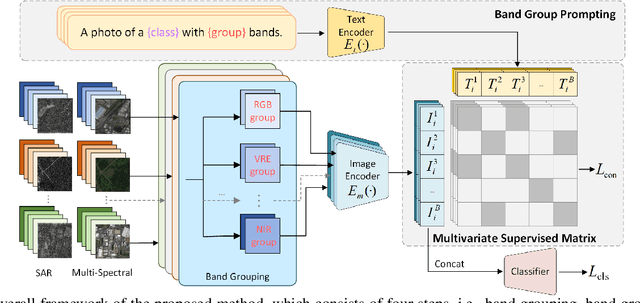
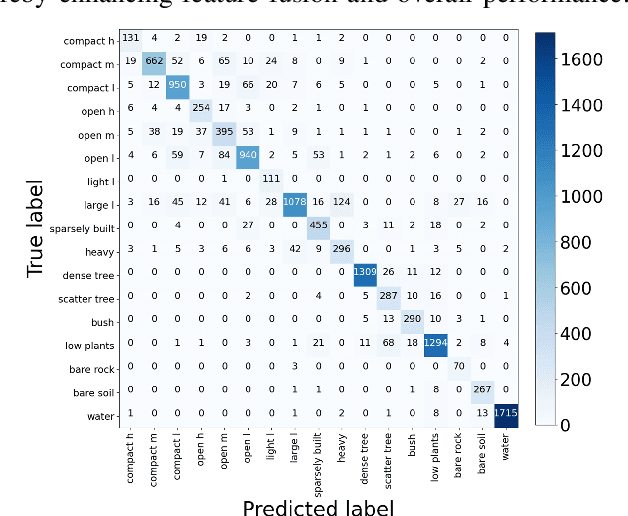
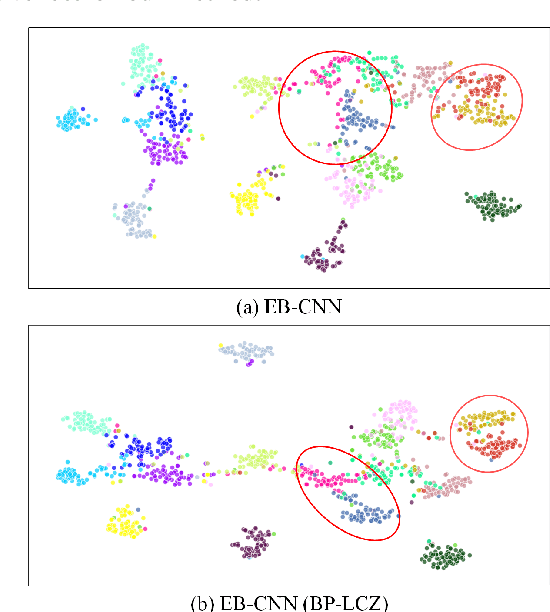
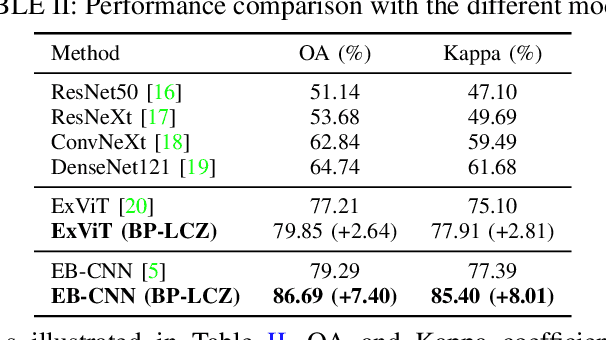
Local climate zone (LCZ) classification is of great value for understanding the complex interactions between urban development and local climate. Recent studies have increasingly focused on the fusion of synthetic aperture radar (SAR) and multi-spectral data to improve LCZ classification performance. However, it remains challenging due to the distinct physical properties of these two types of data and the absence of effective fusion guidance. In this paper, a novel band prompting aided data fusion framework is proposed for LCZ classification, namely BP-LCZ, which utilizes textual prompts associated with band groups to guide the model in learning the physical attributes of different bands and semantics of various categories inherent in SAR and multi-spectral data to augment the fused feature, thus enhancing LCZ classification performance. Specifically, a band group prompting (BGP) strategy is introduced to align the visual representation effectively at the level of band groups, which also facilitates a more adequate extraction of semantic information of different bands with textual information. In addition, a multivariate supervised matrix (MSM) based training strategy is proposed to alleviate the problem of positive and negative sample confusion by completing the supervised information. The experimental results demonstrate the effectiveness and superiority of the proposed data fusion framework.
SISP: A Benchmark Dataset for Fine-grained Ship Instance Segmentation in Panchromatic Satellite Images
Feb 06, 2024Fine-grained ship instance segmentation in satellite images holds considerable significance for monitoring maritime activities at sea. However, existing datasets often suffer from the scarcity of fine-grained information or pixel-wise localization annotations, as well as the insufficient image diversity and variations, thus limiting the research of this task. To this end, we propose a benchmark dataset for fine-grained Ship Instance Segmentation in Panchromatic satellite images, namely SISP, which contains 56,693 well-annotated ship instances with four fine-grained categories across 10,000 sliced images, and all the images are collected from SuperView-1 satellite with the resolution of 0.5m. Targets in the proposed SISP dataset have characteristics that are consistent with real satellite scenes, such as high class imbalance, various scenes, large variations in target densities and scales, and high inter-class similarity and intra-class diversity, all of which make the SISP dataset more suitable for real-world applications. In addition, we introduce a Dynamic Feature Refinement-assist Instance segmentation network, namely DFRInst, as the benchmark method for ship instance segmentation in satellite images, which can fortify the explicit representation of crucial features, thus improving the performance of ship instance segmentation. Experiments and analysis are performed on the proposed SISP dataset to evaluate the benchmark method and several state-of-the-art methods to establish baselines for facilitating future research. The proposed dataset and source codes will be available at: https://github.com/Justlovesmile/SISP.
EARL: An Elliptical Distribution aided Adaptive Rotation Label Assignment for Oriented Object Detection in Remote Sensing Images
Jan 14, 2023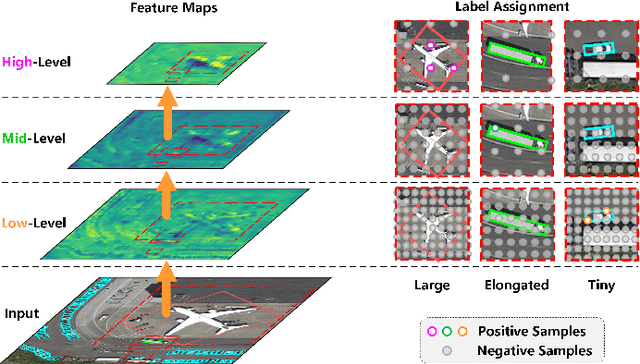
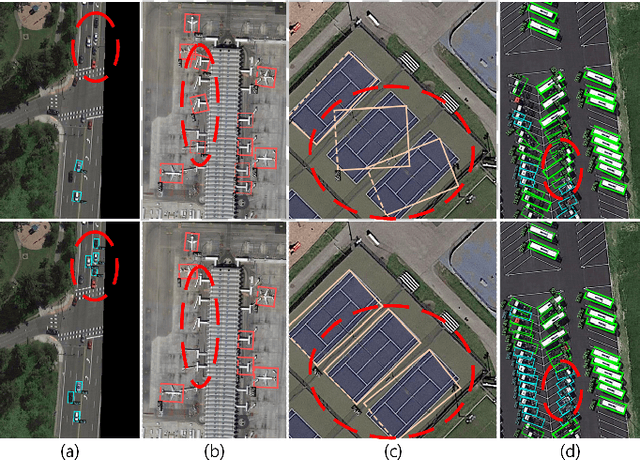
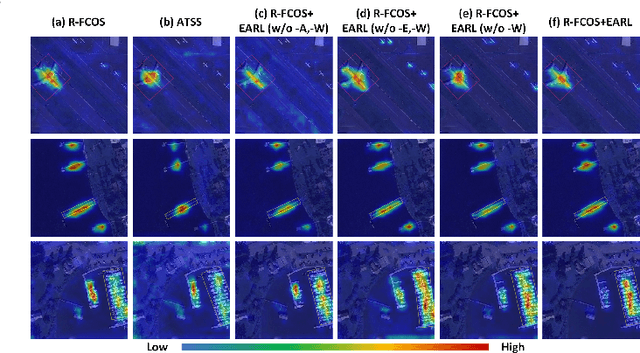

Label assignment is often employed in recent convolutional neural network (CNN) based detectors to determine positive or negative samples during training process. However, we note that current label assignment strategies barely consider the characteristics of targets in remote sensing images thoroughly, such as large variations in orientations, aspect ratios and scales, which lead to insufficient sampling. In this paper, an Elliptical Distribution aided Adaptive Rotation Label Assignment (EARL) is proposed to select positive samples with higher quality in orientation detectors, and yields better performance. Concretely, to avoid inadequate sampling of targets with extreme scales, an adaptive scale sampling (ADS) strategy is proposed to dynamically select samples on different feature levels according to the scales of targets. To enhance ADS, positive samples are selected following a dynamic elliptical distribution (DED), which can further exploit the orientation and shape properties of targets. Moreover, a spatial distance weighting (SDW) module is introduced to mitigate the influence from low-quality samples on detection performance. Extensive experiments on popular remote sensing datasets, such as DOTA and HRSC2016, demonstrate the effectiveness and the superiority of our proposed EARL, where without bells and whistles, it achieves 72.87 of mAP on DOTA dataset by being integrated with simple structure, which outperforms current state-of-the-art anchor-free detectors and provides comparable performance as anchor-based methods. The source code will be available at https://github.com/Justlovesmile/EARL