 Add to Chrome
 Add to Firefox
 Add to Edge
A Replay-Constrained Simulation Framework for Personalization of Powered Knee--Ankle Prosthesis Controllers
Jul 24, 2026
Personalization of impedance controllers for powered prosthetic legs is critical to accommodating individual gait biomechanics but remains challenging. Existing methods rely on time-intensive human-in-the-loop exploration and/or constrain optimization to low-dimensional, single-joint parameter subspaces. Sim-to-real transfer has enabled high-dimensional locomotion control for legged robots, but in assistive device control the human partner remains un-modelable. We present a replay-constrained simulation framework: a MuJoCo-based simulator reproduces prosthetic knee-ankle dynamics while replaying recorded hip kinematics and feedback-based ground reaction forces from individual walking data, bypassing the need to model complex human neuromuscular control mechanisms. We demonstrate the framework with a deep reinforcement learning policy that personalizes phase-dependent stiffness, damping, and equilibrium angle at both joints simultaneously, maximizing a biomimicry-based reward computed solely from onboard prosthesis measurements. Experiments with three participants with transfemoral amputation during level-ground walking at 0.8~m/s demonstrate strong simulation-to-hardware predictive validity (Pearson $r=0.96$--$0.997$). The best-performing policy on hardware was consistently predicted within the top five simulation policies for all participants. The learned controllers improved overall biomimicry rewards by 42--59\% relative to the unpersonalized baseline. The framework supports scalable high-dimensional personalization of powered prosthetic legs and is amenable to extension to higher-dimensional controller parameterizations such as neural-network controllers.

Simultaneous Locomotion Mode Classification and Continuous Gait Phase Estimation for Transtibial Prostheses
Nov 12, 2024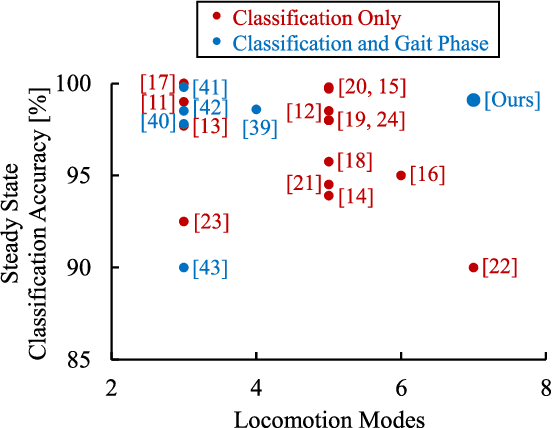
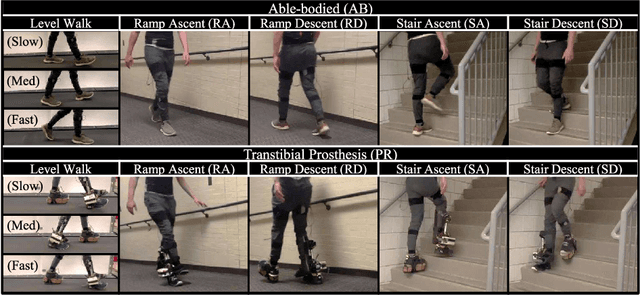
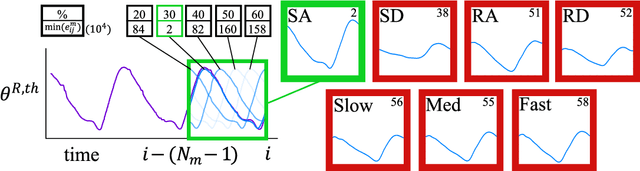
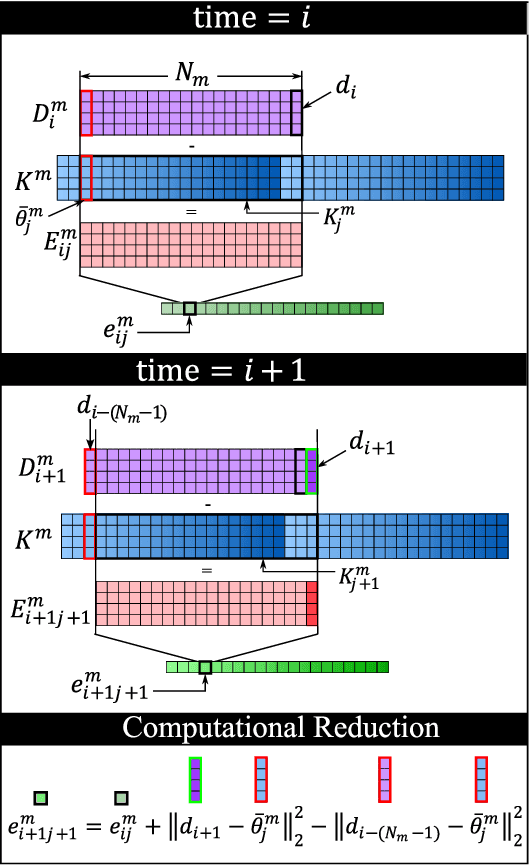
Recognizing and identifying human locomotion is a critical step to ensuring fluent control of wearable robots, such as transtibial prostheses. In particular, classifying the intended locomotion mode and estimating the gait phase are key. In this work, a novel, interpretable, and computationally efficient algorithm is presented for simultaneously predicting locomotion mode and gait phase. Using able-bodied (AB) and transtibial prosthesis (PR) data, seven locomotion modes are tested including slow, medium, and fast level walking (0.6, 0.8, and 1.0 m/s), ramp ascent/descent (5 degrees), and stair ascent/descent (20 cm height). Overall classification accuracy was 99.1$\%$ and 99.3$\%$ for the AB and PR conditions, respectively. The average gait phase error across all data was less than 4$\%$. Exploiting the structure of the data, computational efficiency reached 2.91 $\mu$s per time step. The time complexity of this algorithm scales as $O(N\cdot M)$ with the number of locomotion modes $M$ and samples per gait cycle $N$. This efficiency and high accuracy could accommodate a much larger set of locomotion modes ($\sim$ 700 on Open-Source Leg Prosthesis) to handle the wide range of activities pursued by individuals during daily living.