 Add to Chrome
 Add to Firefox
 Add to Edge
Gecko: An Efficient Neural Architecture Inherently Processing Sequences with Arbitrary Lengths
Jan 10, 2026
Designing a unified neural network to efficiently and inherently process sequential data with arbitrary lengths is a central and challenging problem in sequence modeling. The design choices in Transformer, including quadratic complexity and weak length extrapolation, have limited their ability to scale to long sequences. In this work, we propose Gecko, a neural architecture that inherits the design of Mega and Megalodon (exponential moving average with gated attention), and further introduces multiple technical components to improve its capability to capture long range dependencies, including timestep decay normalization, sliding chunk attention mechanism, and adaptive working memory. In a controlled pretraining comparison with Llama2 and Megalodon in the scale of 7 billion parameters and 2 trillion training tokens, Gecko achieves better efficiency and long-context scalability. Gecko reaches a training loss of 1.68, significantly outperforming Llama2-7B (1.75) and Megalodon-7B (1.70), and landing close to Llama2-13B (1.67). Notably, without relying on any context-extension techniques, Gecko exhibits inherent long-context processing and retrieval capabilities, stably handling sequences of up to 4 million tokens and retrieving information from contexts up to $4\times$ longer than its attention window. Code: https://github.com/XuezheMax/gecko-llm

Faster Video Diffusion with Trainable Sparse Attention
May 19, 2025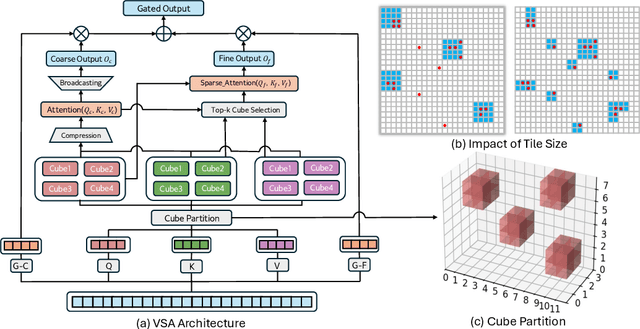
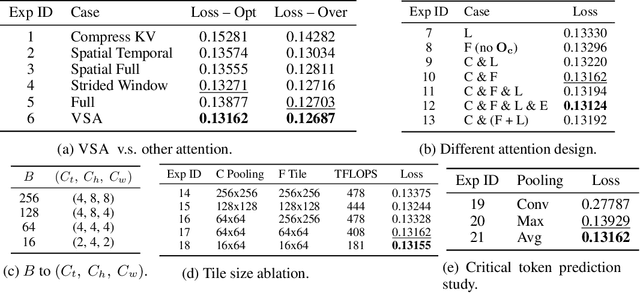
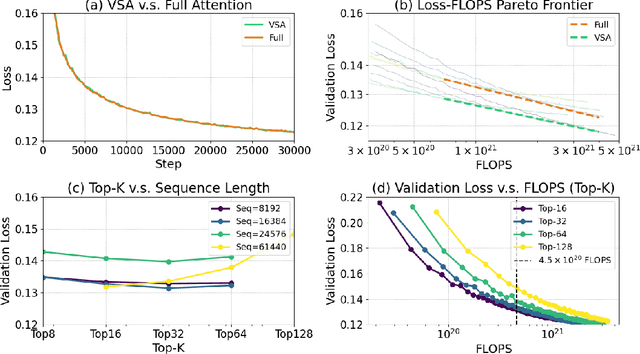
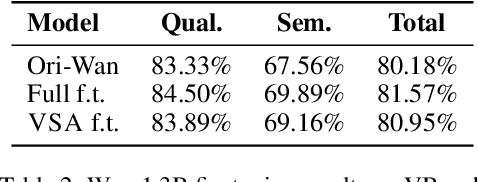
Scaling video diffusion transformers (DiTs) is limited by their quadratic 3D attention, even though most of the attention mass concentrates on a small subset of positions. We turn this observation into VSA, a trainable, hardware-efficient sparse attention that replaces full attention at \emph{both} training and inference. In VSA, a lightweight coarse stage pools tokens into tiles and identifies high-weight \emph{critical tokens}; a fine stage computes token-level attention only inside those tiles subjecting to block computing layout to ensure hard efficiency. This leads to a single differentiable kernel that trains end-to-end, requires no post-hoc profiling, and sustains 85\% of FlashAttention3 MFU. We perform a large sweep of ablation studies and scaling-law experiments by pretraining DiTs from 60M to 1.4B parameters. VSA reaches a Pareto point that cuts training FLOPS by 2.53$\times$ with no drop in diffusion loss. Retrofitting the open-source Wan-2.1 model speeds up attention time by 6$\times$ and lowers end-to-end generation time from 31s to 18s with comparable quality. These results establish trainable sparse attention as a practical alternative to full attention and a key enabler for further scaling of video diffusion models.