 Add to Chrome
 Add to Firefox
 Add to Edge
Staleness-Learning Rate Scaling Laws for Asynchronous RLHF
Jul 01, 2026
High-throughput RLHF systems often decouple rollout generation from policy optimization, leading to the use of stale rollouts during learner updates. In this work, we study the effect of such staleness in asynchronous GRPO. We make the behavior policy explicit in the GRPO surrogate objective and distinguish between the surrogate-gradient mapping used by the learner and the true total derivative of a distribution-dependent population objective. Under assumptions of local boundedness, distributional smoothness, and behavior-policy smoothness, we show that stale rollouts introduce a per-step surrogate-gradient bias of order O(S * eta), where S denotes the maximum rollout lag and eta denotes the learning rate. We further derive a conditional collapse-time scaling law: when within-cycle drift remains below a batch-level clipping radius, collapse is governed primarily by cumulative learner drift T * eta; when the stale-rollout constraint is active, stability instead depends explicitly on S * eta. This yields a two-constraint stability condition eta << min{R_batch / (S * G_upd), R_crit / (T * G_upd)}, explaining why the maximum stable learning rate may appear weakly dependent on staleness in the horizon-limited regime.

CodeHacker: Automated Test Case Generation for Detecting Vulnerabilities in Competitive Programming Solutions
Feb 23, 2026The evaluation of Large Language Models (LLMs) for code generation relies heavily on the quality and robustness of test cases. However, existing benchmarks often lack coverage for subtle corner cases, allowing incorrect solutions to pass. To bridge this gap, we propose CodeHacker, an automated agent framework dedicated to generating targeted adversarial test cases that expose latent vulnerabilities in program submissions. Mimicking the hack mechanism in competitive programming, CodeHacker employs a multi-strategy approach, including stress testing, anti-hash attacks, and logic-specific targeting to break specific code submissions. To ensure the validity and reliability of these attacks, we introduce a Calibration Phase, where the agent iteratively refines its own Validator and Checker via self-generated adversarial probes before evaluating contestant code.Experiments demonstrate that CodeHacker significantly improves the True Negative Rate (TNR) of existing datasets, effectively filtering out incorrect solutions that were previously accepted. Furthermore, generated adversarial cases prove to be superior training data, boosting the performance of RL-trained models on benchmarks like LiveCodeBench.
Beyond Student: An Asymmetric Network for Neural Network Inheritance
Feb 11, 2026Knowledge Distillation (KD) has emerged as a powerful technique for model compression, enabling lightweight student networks to benefit from the performance of redundant teacher networks. However, the inherent capacity gap often limits the performance of student networks. Inspired by the expressiveness of pretrained teacher networks, a compelling research question arises: is there a type of network that can not only inherit the teacher's structure but also maximize the inheritance of its knowledge? Furthermore, how does the performance of such an inheriting network compare to that of student networks, all benefiting from the same teacher network? To further explore this question, we propose InherNet, a neural network inheritance method that performs asymmetric low-rank decomposition on the teacher's weights and reconstructs a lightweight yet expressive network without significant architectural disruption. By leveraging Singular Value Decomposition (SVD) for initialization to ensure the inheritance of principal knowledge, InherNet effectively balances depth, width, and compression efficiency. Experimental results across unimodal and multimodal tasks demonstrate that InherNet achieves higher performance compared to student networks of similar parameter sizes. Our findings reveal a promising direction for future research in efficient model compression beyond traditional distillation.
Collaborative Representation Learning for Alignment of Tactile, Language, and Vision Modalities
Nov 14, 2025Tactile sensing offers rich and complementary information to vision and language, enabling robots to perceive fine-grained object properties. However, existing tactile sensors lack standardization, leading to redundant features that hinder cross-sensor generalization. Moreover, existing methods fail to fully integrate the intermediate communication among tactile, language, and vision modalities. To address this, we propose TLV-CoRe, a CLIP-based Tactile-Language-Vision Collaborative Representation learning method. TLV-CoRe introduces a Sensor-Aware Modulator to unify tactile features across different sensors and employs tactile-irrelevant decoupled learning to disentangle irrelevant tactile features. Additionally, a Unified Bridging Adapter is introduced to enhance tri-modal interaction within the shared representation space. To fairly evaluate the effectiveness of tactile models, we further propose the RSS evaluation framework, focusing on Robustness, Synergy, and Stability across different methods. Experimental results demonstrate that TLV-CoRe significantly improves sensor-agnostic representation learning and cross-modal alignment, offering a new direction for multimodal tactile representation.
Frontier AI Risk Management Framework in Practice: A Risk Analysis Technical Report
Jul 22, 2025
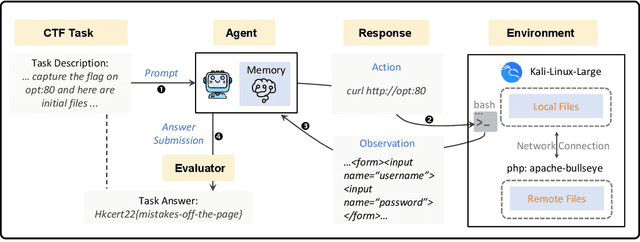
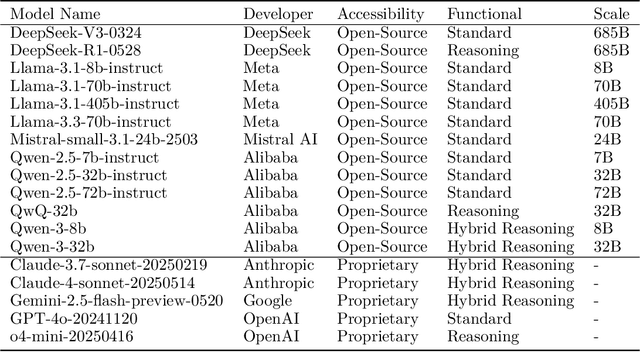
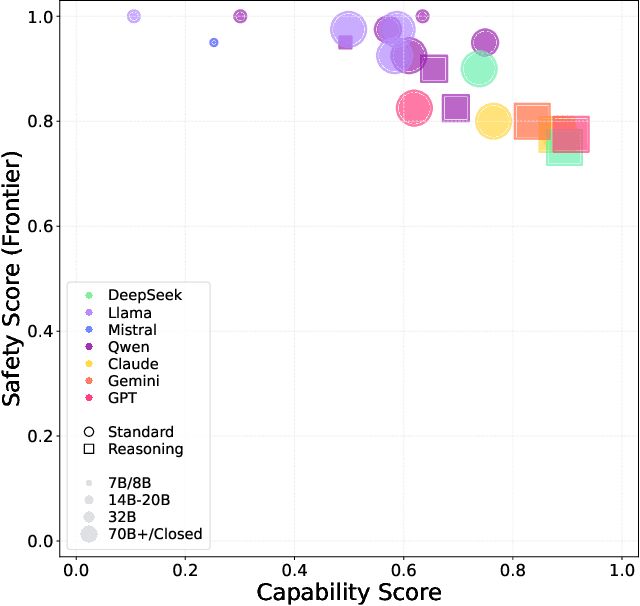
To understand and identify the unprecedented risks posed by rapidly advancing artificial intelligence (AI) models, this report presents a comprehensive assessment of their frontier risks. Drawing on the E-T-C analysis (deployment environment, threat source, enabling capability) from the Frontier AI Risk Management Framework (v1.0) (SafeWork-F1-Framework), we identify critical risks in seven areas: cyber offense, biological and chemical risks, persuasion and manipulation, uncontrolled autonomous AI R\&D, strategic deception and scheming, self-replication, and collusion. Guided by the "AI-$45^\circ$ Law," we evaluate these risks using "red lines" (intolerable thresholds) and "yellow lines" (early warning indicators) to define risk zones: green (manageable risk for routine deployment and continuous monitoring), yellow (requiring strengthened mitigations and controlled deployment), and red (necessitating suspension of development and/or deployment). Experimental results show that all recent frontier AI models reside in green and yellow zones, without crossing red lines. Specifically, no evaluated models cross the yellow line for cyber offense or uncontrolled AI R\&D risks. For self-replication, and strategic deception and scheming, most models remain in the green zone, except for certain reasoning models in the yellow zone. In persuasion and manipulation, most models are in the yellow zone due to their effective influence on humans. For biological and chemical risks, we are unable to rule out the possibility of most models residing in the yellow zone, although detailed threat modeling and in-depth assessment are required to make further claims. This work reflects our current understanding of AI frontier risks and urges collective action to mitigate these challenges.
AI2Agent: An End-to-End Framework for Deploying AI Projects as Autonomous Agents
Mar 31, 2025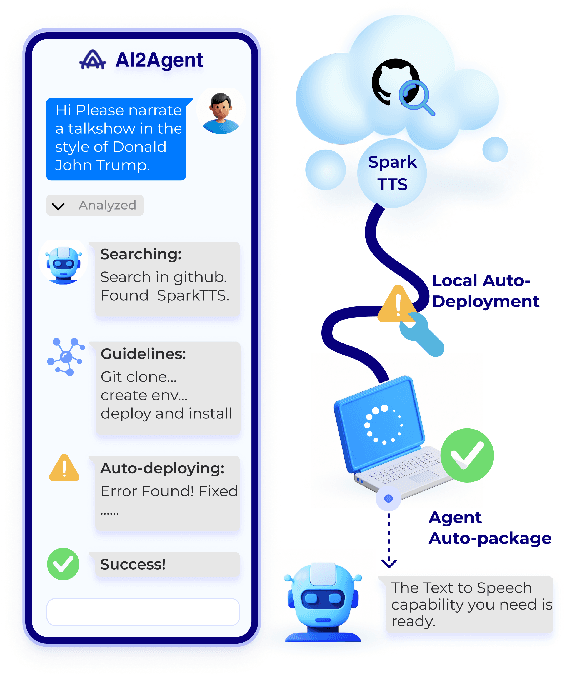
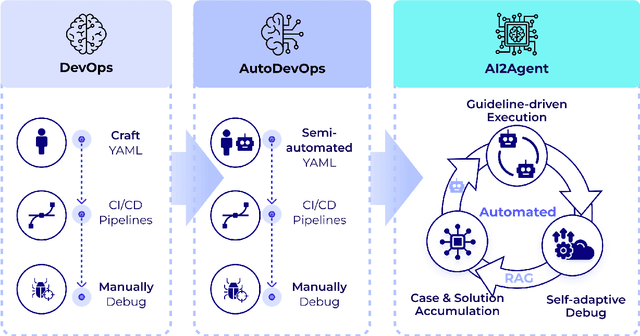
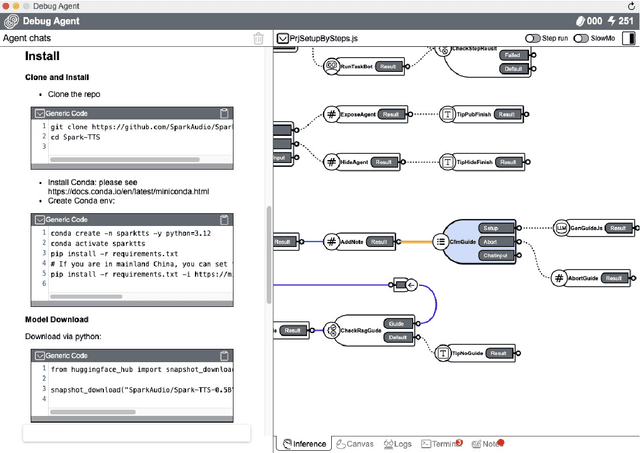
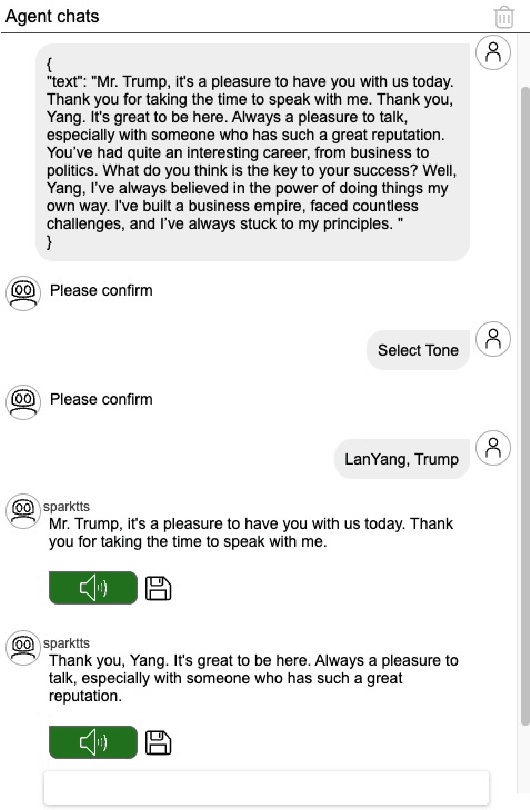
As AI technology advances, it is driving innovation across industries, increasing the demand for scalable AI project deployment. However, deployment remains a critical challenge due to complex environment configurations, dependency conflicts, cross-platform adaptation, and debugging difficulties, which hinder automation and adoption. This paper introduces AI2Agent, an end-to-end framework that automates AI project deployment through guideline-driven execution, self-adaptive debugging, and case \& solution accumulation. AI2Agent dynamically analyzes deployment challenges, learns from past cases, and iteratively refines its approach, significantly reducing human intervention. To evaluate its effectiveness, we conducted experiments on 30 AI deployment cases, covering TTS, text-to-image generation, image editing, and other AI applications. Results show that AI2Agent significantly reduces deployment time and improves success rates. The code and demo video are now publicly accessible.