 Add to Chrome
 Add to Firefox
 Add to Edge
FedCVU: Federated Learning for Cross-View Video Understanding
Mar 23, 2026
Federated learning (FL) has emerged as a promising paradigm for privacy-preserving multi-camera video understanding. However, applying FL to cross-view scenarios faces three major challenges: (i) heterogeneous viewpoints and backgrounds lead to highly non-IID client distributions and overfitting to view-specific patterns, (ii) local distribution biases cause misaligned representations that hinder consistent cross-view semantics, and (iii) large video architectures incur prohibitive communication overhead. To address these issues, we propose FedCVU, a federated framework with three components: VS-Norm, which preserves normalization parameters to handle view-specific statistics; CV-Align, a lightweight contrastive regularization module to improve cross-view representation alignment; and SLA, a selective layer aggregation strategy that reduces communication without sacrificing accuracy. Extensive experiments on action understanding and person re-identification tasks under a cross-view protocol demonstrate that FedCVU consistently boosts unseen-view accuracy while maintaining strong seen-view performance, outperforming state-of-the-art FL baselines and showing robustness to domain heterogeneity and communication constraints.

InternVLA-A1: Unifying Understanding, Generation and Action for Robotic Manipulation
Jan 05, 2026Prevalent Vision-Language-Action (VLA) models are typically built upon Multimodal Large Language Models (MLLMs) and demonstrate exceptional proficiency in semantic understanding, but they inherently lack the capability to deduce physical world dynamics. Consequently, recent approaches have shifted toward World Models, typically formulated via video prediction; however, these methods often suffer from a lack of semantic grounding and exhibit brittleness when handling prediction errors. To synergize semantic understanding with dynamic predictive capabilities, we present InternVLA-A1. This model employs a unified Mixture-of-Transformers architecture, coordinating three experts for scene understanding, visual foresight generation, and action execution. These components interact seamlessly through a unified masked self-attention mechanism. Building upon InternVL3 and Qwen3-VL, we instantiate InternVLA-A1 at 2B and 3B parameter scales. We pre-train these models on hybrid synthetic-real datasets spanning InternData-A1 and Agibot-World, covering over 533M frames. This hybrid training strategy effectively harnesses the diversity of synthetic simulation data while minimizing the sim-to-real gap. We evaluated InternVLA-A1 across 12 real-world robotic tasks and simulation benchmark. It significantly outperforms leading models like pi0 and GR00T N1.5, achieving a 14.5\% improvement in daily tasks and a 40\%-73.3\% boost in dynamic settings, such as conveyor belt sorting.
PheME: A deep ensemble framework for improving phenotype prediction from multi-modal data
Mar 19, 2023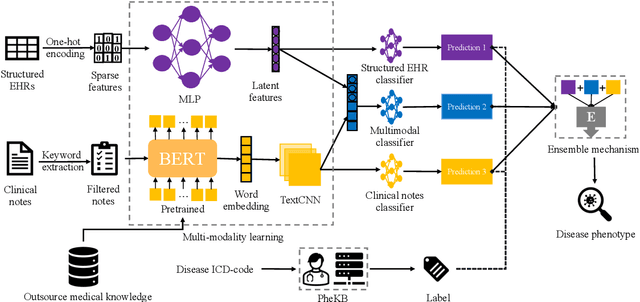
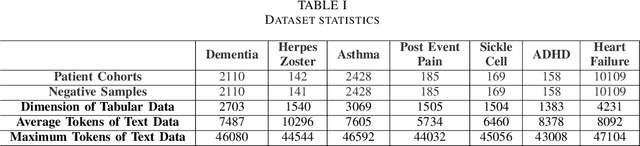
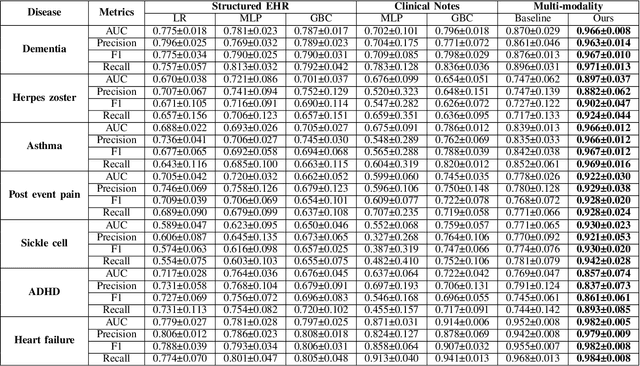
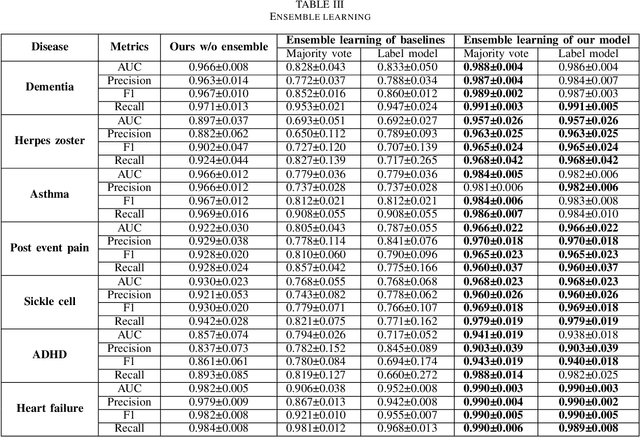
Detailed phenotype information is fundamental to accurate diagnosis and risk estimation of diseases. As a rich source of phenotype information, electronic health records (EHRs) promise to empower diagnostic variant interpretation. However, how to accurately and efficiently extract phenotypes from the heterogeneous EHR data remains a challenge. In this work, we present PheME, an Ensemble framework using Multi-modality data of structured EHRs and unstructured clinical notes for accurate Phenotype prediction. Firstly, we employ multiple deep neural networks to learn reliable representations from the sparse structured EHR data and redundant clinical notes. A multi-modal model then aligns multi-modal features onto the same latent space to predict phenotypes. Secondly, we leverage ensemble learning to combine outputs from single-modal models and multi-modal models to improve phenotype predictions. We choose seven diseases to evaluate the phenotyping performance of the proposed framework. Experimental results show that using multi-modal data significantly improves phenotype prediction in all diseases, the proposed ensemble learning framework can further boost the performance.