 Add to Chrome
 Add to Firefox
 Add to Edge
Beyond Independent Manipulation: Individual Fairness-aware Strategic Classification with Peer Imitation
May 30, 2026
Strategic classification (SC) investigates scenarios where agents manipulate their features to obtain favorable decisions from predictive models. Existing fairness-aware SC approaches primarily focus on group fairness and typically assume that agents respond independently. However, when individual fairness is required, ensuring similar individuals receive similar outcomes, agents' manipulation becomes interdependent: an agent's preferred manipulation depends on the neighborhoods' outcomes. This induces a mismatch between classical SC formulations and fairness-aware decision settings, where independent models no longer accurately characterize strategic manipulations. To address this issue, we introduce individual fairness-aware strategic classification (IFSC), a framework that models peer-driven manipulation arising from individual fairness, where agents imitate nearby positively decided peers to obtain favorable outcomes. IFSC characterizes strategic manipulation as similarity-based imitation toward visible accepted peers and learns classifiers under the resulting post-manipulation distributions. To account for uncertainty in peer observability, IFSC employs a robust learning process that introduces stochastic perturbations during manipulation simulation. Experiments on synthetic and real-world datasets demonstrate that IFSC improves individual-fairness consistency and mitigates imitation-induced distortions.

Beyond Rational Illusion: Behaviorally Realistic Strategic Classification
May 19, 2026Strategic classification(SC) studies the interaction between decision models and agents who strategically manipulate their features for favorable outcomes. Existing SC frameworks typically rely on the idealized assumption that agents are strictly rational. However, evidence from behavioral economics and psychology consistently shows that real-world decision-making is often shaped by cognitive biases, deviating from pure rationality. To formalize this limitation, we identify and define a new problem setting, termed the behaviorally realistic strategic classification problem, where agents' strategic manipulations deviate from full rationality due to psychological biases. Motivated by the identified limitation, we propose the Prospect-Guided Strategic Framework (Pro-SF) to address the problem, a principled framework grounded in prospect theory to model and learn under behaviorally realistic strategic responses. Specifically, to capture behaviorally realistic strategic manipulations, our framework reformulates the Stackelberg-style interaction between agents and the decision-maker by incorporating three key mechanisms inspired by prospect theory, including the asymmetry between benefits and costs, different subjective reference points, and non-rational probability distortion. Experiments on synthetic and real-world datasets establish Pro-SF as a behaviorally grounded approach to strategic classification, bridging machine learning and behavioral economics for more reliable deployment in the real world.
When Tabular Foundation Models Meet Strategic Tabular Data: A Prior Alignment Approach
May 19, 2026Tabular foundation models based on pretrained prior-data fitted networks~(PFNs) have shown strong generalization on diverse tabular tasks, but they are typically designed for \emph{non-strategic} settings where data distributions are independent of deployed classifiers. In many real-world decision scenarios, however, individuals may strategically modify their features after deployment to obtain favorable outcomes, inducing a post-deployment distribution shift. This paper studies whether PFN-style tabular foundation models can generalize to such \emph{strategic} tabular data. We show that strategic manipulation creates a mismatch between the non-strategic prior learned during pretraining and the post-manipulation strategic prior, which leads to systematic prediction bias. To address this issue, we propose \textbf{Strategic Prior-data Fitted Network}~\textit{(SPN)}, an inference-time strategy-aware framework that adapts tabular foundation models to strategic environments without retraining. SPN constructs strategic in-context examples to approximate post-manipulation inputs and aligns PFN predictions with the induced strategic distribution. Experiments on real-world and synthetic tabular datasets show that SPN consistently improves robustness and predictive performance under strategic manipulation compared with both tabular foundation models and classical tabular methods.
Delay-Empowered Causal Hierarchical Reinforcement Learning
May 12, 2026Many real-world tasks involve delayed effects, where the outcomes of actions emerge after varying time lags. Existing delay-aware reinforcement learning methods often rely on state augmentation, prior knowledge of delay distributions, or access to non-delayed data, limiting their generalization. Hierarchical reinforcement learning, by contrast, inherently offers advantages in handling delays due to its hierarchical structure, yet existing methods are restricted to fixed delays. To address these limitations, we propose Delay-Empowered Causal Hierarchical Reinforcement Learning (DECHRL). DECHRL explicitly models both the causal structure of state transitions and their associated stochastic delay distributions. These are then incorporated into a delay-aware empowerment objective that drives proactive exploration toward highly controllable states, thereby improving performance under temporal uncertainty. We evaluate DECHRL in modified 2D-Minecraft and MiniGrid environments featuring stochastic delays. Experimental results show that DECHRL effectively models temporal delays and significantly outperforms baselines in decision-making under temporal uncertainty.
Transferable Delay-Aware Reinforcement Learning via Implicit Causal Graph Modeling
May 12, 2026Random delays weaken the temporal correspondence between actions and subsequent state feedback, making it difficult for agents to identify the true propagation process of action effects. In cross-task scenarios, changes in task objectives and reward formulations further reduce the reusability of previously acquired task knowledge. To address this problem, this paper proposes a transferable delay-aware reinforcement learning method based on implicit causal graph modeling. The proposed method uses a field-node encoder to represent high-dimensional observations as latent states with node-level semantics, and employs a message-passing mechanism to characterize dynamic causal dependencies among nodes, thereby learning transferable structured representations and environment dynamics knowledge. On this basis, imagination-driven behavior learning and planning are incorporated to optimize policies in the latent space, enabling cross-task knowledge transfer and rapid adaptation. Experimental results show that the proposed method outperforms baseline methods on DMC continuous control tasks with random delays. Cross-task transfer experiments further demonstrate that the learned structured representations and dynamics knowledge can be effectively transferred to new tasks and significantly accelerate policy adaptation.
AnyUser: Translating Sketched User Intent into Domestic Robots
Apr 06, 2026We introduce AnyUser, a unified robotic instruction system for intuitive domestic task instruction via free-form sketches on camera images, optionally with language. AnyUser interprets multimodal inputs (sketch, vision, language) as spatial-semantic primitives to generate executable robot actions requiring no prior maps or models. Novel components include multimodal fusion for understanding and a hierarchical policy for robust action generation. Efficacy is shown via extensive evaluations: (1) Quantitative benchmarks on the large-scale dataset showing high accuracy in interpreting diverse sketch-based commands across various simulated domestic scenes. (2) Real-world validation on two distinct robotic platforms, a statically mounted 7-DoF assistive arm (KUKA LBR iiwa) and a dual-arm mobile manipulator (Realman RMC-AIDAL), performing representative tasks like targeted wiping and area cleaning, confirming the system's ability to ground instructions and execute them reliably in physical environments. (3) A comprehensive user study involving diverse demographics (elderly, simulated non-verbal, low technical literacy) demonstrating significant improvements in usability and task specification efficiency, achieving high task completion rates (85.7%-96.4%) and user satisfaction. AnyUser bridges the gap between advanced robotic capabilities and the need for accessible non-expert interaction, laying the foundation for practical assistive robots adaptable to real-world human environments.
BeyondFacial: Identity-Preserving Personalized Generation Beyond Facial Close-ups
Nov 15, 2025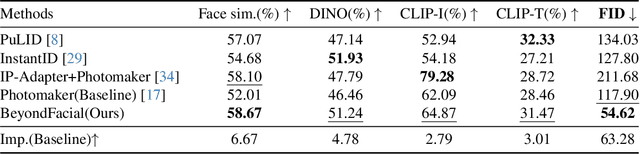
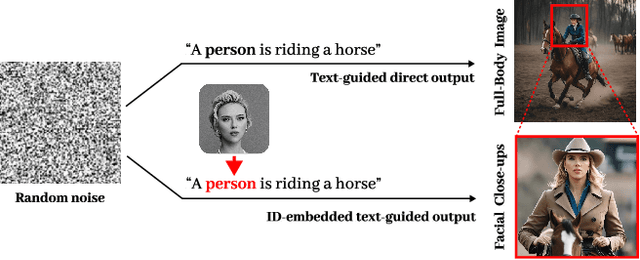
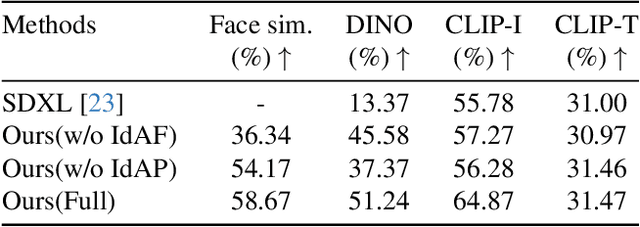
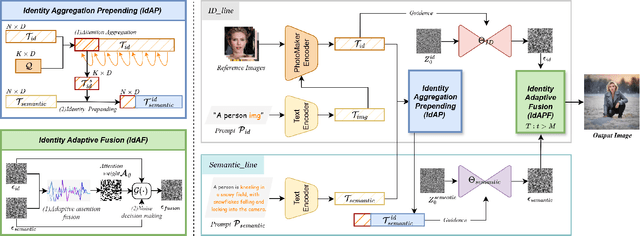
Identity-Preserving Personalized Generation (IPPG) has advanced film production and artistic creation, yet existing approaches overemphasize facial regions, resulting in outputs dominated by facial close-ups.These methods suffer from weak visual narrativity and poor semantic consistency under complex text prompts, with the core limitation rooted in identity (ID) feature embeddings undermining the semantic expressiveness of generative models. To address these issues, this paper presents an IPPG method that breaks the constraint of facial close-ups, achieving synergistic optimization of identity fidelity and scene semantic creation. Specifically, we design a Dual-Line Inference (DLI) pipeline with identity-semantic separation, resolving the representation conflict between ID and semantics inherent in traditional single-path architectures. Further, we propose an Identity Adaptive Fusion (IdAF) strategy that defers ID-semantic fusion to the noise prediction stage, integrating adaptive attention fusion and noise decision masking to avoid ID embedding interference on semantics without manual masking. Finally, an Identity Aggregation Prepending (IdAP) module is introduced to aggregate ID information and replace random initializations, further enhancing identity preservation. Experimental results validate that our method achieves stable and effective performance in IPPG tasks beyond facial close-ups, enabling efficient generation without manual masking or fine-tuning. As a plug-and-play component, it can be rapidly deployed in existing IPPG frameworks, addressing the over-reliance on facial close-ups, facilitating film-level character-scene creation, and providing richer personalized generation capabilities for related domains.
CEIDM: A Controlled Entity and Interaction Diffusion Model for Enhanced Text-to-Image Generation
Aug 25, 2025In Text-to-Image (T2I) generation, the complexity of entities and their intricate interactions pose a significant challenge for T2I method based on diffusion model: how to effectively control entity and their interactions to produce high-quality images. To address this, we propose CEIDM, a image generation method based on diffusion model with dual controls for entity and interaction. First, we propose an entity interactive relationships mining approach based on Large Language Models (LLMs), extracting reasonable and rich implicit interactive relationships through chain of thought to guide diffusion models to generate high-quality images that are closer to realistic logic and have more reasonable interactive relationships. Furthermore, We propose an interactive action clustering and offset method to cluster and offset the interactive action features contained in each text prompts. By constructing global and local bidirectional offsets, we enhance semantic understanding and detail supplementation of original actions, making the model's understanding of the concept of interactive "actions" more accurate and generating images with more accurate interactive actions. Finally, we design an entity control network which generates masks with entity semantic guidance, then leveraging multi-scale convolutional network to enhance entity feature and dynamic network to fuse feature. It effectively controls entities and significantly improves image quality. Experiments show that the proposed CEIDM method is better than the most representative existing methods in both entity control and their interaction control.
Retrieval Feedback Memory Enhancement Large Model Retrieval Generation Method
Aug 25, 2025Large Language Models (LLMs) have shown remarkable capabilities across diverse tasks, yet they face inherent limitations such as constrained parametric knowledge and high retraining costs. Retrieval-Augmented Generation (RAG) augments the generation process by retrieving externally stored knowledge absent from the models internal parameters. However, RAG methods face challenges such as information loss and redundant retrievals during multi-round queries, accompanying the difficulties in precisely characterizing knowledge gaps for complex tasks. To address these problems, we propose Retrieval Feedback and Memory Retrieval Augmented Generation(RFM-RAG), which transforms the stateless retrieval of previous methods into stateful continuous knowledge management by constructing a dynamic evidence pool. Specifically, our method generates refined queries describing the models knowledge gaps using relational triples from questions and evidence from the dynamic evidence pool; Retrieves critical external knowledge to iteratively update this evidence pool; Employs a R-Feedback Model to evaluate evidence completeness until convergence. Compared to traditional RAG methods, our approach enables persistent storage of retrieved passages and effectively distills key information from passages to construct clearly new queries. Experiments on three public QA benchmarks demonstrate that RFM-RAG outperforms previous methods and improves overall system accuracy.
Separation and Collaboration: Two-Level Routing Grouped Mixture-of-Experts for Multi-Domain Continual Learning
Aug 11, 2025Multi-Domain Continual Learning (MDCL) acquires knowledge from sequential tasks with shifting class sets and distribution. Despite the Parameter-Efficient Fine-Tuning (PEFT) methods can adapt for this dual heterogeneity, they still suffer from catastrophic forgetting and forward forgetting. To address these challenges, we propose a Two-Level Routing Grouped Mixture-of-Experts (TRGE) method. Firstly, TRGE dynamically expands the pre-trained CLIP model, assigning specific expert group for each task to mitigate catastrophic forgetting. With the number of experts continually grows in this process, TRGE maintains the static experts count within the group and introduces the intra-group router to alleviate routing overfitting caused by the increasing routing complexity. Meanwhile, we design an inter-group routing policy based on task identifiers and task prototype distance, which dynamically selects relevant expert groups and combines their outputs to enhance inter-task collaboration. Secondly, to get the correct task identifiers, we leverage Multimodal Large Language Models (MLLMs) which own powerful multimodal comprehension capabilities to generate semantic task descriptions and recognize the correct task identifier. Finally, to mitigate forward forgetting, we dynamically fuse outputs for unseen samples from the frozen CLIP model and TRGE adapter based on training progress, leveraging both pre-trained and learned knowledge. Through extensive experiments across various settings, our method outperforms other advanced methods with fewer trainable parameters.