 Add to Chrome
 Add to Firefox
 Add to Edge
Transferable Delay-Aware Reinforcement Learning via Implicit Causal Graph Modeling
May 12, 2026
Random delays weaken the temporal correspondence between actions and subsequent state feedback, making it difficult for agents to identify the true propagation process of action effects. In cross-task scenarios, changes in task objectives and reward formulations further reduce the reusability of previously acquired task knowledge. To address this problem, this paper proposes a transferable delay-aware reinforcement learning method based on implicit causal graph modeling. The proposed method uses a field-node encoder to represent high-dimensional observations as latent states with node-level semantics, and employs a message-passing mechanism to characterize dynamic causal dependencies among nodes, thereby learning transferable structured representations and environment dynamics knowledge. On this basis, imagination-driven behavior learning and planning are incorporated to optimize policies in the latent space, enabling cross-task knowledge transfer and rapid adaptation. Experimental results show that the proposed method outperforms baseline methods on DMC continuous control tasks with random delays. Cross-task transfer experiments further demonstrate that the learned structured representations and dynamics knowledge can be effectively transferred to new tasks and significantly accelerate policy adaptation.

Delay-Empowered Causal Hierarchical Reinforcement Learning
May 12, 2026Many real-world tasks involve delayed effects, where the outcomes of actions emerge after varying time lags. Existing delay-aware reinforcement learning methods often rely on state augmentation, prior knowledge of delay distributions, or access to non-delayed data, limiting their generalization. Hierarchical reinforcement learning, by contrast, inherently offers advantages in handling delays due to its hierarchical structure, yet existing methods are restricted to fixed delays. To address these limitations, we propose Delay-Empowered Causal Hierarchical Reinforcement Learning (DECHRL). DECHRL explicitly models both the causal structure of state transitions and their associated stochastic delay distributions. These are then incorporated into a delay-aware empowerment objective that drives proactive exploration toward highly controllable states, thereby improving performance under temporal uncertainty. We evaluate DECHRL in modified 2D-Minecraft and MiniGrid environments featuring stochastic delays. Experimental results show that DECHRL effectively models temporal delays and significantly outperforms baselines in decision-making under temporal uncertainty.
D3HRL: A Distributed Hierarchical Reinforcement Learning Approach Based on Causal Discovery and Spurious Correlation Detection
May 04, 2025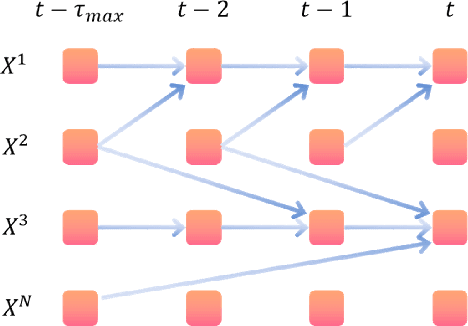
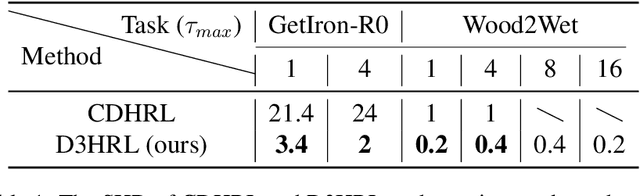
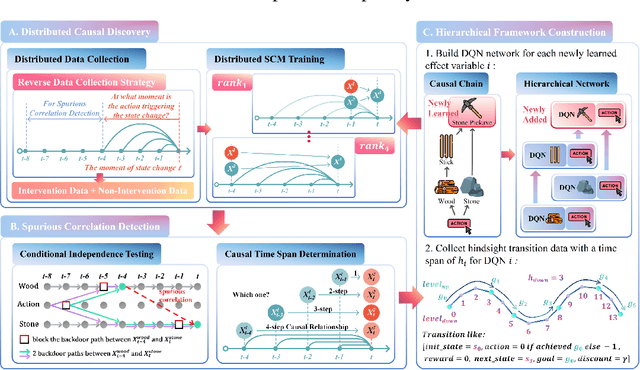
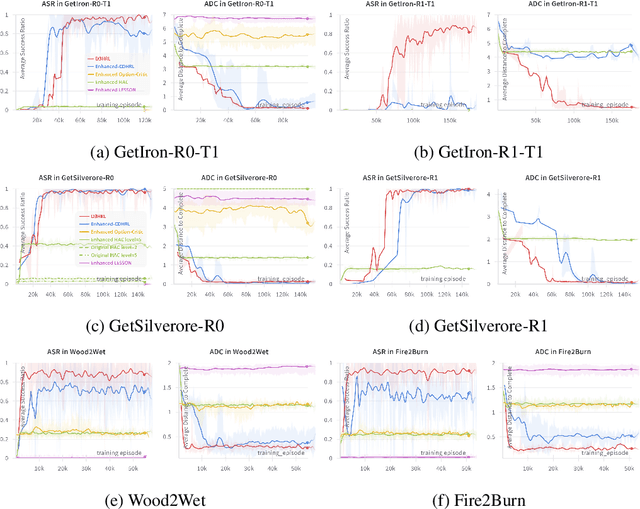
Current Hierarchical Reinforcement Learning (HRL) algorithms excel in long-horizon sequential decision-making tasks but still face two challenges: delay effects and spurious correlations. To address them, we propose a causal HRL approach called D3HRL. First, D3HRL models delayed effects as causal relationships across different time spans and employs distributed causal discovery to learn these relationships. Second, it employs conditional independence testing to eliminate spurious correlations. Finally, D3HRL constructs and trains hierarchical policies based on the identified true causal relationships. These three steps are iteratively executed, gradually exploring the complete causal chain of the task. Experiments conducted in 2D-MineCraft and MiniGrid show that D3HRL demonstrates superior sensitivity to delay effects and accurately identifies causal relationships, leading to reliable decision-making in complex environments.