 Add to Chrome
 Add to Firefox
 Add to Edge
VLM-CASE: Vision-Language Model Enabled Context-Adaptive Safety Envelopes for Anticipatory Safe Autonomous Driving
Jul 06, 2026
Adverse driving conditions, such as bad weather, remain a principal barrier to autonomous driving because they degrade two things at once: what the vehicle can perceive and what it can physically do. Human drivers cope by anticipation, reasoning about the scene and re-budgeting speed, following distance, and steering before grip or sight is lost, whereas current autonomous driving systems at best react after the fact. This paper proposes VLM-CASE, a framework that gives an autonomous vehicle this anticipatory capacity while keeping its motion bounded by a formal safety model at all times. A vision-language model (VLM), fine-tuned with low-rank adaptation (LoRA), reasons about the scene from the front-camera image and reports the road surface and visibility conditions. This output parametrizes a context-adaptive safety envelope (CASE), derived from physical limits and the guarantees of responsibility-sensitive safety, that couples braking and steering through a shared friction budget. A model predictive controller then drives freely within the envelope, while the VLM runs asynchronously so it never blocks the real-time control loop. We validate the framework in closed-loop CARLA simulation on tasks that demand both lateral and longitudinal control, across a range of weather, road-surface, and lighting conditions. The resulting controller, VLM-CASE-MPC, completes all trials, outperforming a conventional MPC baseline and a state-of-the-art VLM-integrated controller. Ablations confirm that the gains come from context adaptation, with the friction and visibility adaptations proving complementary. Furthermore, the framework is controller-agnostic and pairs with almost any low-level controller, offering a promising direction for safe autonomous driving. The dataset and supplementary materials for VLM-CASE are available at https://github.com/ytj254/VLM-CASE.

CCFM: Collision-Constrained Flow Matching for Safety-Critical Scenario Generation
Jul 05, 2026Evaluation of autonomous vehicle (AV) planners in safety-critical closed-loop simulation is essential for real-world deployment. However, generating controllable safety-critical scenarios remains challenging. Existing approaches use soft guidance that provides only probabilistic preferences and cannot guarantee the satisfaction of geometric and severity constraints associated with specific collision types. We introduce Collision-Constrained Flow Matching (CCFM), a novel framework that guarantees precise collision control through hard physical constraints. CCFM consists of three key components: (i) a heuristic collision selector that optimally identifies an adversarial agent and collision type via composite scoring; (ii) structured hard constraints that explicitly define four collision types (rear-end, side, cut-in, head-on) through contact point, heading, and severity requirements; and (iii) a collision-constrained flow matching sampler that enforces the constraints via Gauss-Newton manifold projection. CCFM achieves collision rate up to 46.4% on nuScenes and 83.1% on nuPlan, significantly outperforming baselines while preserving realistic driving behavior. By enabling controllable collision characteristics in safety-critical scenario generation, CCFM provides a reliable foundation for AV safety evaluation and sim-to-real crash data generation. The code and implementation details are available at https://github.com/KELISBU/CCFM.
HMPDM: A Diffusion Model for Driving Video Prediction with Historical Motion Priors
Mar 28, 2026Video prediction is a useful function for autonomous driving, enabling intelligent vehicles to reliably anticipate how driving scenes will evolve and thereby supporting reasoning and safer planning. However, existing models are constrained by multi-stage training pipelines and remain insufficient in modeling the diverse motion patterns in real driving scenes, leading to degraded temporal consistency and visual quality. To address these challenges, this paper introduces the historical motion priors-informed diffusion model (HMPDM), a video prediction model that leverages historical motion priors to enhance motion understanding and temporal coherence. The proposed deep learning system introduces three key designs: (i) a Temporal-aware Latent Conditioning (TaLC) module for implicit historical motion injection; (ii) a Motion-aware Pyramid Encoder (MaPE) for multi-scale motion representation; (iii) a Self-Conditioning (SC) strategy for stable iterative denoising. Extensive experiments on the Cityscapes and KITTI benchmarks demonstrate that HMPDM outperforms state-of-the-art video prediction methods with efficiency, achieving a 28.2% improvement in FVD on Cityscapes under the same monocular RGB input configuration setting. The implementation codes are publicly available at https://github.com/KELISBU/HMPDM.
CrashChat: A Multimodal Large Language Model for Multitask Traffic Crash Video Analysis
Dec 21, 2025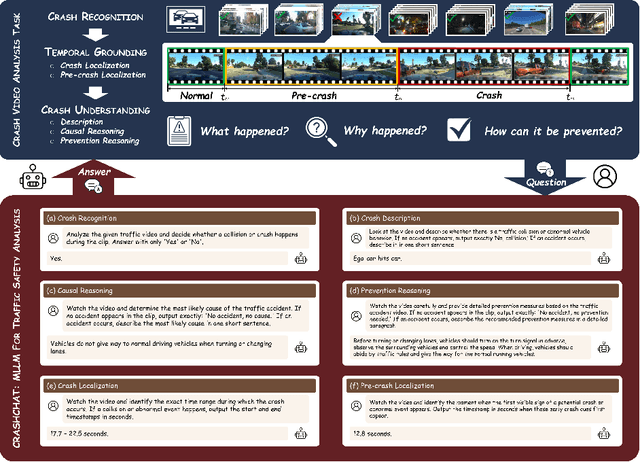
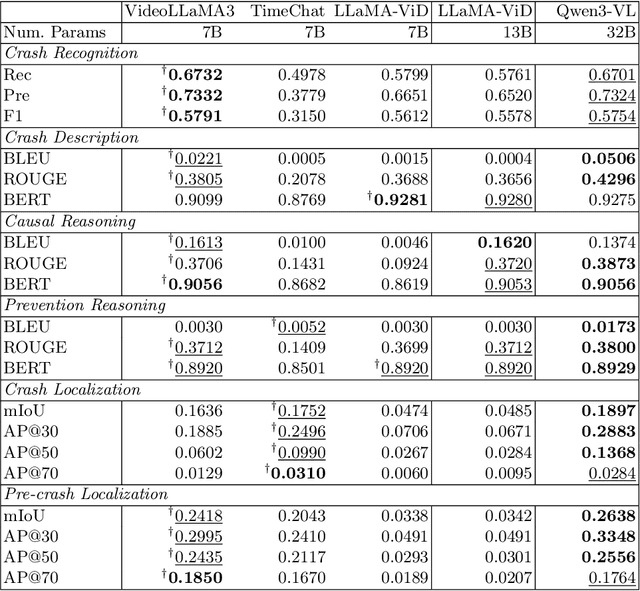
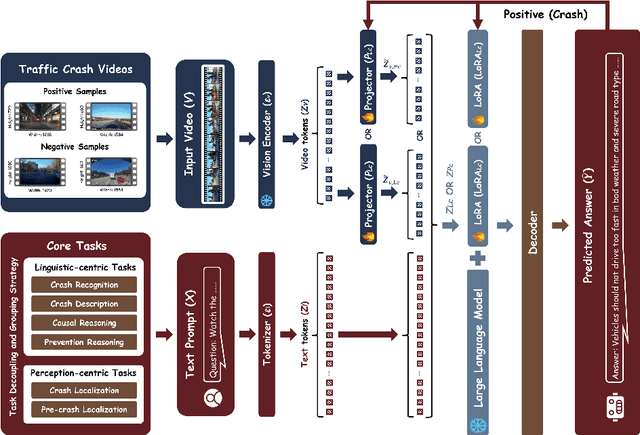
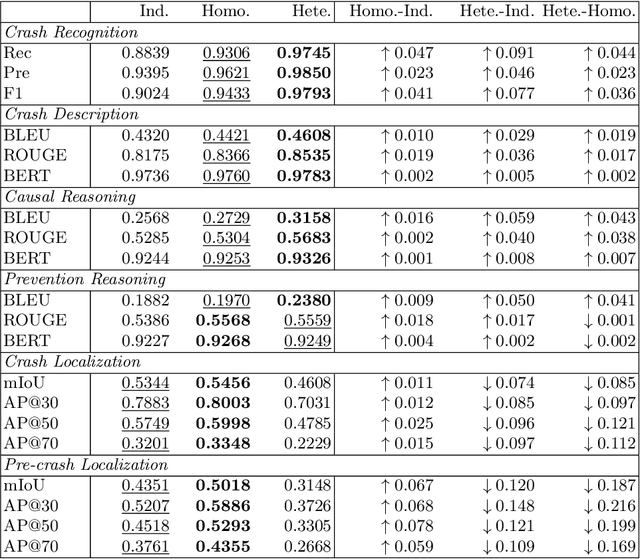
Automating crash video analysis is essential to leverage the growing availability of driving video data for traffic safety research and accountability attribution in autonomous driving. Crash video analysis is a challenging multitask problem due to the complex spatiotemporal dynamics of crash events in video data and the diverse analytical requirements involved. It requires capabilities spanning crash recognition, temporal grounding, and high-level video understanding. Existing models, however, cannot perform all these tasks within a unified framework, and effective training strategies for such models remain underexplored. To fill these gaps, this paper proposes CrashChat, a multimodal large language model (MLLM) for multitask traffic crash analysis, built upon VideoLLaMA3. CrashChat acquires domain-specific knowledge through instruction fine-tuning and employs a novel multitask learning strategy based on task decoupling and grouping, which maximizes the benefit of joint learning within and across task groups while mitigating negative transfer. Numerical experiments on consolidated public datasets demonstrate that CrashChat consistently outperforms existing MLLMs across model scales and traditional vision-based methods, achieving state-of-the-art performance. It reaches near-perfect accuracy in crash recognition, a 176\% improvement in crash localization, and a 40\% improvement in the more challenging pre-crash localization. Compared to general MLLMs, it substantially enhances textual accuracy and content coverage in crash description and reasoning tasks, with 0.18-0.41 increases in BLEU scores and 0.18-0.42 increases in ROUGE scores. Beyond its strong performance, CrashChat is a convenient, end-to-end analytical tool ready for practical implementation. The dataset and implementation code for CrashChat are available at https://github.com/Liangkd/CrashChat.
Fusion-GRU: A Deep Learning Model for Future Bounding Box Prediction of Traffic Agents in Risky Driving Videos
Aug 12, 2023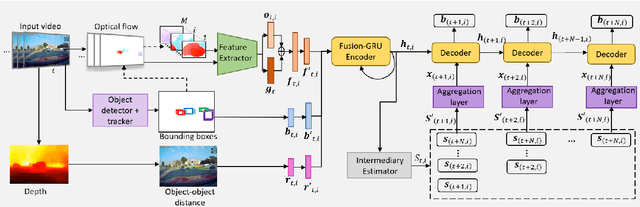
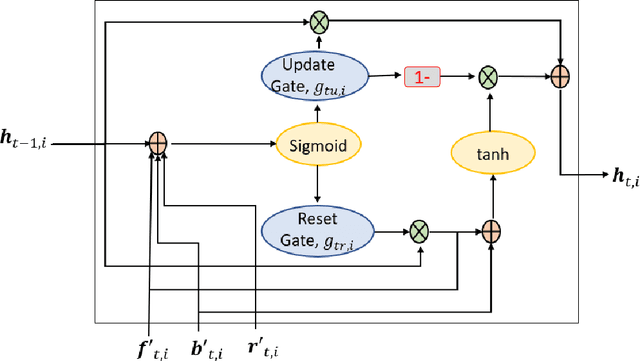

To ensure the safe and efficient navigation of autonomous vehicles and advanced driving assistance systems in complex traffic scenarios, predicting the future bounding boxes of surrounding traffic agents is crucial. However, simultaneously predicting the future location and scale of target traffic agents from the egocentric view poses challenges due to the vehicle's egomotion causing considerable field-of-view changes. Moreover, in anomalous or risky situations, tracking loss or abrupt motion changes limit the available observation time, requiring learning of cues within a short time window. Existing methods typically use a simple concatenation operation to combine different cues, overlooking their dynamics over time. To address this, this paper introduces the Fusion-Gated Recurrent Unit (Fusion-GRU) network, a novel encoder-decoder architecture for future bounding box localization. Unlike traditional GRUs, Fusion-GRU accounts for mutual and complex interactions among input features. Moreover, an intermediary estimator coupled with a self-attention aggregation layer is also introduced to learn sequential dependencies for long range prediction. Finally, a GRU decoder is employed to predict the future bounding boxes. The proposed method is evaluated on two publicly available datasets, ROL and HEV-I. The experimental results showcase the promising performance of the Fusion-GRU, demonstrating its effectiveness in predicting future bounding boxes of traffic agents.
ACF-Net: An Attention-enhanced Co-interactive Fusion Network for Automated Structural Condition Assessment in Visual Inspection
Jul 14, 2023Efficiently monitoring the condition of civil infrastructures necessitates automating the structural condition assessment in visual inspection. This paper proposes an Attention-enhanced Co-interactive Fusion Network (ACF-Net) for automatic structural condition assessment in visual bridge inspection. The ACF-Net can simultaneously parse structural elements and segment surface defects on the elements in inspection images. It integrates two task-specific relearning subnets to extract task-specific features from an overall feature embedding and a co-interactive feature fusion module to capture the spatial correlation and facilitate information sharing between tasks. Experimental results demonstrate that the proposed ACF-Net outperforms the current state-of-the-art approaches, achieving promising performance with 92.11% mIoU for element parsing and 87.16% mIoU for corrosion segmentation on the new benchmark dataset Steel Bridge Condition Inspection Visual (SBCIV) testing set. An ablation study reveals the strengths of ACF-Net, and a case study showcases its capability to automate structural condition assessment. The code will be open-source after acceptance.
An Attention-guided Multistream Feature Fusion Network for Localization of Risky Objects in Driving Videos
Sep 16, 2022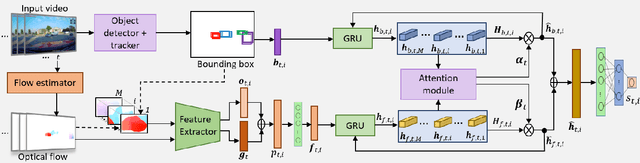
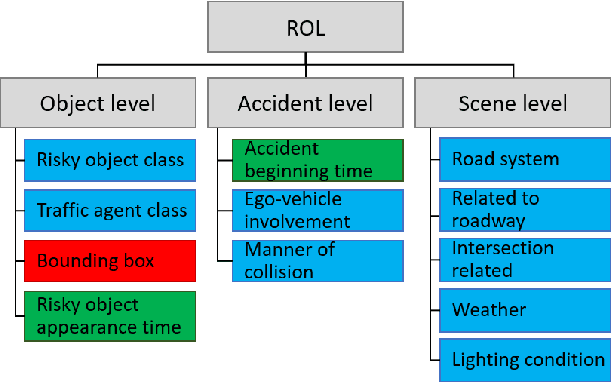
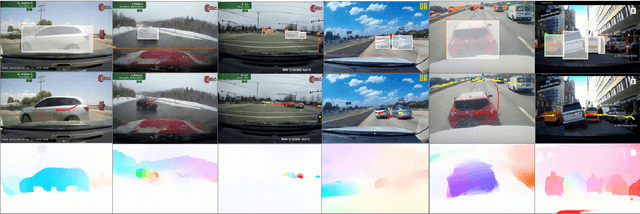
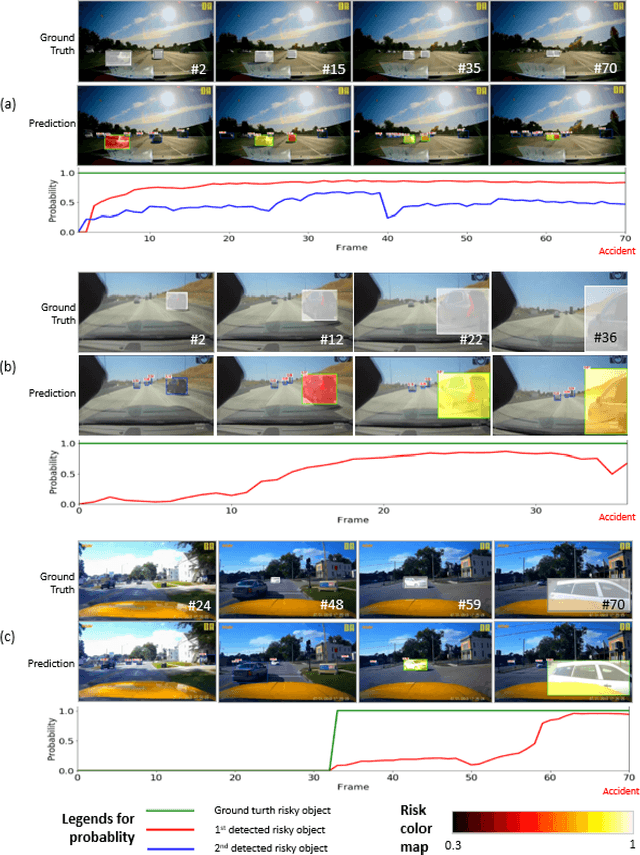
Detecting dangerous traffic agents in videos captured by vehicle-mounted dashboard cameras (dashcams) is essential to facilitate safe navigation in a complex environment. Accident-related videos are just a minor portion of the driving video big data, and the transient pre-accident processes are highly dynamic and complex. Besides, risky and non-risky traffic agents can be similar in their appearance. These make risky object localization in the driving video particularly challenging. To this end, this paper proposes an attention-guided multistream feature fusion network (AM-Net) to localize dangerous traffic agents from dashcam videos. Two Gated Recurrent Unit (GRU) networks use object bounding box and optical flow features extracted from consecutive video frames to capture spatio-temporal cues for distinguishing dangerous traffic agents. An attention module coupled with the GRUs learns to attend to the traffic agents relevant to an accident. Fusing the two streams of features, AM-Net predicts the riskiness scores of traffic agents in the video. In supporting this study, the paper also introduces a benchmark dataset called Risky Object Localization (ROL). The dataset contains spatial, temporal, and categorical annotations with the accident, object, and scene-level attributes. The proposed AM-Net achieves a promising performance of 85.73% AUC on the ROL dataset. Meanwhile, the AM-Net outperforms current state-of-the-art for video anomaly detection by 6.3% AUC on the DoTA dataset. A thorough ablation study further reveals AM-Net's merits by evaluating the contributions of its different components.
A Multitask Deep Learning Model for Parsing Bridge Elements and Segmenting Defect in Bridge Inspection Images
Sep 06, 2022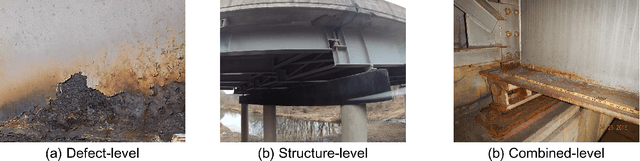
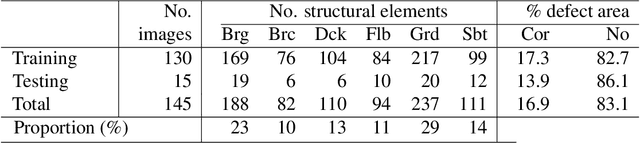
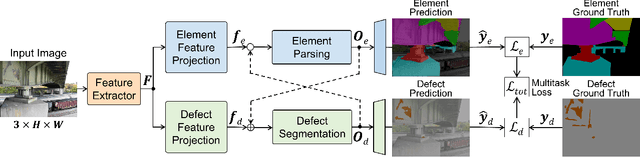
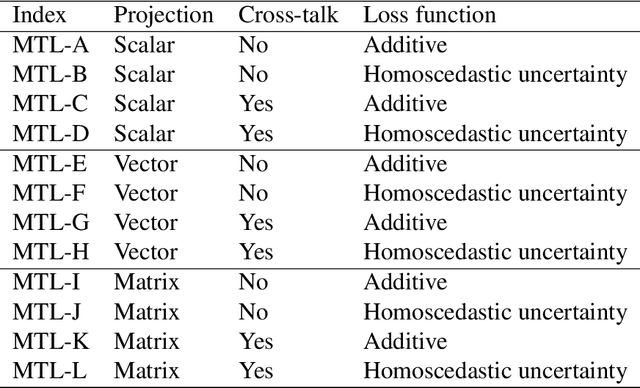
The vast network of bridges in the United States raises a high requirement for its maintenance and rehabilitation. The massive cost of manual visual inspection to assess the conditions of the bridges turns out to be a burden to some extent. Advanced robots have been leveraged to automate inspection data collection. Automating the segmentations of multiclass elements, as well as surface defects on the elements, in the large volume of inspection image data would facilitate an efficient and effective assessment of the bridge condition. Training separate single-task networks for element parsing (i.e., semantic segmentation of multiclass elements) and defect segmentation fails to incorporate the close connection between these two tasks in the inspection images where both recognizable structural elements and apparent surface defects are present. This paper is motivated to develop a multitask deep neural network that fully utilizes such interdependence between bridge elements and defects to boost the performance and generalization of the model. Furthermore, the effectiveness of the proposed network designs in improving the task performance was investigated, including feature decomposition, cross-talk sharing, and multi-objective loss function. A dataset with pixel-level labels of bridge elements and corrosion was developed for training and assessment of the models. Quantitative and qualitative results from evaluating the developed multitask deep neural network demonstrate that the recommended network outperforms the independent single-task networks not only in performance (2.59% higher mIoU on bridge parsing and 1.65% on corrosion segmentation) but also in computational time and implementation capability.
A Deep Neural Network for Multiclass Bridge Element Parsing in Inspection Image Analysis
Sep 05, 2022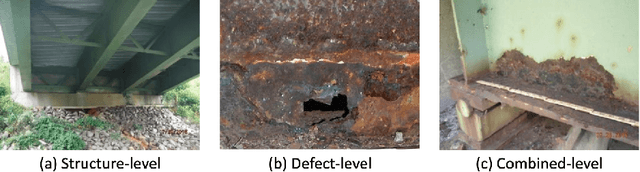
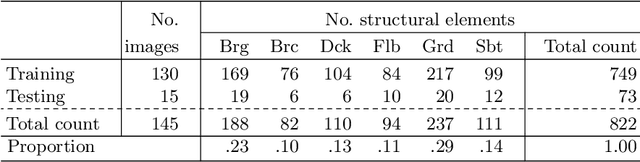

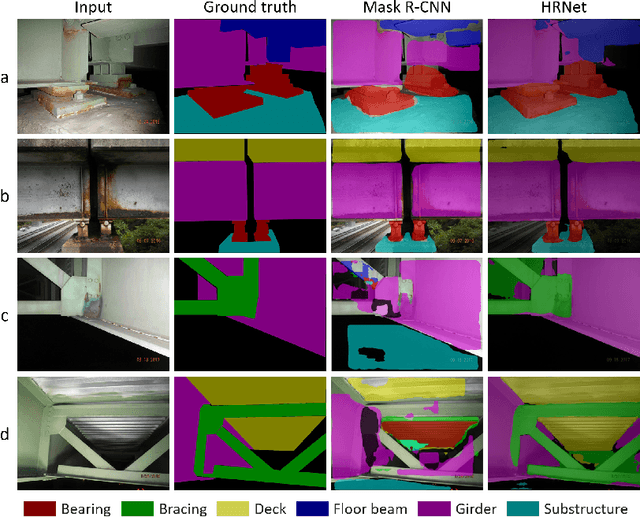
Aerial robots such as drones have been leveraged to perform bridge inspections. Inspection images with both recognizable structural elements and apparent surface defects can be collected by onboard cameras to provide valuable information for the condition assessment. This article aims to determine a suitable deep neural network (DNN) for parsing multiclass bridge elements in inspection images. An extensive set of quantitative evaluations along with qualitative examples show that High-Resolution Net (HRNet) possesses the desired ability. With data augmentation and a training sample of 130 images, a pre-trained HRNet is efficiently transferred to the task of structural element parsing and has achieved a 92.67% mean F1-score and 86.33% mean IoU.
A Simulation Study of Passing Drivers' Responses to the Automated Truck-Mounted Attenuator System in Road Maintenance
Aug 01, 2022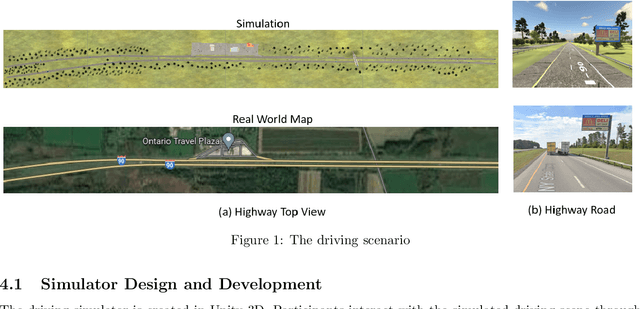
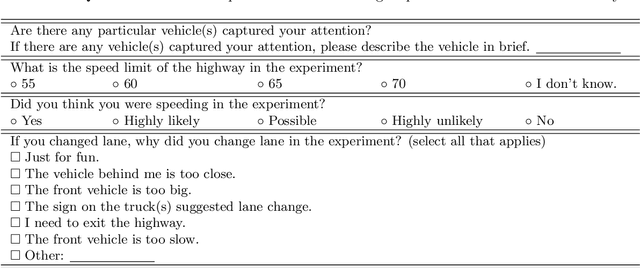
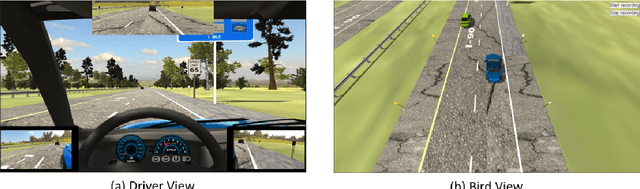

The Autonomous Truck-Mounted Attenuator (ATMA) system is a lead-follower vehicle system based on autonomous driving and connected vehicle technologies. The lead truck performs maintenance tasks on the road, and the unmanned follower truck is designed to improve the visibility of the moving work zone to passing vehicles and to protect workers and equipment. While the ATMA has been under testing by transportation maintenance and operations agencies in recent years, a simulator-based testing capability is a supplement, especially if human subjects are involved. This paper aims to discover how passing drivers perceive, understand, and react to the ATMA system in road maintenance accordingly. A driving simulator for ATMA studies is developed for collecting the driving data. Then, driving simulation experiments were performed, wherein a screen-based eye tracker collected sixteen subjects' gaze points and pupil diameters. Data analysis has evidenced the changes in the visual attention pattern of subjects when they were passing the ATMA. On average, the ATMA starts to attract subjects' attention from 500 ft behind the follower truck. Most (87.50%) understood the follower truck's protection purpose, and the majority (86.67%) reasoned the association between the two trucks. But still, many (43.75%) did not recognize that ATMA is a connected autonomous vehicle system. While all subjects safely changed lanes and attempted to pass the slow-moving ATMA, their inadequate understanding of ATMA is a potential risk, like cutting into the ATAM. Results implied that transportation maintenance and operations agencies should take this into consideration in establishing the deployment guidance.