 Add to Chrome
 Add to Firefox
 Add to Edge
VID-AD: A Dataset for Image-Level Logical Anomaly Detection under Vision-Induced Distraction
Mar 14, 2026
Logical anomaly detection in industrial inspection remains challenging due to variations in visual appearance (e.g., background clutter, illumination shift, and blur), which often distract vision-centric detectors from identifying rule-level violations. However, existing benchmarks rarely provide controlled settings where logical states are fixed while such nuisance factors vary. To address this gap, we introduce VID-AD, a dataset for logical anomaly detection under vision-induced distraction. It comprises 10 manufacturing scenarios and five capture conditions, totaling 50 one-class tasks and 10,395 images. Each scenario is defined by two logical constraints selected from quantity, length, type, placement, and relation, with anomalies including both single-constraint and combined violations. We further propose a language-based anomaly detection framework that relies solely on text descriptions generated from normal images. Using contrastive learning with positive texts and contradiction-based negative texts synthesized from these descriptions, our method learns embeddings that capture logical attributes rather than low-level features. Extensive experiments demonstrate consistent improvements over baselines across the evaluated settings. The dataset is available at: https://github.com/nkthiroto/VID-AD.

3D Human-Human Interaction Anomaly Detection
Dec 15, 2025Human-centric anomaly detection (AD) has been primarily studied to specify anomalous behaviors in a single person. However, as humans by nature tend to act in a collaborative manner, behavioral anomalies can also arise from human-human interactions. Detecting such anomalies using existing single-person AD models is prone to low accuracy, as these approaches are typically not designed to capture the complex and asymmetric dynamics of interactions. In this paper, we introduce a novel task, Human-Human Interaction Anomaly Detection (H2IAD), which aims to identify anomalous interactive behaviors within collaborative 3D human actions. To address H2IAD, we then propose Interaction Anomaly Detection Network (IADNet), which is formalized with a Temporal Attention Sharing Module (TASM). Specifically, in designing TASM, we share the encoded motion embeddings across both people such that collaborative motion correlations can be effectively synchronized. Moreover, we notice that in addition to temporal dynamics, human interactions are also characterized by spatial configurations between two people. We thus introduce a Distance-Based Relational Encoding Module (DREM) to better reflect social cues in H2IAD. The normalizing flow is eventually employed for anomaly scoring. Extensive experiments on human-human motion benchmarks demonstrate that IADNet outperforms existing Human-centric AD baselines in H2IAD.
Few-shot Human Action Anomaly Detection via a Unified Contrastive Learning Framework
Aug 25, 2025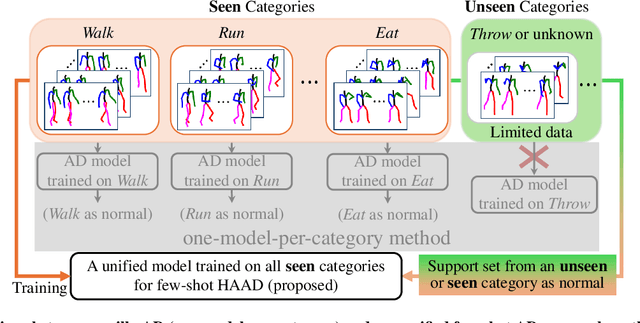
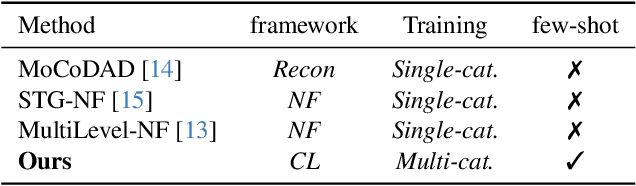
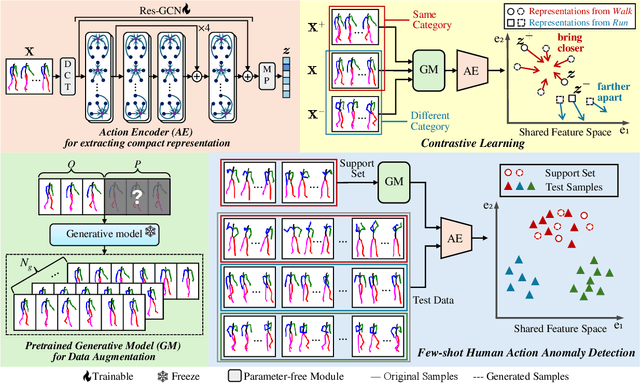
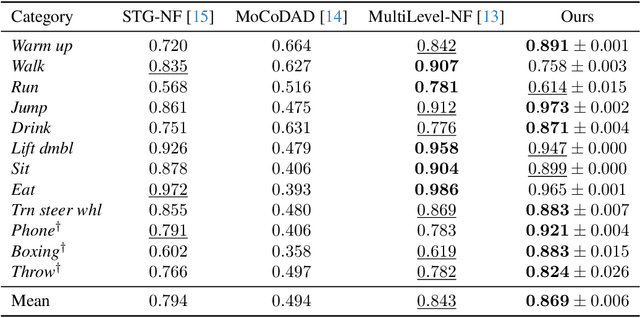
Human Action Anomaly Detection (HAAD) aims to identify anomalous actions given only normal action data during training. Existing methods typically follow a one-model-per-category paradigm, requiring separate training for each action category and a large number of normal samples. These constraints hinder scalability and limit applicability in real-world scenarios, where data is often scarce or novel categories frequently appear. To address these limitations, we propose a unified framework for HAAD that is compatible with few-shot scenarios. Our method constructs a category-agnostic representation space via contrastive learning, enabling AD by comparing test samples with a given small set of normal examples (referred to as the support set). To improve inter-category generalization and intra-category robustness, we introduce a generative motion augmentation strategy harnessing a diffusion-based foundation model for creating diverse and realistic training samples. Notably, to the best of our knowledge, our work is the first to introduce such a strategy specifically tailored to enhance contrastive learning for action AD. Extensive experiments on the HumanAct12 dataset demonstrate the state-of-the-art effectiveness of our approach under both seen and unseen category settings, regarding training efficiency and model scalability for few-shot HAAD.
Frequency-Guided Multi-Level Human Action Anomaly Detection with Normalizing Flows
Apr 26, 2024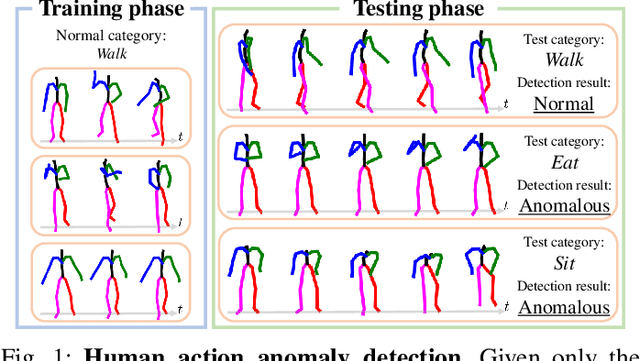

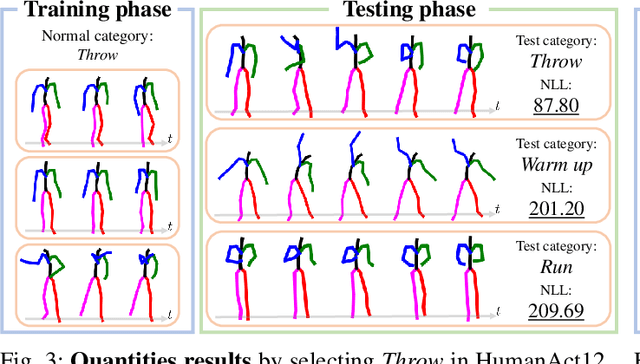
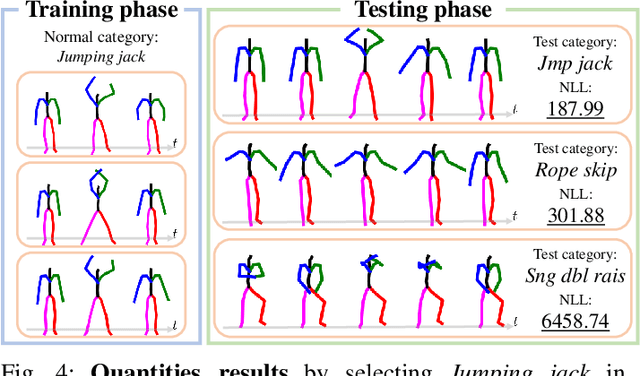
We introduce the task of human action anomaly detection (HAAD), which aims to identify anomalous motions in an unsupervised manner given only the pre-determined normal category of training action samples. Compared to prior human-related anomaly detection tasks which primarily focus on unusual events from videos, HAAD involves the learning of specific action labels to recognize semantically anomalous human behaviors. To address this task, we propose a normalizing flow (NF)-based detection framework where the sample likelihood is effectively leveraged to indicate anomalies. As action anomalies often occur in some specific body parts, in addition to the full-body action feature learning, we incorporate extra encoding streams into our framework for a finer modeling of body subsets. Our framework is thus multi-level to jointly discover global and local motion anomalies. Furthermore, to show awareness of the potentially jittery data during recording, we resort to discrete cosine transformation by converting the action samples from the temporal to the frequency domain to mitigate the issue of data instability. Extensive experimental results on two human action datasets demonstrate that our method outperforms the baselines formed by adapting state-of-the-art human activity AD approaches to our task of HAAD.