 Add to Chrome
 Add to Firefox
 Add to Edge
Identifying and Mitigating Gender Cues in Academic Recommendation Letters: An Interpretability Case Study
Apr 14, 2026
Letters of recommendation (LoRs) can carry patterns of implicitly gendered language that can inadvertently influence downstream decisions, e.g. in hiring and admissions. In this work, we investigate the extent to which Transformer-based encoder models as well as Large Language Models (LLMs) can infer the gender of applicants in academic LoRs submitted to an U.S. medical-residency program after explicit identifiers like names and pronouns are de-gendered. While using three models (DistilBERT, RoBERTa, and Llama 2) to classify the gender of anonymized and de-gendered LoRs, significant gender leakage was observed as evident from up to 68% classification accuracy. Text interpretation methods, like TF-IDF and SHAP, demonstrate that certain linguistic patterns are strong proxies for gender, e.g. "emotional'' and "humanitarian'' are commonly associated with LoRs from female applicants. As an experiment in creating truly gender-neutral LoRs, these implicit gender cues were remove resulting in a drop of up to 5.5% accuracy and 2.7% macro $F_1$ score on re-training the classifiers. However, applicant gender prediction still remains better than chance. In this case study, our findings highlight that 1) LoRs contain gender-identifying cues that are hard to remove and may activate bias in decision-making and 2) while our technical framework may be a concrete step toward fairer academic and professional evaluations, future work is needed to interrogate the role that gender plays in LoR review. Taken together, our findings motivate upstream auditing of evaluative text in real-world academic letters of recommendation as a necessary complement to model-level fairness interventions.

Lex Rosetta: Transfer of Predictive Models Across Languages, Jurisdictions, and Legal Domains
Dec 15, 2021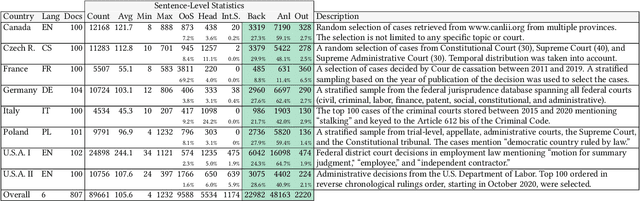
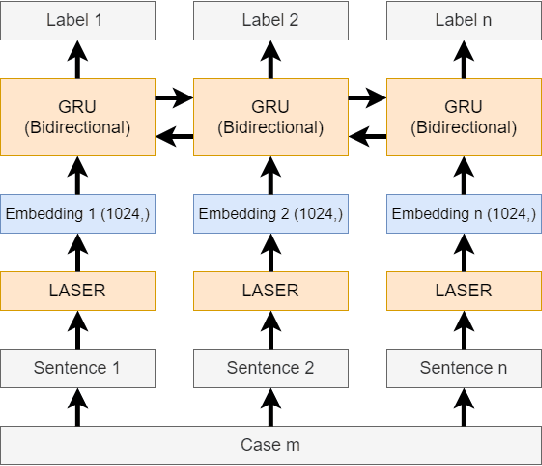
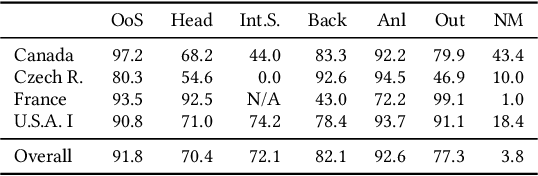
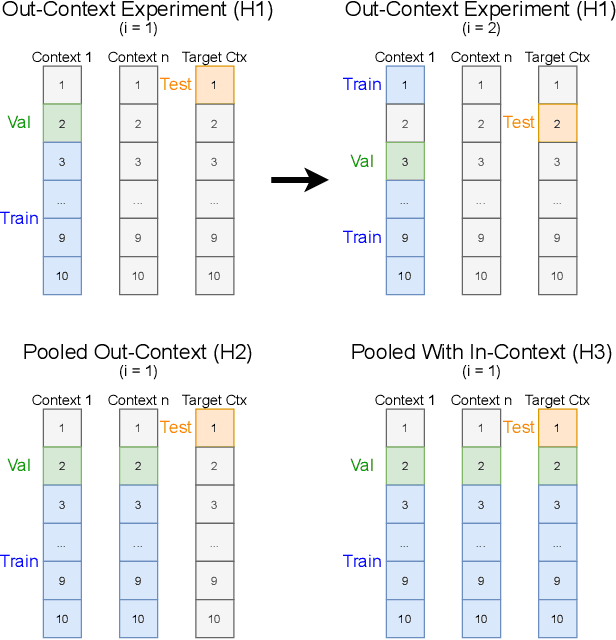
In this paper, we examine the use of multi-lingual sentence embeddings to transfer predictive models for functional segmentation of adjudicatory decisions across jurisdictions, legal systems (common and civil law), languages, and domains (i.e. contexts). Mechanisms for utilizing linguistic resources outside of their original context have significant potential benefits in AI & Law because differences between legal systems, languages, or traditions often block wider adoption of research outcomes. We analyze the use of Language-Agnostic Sentence Representations in sequence labeling models using Gated Recurrent Units (GRUs) that are transferable across languages. To investigate transfer between different contexts we developed an annotation scheme for functional segmentation of adjudicatory decisions. We found that models generalize beyond the contexts on which they were trained (e.g., a model trained on administrative decisions from the US can be applied to criminal law decisions from Italy). Further, we found that training the models on multiple contexts increases robustness and improves overall performance when evaluating on previously unseen contexts. Finally, we found that pooling the training data from all the contexts enhances the models' in-context performance.
* 10 pages