 Add to Chrome
 Add to Firefox
 Add to Edge
Depth-guided Multi-view Exposure Bracketing for HDR Robot Vision
Aug 17, 2026
Achieving reliable single-shot high dynamic range (HDR) imaging under extreme illumination conditions remains a long-standing challenge, yet no comprehensive benchmark exist for evaluating HDR perception in multi-sensor robotic systems. To fill this gap, we introduce a large-scale dataset collected via a custom robotic vision platform and an iPhone 13 Pro: 121 real-world scenes spanning modest and ultra-high dynamic range conditions, alongside 20 synthetic video sequences from the CARLA simulator. As a reference pipeline for this dataset, we propose Depth-guided Multi-view Exposure Bracketing (DMEB), a single-shot HDR method that distributes drastically different exposures across multi-view low-bit-depth cameras and fuses them via depth-guided confidence-aware fusion. Evaluations on our dataset show that DMEB establishes a strong reference point and highlight the promise of this sensor configuration for robust HDR perception in diverse multi-camera and depth sensor system.

Dual Exposure Stereo for Extended Dynamic Range 3D Imaging
Dec 03, 2024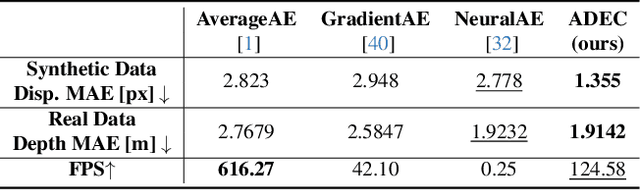
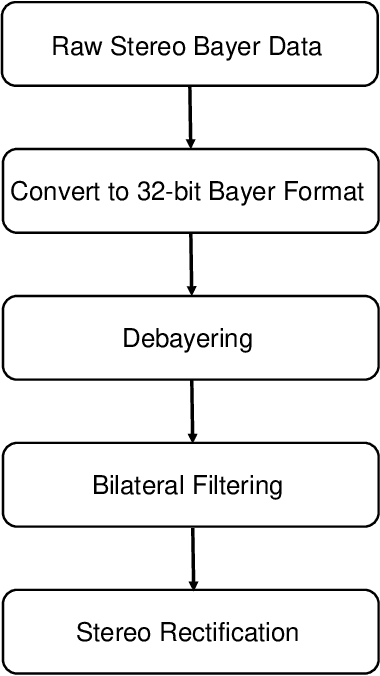
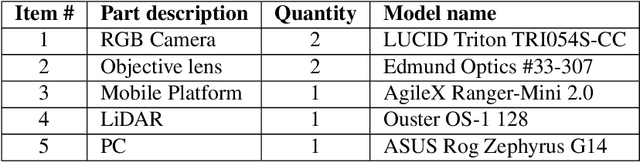

Achieving robust stereo 3D imaging under diverse illumination conditions is an important however challenging task, due to the limited dynamic ranges (DRs) of cameras, which are significantly smaller than real world DR. As a result, the accuracy of existing stereo depth estimation methods is often compromised by under- or over-exposed images. Here, we introduce dual-exposure stereo for extended dynamic range 3D imaging. We develop automatic dual-exposure control method that adjusts the dual exposures, diverging them when the scene DR exceeds the camera DR, thereby providing information about broader DR. From the captured dual-exposure stereo images, we estimate depth using motion-aware dual-exposure stereo network. To validate our method, we develop a robot-vision system, collect stereo video datasets, and generate a synthetic dataset. Our method outperforms other exposure control methods.