 Add to Chrome
 Add to Firefox
 Add to Edge
Telescope: Learnable Hyperbolic Foveation for Ultra-Long-Range Object Detection
Apr 07, 2026
Autonomous highway driving, especially for long-haul heavy trucks, requires detecting objects at long ranges beyond 500 meters to satisfy braking distance requirements at high speeds. At long distances, vehicles and other critical objects occupy only a few pixels in high-resolution images, causing state-of-the-art object detectors to fail. This challenge is compounded by the limited effective range of commercially available LiDAR sensors, which fall short of ultra-long range thresholds because of quadratic loss of resolution with distance, making image-based detection the most practically scalable solution given commercially available sensor constraints. We introduce Telescope, a two-stage detection model designed for ultra-long range autonomous driving. Alongside a powerful detection backbone, this model contains a novel re-sampling layer and image transformation to address the fundamental challenges of detecting small, distant objects. Telescope achieves $76\%$ relative improvement in mAP in ultra-long range detection compared to state-of-the-art methods (improving from an absolute mAP of 0.185 to 0.326 at distances beyond 250 meters), requires minimal computational overhead, and maintains strong performance across all detection ranges.

Zero-Shot Depth from Defocus
Mar 27, 2026Depth from Defocus (DfD) is the task of estimating a dense metric depth map from a focus stack. Unlike previous works overfitting to a certain dataset, this paper focuses on the challenging and practical setting of zero-shot generalization. We first propose a new real-world DfD benchmark ZEDD, which contains 8.3x more scenes and significantly higher quality images and ground-truth depth maps compared to previous benchmarks. We also design a novel network architecture named FOSSA. FOSSA is a Transformer-based architecture with novel designs tailored to the DfD task. The key contribution is a stack attention layer with a focus distance embedding, allowing efficient information exchange across the focus stack. Finally, we develop a new training data pipeline allowing us to utilize existing large-scale RGBD datasets to generate synthetic focus stacks. Experiment results on ZEDD and other benchmarks show a significant improvement over the baselines, reducing errors by up to 55.7%. The ZEDD benchmark is released at https://zedd.cs.princeton.edu. The code and checkpoints are released at https://github.com/princeton-vl/FOSSA.
ChopGrad: Pixel-Wise Losses for Latent Video Diffusion via Truncated Backpropagation
Mar 18, 2026Recent video diffusion models achieve high-quality generation through recurrent frame processing where each frame generation depends on previous frames. However, this recurrent mechanism means that training such models in the pixel domain incurs prohibitive memory costs, as activations accumulate across the entire video sequence. This fundamental limitation also makes fine-tuning these models with pixel-wise losses computationally intractable for long or high-resolution videos. This paper introduces ChopGrad, a truncated backpropagation scheme for video decoding, limiting gradient computation to local frame windows while maintaining global consistency. We provide a theoretical analysis of this approximation and show that it enables efficient fine-tuning with frame-wise losses. ChopGrad reduces training memory from scaling linearly with the number of video frames (full backpropagation) to constant memory, and compares favorably to existing state-of-the-art video diffusion models across a suite of conditional video generation tasks with pixel-wise losses, including video super-resolution, video inpainting, video enhancement of neural-rendered scenes, and controlled driving video generation.
TruckDrive: Long-Range Autonomous Highway Driving Dataset
Mar 02, 2026Safe highway autonomy for heavy trucks remains an open and unsolved challenge: due to long braking distances, scene understanding of hundreds of meters is required for anticipatory planning and to allow safe braking margins. However, existing driving datasets primarily cover urban scenes, with perception effectively limited to short ranges of only up to 100 meters. To address this gap, we introduce TruckDrive, a highway-scale multimodal driving dataset, captured with a sensor suite purpose-built for long range sensing: seven long-range FMCW LiDARs measuring range and radial velocity, three high-resolution short-range LiDARs, eleven 8MP surround cameras with varying focal lengths and ten 4D FMCW radars. The dataset offers 475 thousands samples with 165 thousands densely annotated frames for driving perception benchmarking up to 1,000 meters for 2D detection and 400 meters for 3D detection, depth estimation, tracking, planning and end to end driving over 20 seconds sequences at highway speeds. We find that state-of-the-art autonomous driving models do not generalize to ranges beyond 150 meters, with drops between 31% and 99% in 3D perception tasks, exposing a systematic long-range gap that current architectures and training signals cannot close.
UniLiPs: Unified LiDAR Pseudo-Labeling with Geometry-Grounded Dynamic Scene Decomposition
Jan 08, 2026Unlabeled LiDAR logs, in autonomous driving applications, are inherently a gold mine of dense 3D geometry hiding in plain sight - yet they are almost useless without human labels, highlighting a dominant cost barrier for autonomous-perception research. In this work we tackle this bottleneck by leveraging temporal-geometric consistency across LiDAR sweeps to lift and fuse cues from text and 2D vision foundation models directly into 3D, without any manual input. We introduce an unsupervised multi-modal pseudo-labeling method relying on strong geometric priors learned from temporally accumulated LiDAR maps, alongside with a novel iterative update rule that enforces joint geometric-semantic consistency, and vice-versa detecting moving objects from inconsistencies. Our method simultaneously produces 3D semantic labels, 3D bounding boxes, and dense LiDAR scans, demonstrating robust generalization across three datasets. We experimentally validate that our method compares favorably to existing semantic segmentation and object detection pseudo-labeling methods, which often require additional manual supervision. We confirm that even a small fraction of our geometrically consistent, densified LiDAR improves depth prediction by 51.5% and 22.0% MAE in the 80-150 and 150-250 meters range, respectively.
LSD-3D: Large-Scale 3D Driving Scene Generation with Geometry Grounding
Aug 26, 2025Large-scale scene data is essential for training and testing in robot learning. Neural reconstruction methods have promised the capability of reconstructing large physically-grounded outdoor scenes from captured sensor data. However, these methods have baked-in static environments and only allow for limited scene control -- they are functionally constrained in scene and trajectory diversity by the captures from which they are reconstructed. In contrast, generating driving data with recent image or video diffusion models offers control, however, at the cost of geometry grounding and causality. In this work, we aim to bridge this gap and present a method that directly generates large-scale 3D driving scenes with accurate geometry, allowing for causal novel view synthesis with object permanence and explicit 3D geometry estimation. The proposed method combines the generation of a proxy geometry and environment representation with score distillation from learned 2D image priors. We find that this approach allows for high controllability, enabling the prompt-guided geometry and high-fidelity texture and structure that can be conditioned on map layouts -- producing realistic and geometrically consistent 3D generations of complex driving scenes.
Beyond Domain Randomization: Event-Inspired Perception for Visually Robust Adversarial Imitation from Videos
May 24, 2025Imitation from videos often fails when expert demonstrations and learner environments exhibit domain shifts, such as discrepancies in lighting, color, or texture. While visual randomization partially addresses this problem by augmenting training data, it remains computationally intensive and inherently reactive, struggling with unseen scenarios. We propose a different approach: instead of randomizing appearances, we eliminate their influence entirely by rethinking the sensory representation itself. Inspired by biological vision systems that prioritize temporal transients (e.g., retinal ganglion cells) and by recent sensor advancements, we introduce event-inspired perception for visually robust imitation. Our method converts standard RGB videos into a sparse, event-based representation that encodes temporal intensity gradients, discarding static appearance features. This biologically grounded approach disentangles motion dynamics from visual style, enabling robust visual imitation from observations even in the presence of visual mismatches between expert and agent environments. By training policies on event streams, we achieve invariance to appearance-based distractors without requiring computationally expensive and environment-specific data augmentation techniques. Experiments across the DeepMind Control Suite and the Adroit platform for dynamic dexterous manipulation show the efficacy of our method. Our code is publicly available at Eb-LAIfO.
Dual Exposure Stereo for Extended Dynamic Range 3D Imaging
Dec 03, 2024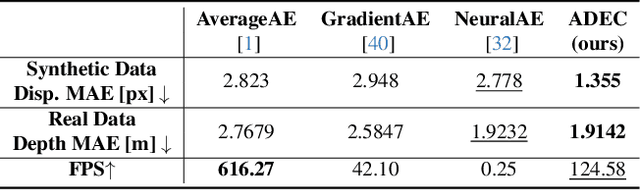
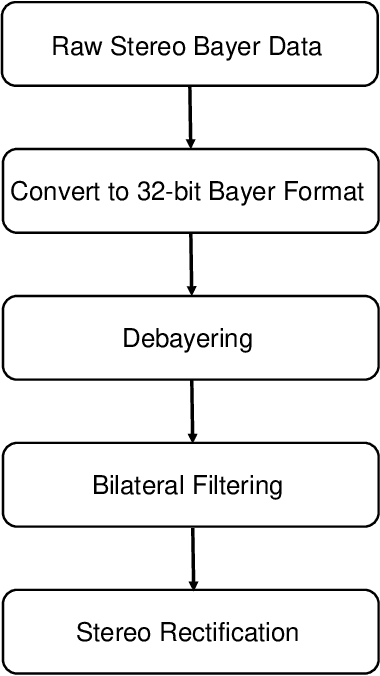
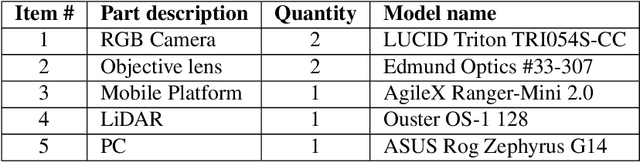

Achieving robust stereo 3D imaging under diverse illumination conditions is an important however challenging task, due to the limited dynamic ranges (DRs) of cameras, which are significantly smaller than real world DR. As a result, the accuracy of existing stereo depth estimation methods is often compromised by under- or over-exposed images. Here, we introduce dual-exposure stereo for extended dynamic range 3D imaging. We develop automatic dual-exposure control method that adjusts the dual exposures, diverging them when the scene DR exceeds the camera DR, thereby providing information about broader DR. From the captured dual-exposure stereo images, we estimate depth using motion-aware dual-exposure stereo network. To validate our method, we develop a robot-vision system, collect stereo video datasets, and generate a synthetic dataset. Our method outperforms other exposure control methods.
Polarization Wavefront Lidar: Learning Large Scene Reconstruction from Polarized Wavefronts
Jun 05, 2024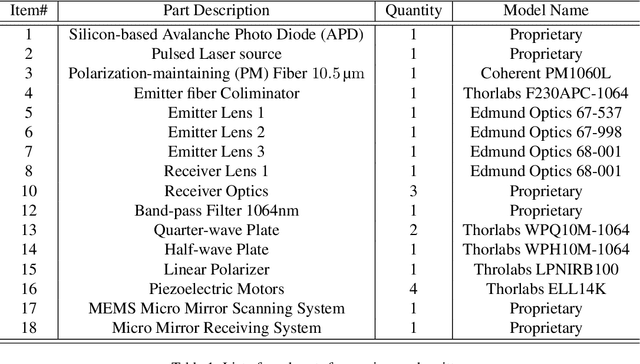


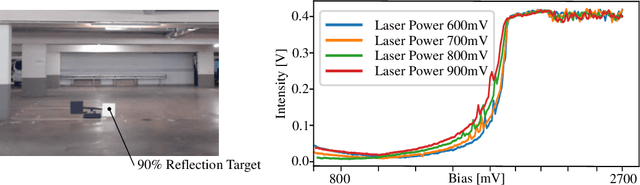
Lidar has become a cornerstone sensing modality for 3D vision, especially for large outdoor scenarios and autonomous driving. Conventional lidar sensors are capable of providing centimeter-accurate distance information by emitting laser pulses into a scene and measuring the time-of-flight (ToF) of the reflection. However, the polarization of the received light that depends on the surface orientation and material properties is usually not considered. As such, the polarization modality has the potential to improve scene reconstruction beyond distance measurements. In this work, we introduce a novel long-range polarization wavefront lidar sensor (PolLidar) that modulates the polarization of the emitted and received light. Departing from conventional lidar sensors, PolLidar allows access to the raw time-resolved polarimetric wavefronts. We leverage polarimetric wavefronts to estimate normals, distance, and material properties in outdoor scenarios with a novel learned reconstruction method. To train and evaluate the method, we introduce a simulated and real-world long-range dataset with paired raw lidar data, ground truth distance, and normal maps. We find that the proposed method improves normal and distance reconstruction by 53\% mean angular error and 41\% mean absolute error compared to existing shape-from-polarization (SfP) and ToF methods. Code and data are open-sourced at https://light.princeton.edu/pollidar.
Gated Fields: Learning Scene Reconstruction from Gated Videos
May 30, 2024


Reconstructing outdoor 3D scenes from temporal observations is a challenge that recent work on neural fields has offered a new avenue for. However, existing methods that recover scene properties, such as geometry, appearance, or radiance, solely from RGB captures often fail when handling poorly-lit or texture-deficient regions. Similarly, recovering scenes with scanning LiDAR sensors is also difficult due to their low angular sampling rate which makes recovering expansive real-world scenes difficult. Tackling these gaps, we introduce Gated Fields - a neural scene reconstruction method that utilizes active gated video sequences. To this end, we propose a neural rendering approach that seamlessly incorporates time-gated capture and illumination. Our method exploits the intrinsic depth cues in the gated videos, achieving precise and dense geometry reconstruction irrespective of ambient illumination conditions. We validate the method across day and night scenarios and find that Gated Fields compares favorably to RGB and LiDAR reconstruction methods. Our code and datasets are available at https://light.princeton.edu/gatedfields/.