 Add to Chrome
 Add to Firefox
 Add to Edge
In-Place Tokenizer Expansion for Pre-trained LLMs
Jul 16, 2026
A tokenizer fixed at the start of pre-training allocates vocabulary in proportion to the pre-training corpus, reflecting the deployment priorities at that time. When those priorities shift, languages added later are split into many more tokens per word, which can raise latency, compute, and energy consumption for users of those languages. Cloud models can afford a broad vocabulary because the embedding and LM-head matrices are a small fraction of their parameters. On a compact model those matrices are a material share of per-token decode bandwidth, so on-device models ship small vocabularies and accept fragmentation outside a fixed language set. We present tokenizer expansion, an in-place recipe for upgrading a pre-trained model's tokenizer when the model producer controls its design. We continue the existing tokenizer's BPE merges on a multilingual corpus, so most source tokens carry over unchanged as single tokens and every new token has an exact decomposition into source tokens. We copy the carried-over embedding rows unchanged and initialize new rows as the mean of their source sub-token embeddings. A two-stage adaptation, embedding-only training then full-model continued pre-training, recovers source-checkpoint quality. We apply the recipe to a continued pre-trained checkpoint of LFM2-8B-A1B, an 8B-parameter Mixture-of-Experts model, to help produce LFM2.5-8B-A1B with a 128K tokenizer. The expanded tokenizer encodes Hindi and Vietnamese in roughly $2.4\times$ and $2.6\times$ fewer tokens than the source (up to $4.0\times$ on Thai). Combining these reductions with the measured per-token cost of the larger vocabulary, we estimate a $2.2$-$3.7\times$ per-character decode speedup for these languages across our reference devices. We release the model weights and the expanded tokenizer, and report the negative findings that shaped the recipe.

Multi-Agent Robotic Control with Onboard Vision-Language Models
Jul 08, 2026Vision Language Models (VLMs) and Vision Language Action (VLA) models have shown promise in robotic control. Yet, they face significant challenges regarding explainability, generalization, and compute requirements. This paper presents a Multi-Agent System (MAS) architecture that addresses these limitations by deploying specialized agents on onboard hardware - eliminating dependence on external compute. The system controls a multi-purpose autonomous mobile manipulator in a simulated industrial warehouse, fulfilling five task categories: safety inspection, warehouse maintenance, warehouse search, package quality verification, and responding to human requests. Compact VLMs (3-20B parameters) are used throughout, with fine-tuning applied to improve package inspection accuracy. A novel "Megamind" orchestration agent mitigates context retention issues inherent to long-horizon planning with smaller models. The system was validated in a hardware-in-the-loop simulation using an AMD Ryzen(TM) AI mini PC. Results demonstrate that a fully onboard MAS architecture is a viable, cost-efficient alternative to cloud-dependent deployments, with strong potential for real-world transfer. The simulation environment has been released as open source under the Apache 2.0 licence.
MMAI Gym for Science: Training Liquid Foundation Models for Drug Discovery
Mar 03, 2026General-purpose large language models (LLMs) that rely on in-context learning do not reliably deliver the scientific understanding and performance required for drug discovery tasks. Simply increasing model size or introducing reasoning tokens does not yield significant performance gains. To address this gap, we introduce the MMAI Gym for Science, a one-stop shop molecular data formats and modalities as well as task-specific reasoning, training, and benchmarking recipes designed to teach foundation models the 'language of molecules' in order to solve practical drug discovery problems. We use MMAI Gym to train an efficient Liquid Foundation Model (LFM) for these applications, demonstrating that smaller, purpose-trained foundation models can outperform substantially larger general-purpose or specialist models on molecular benchmarks. Across essential drug discovery tasks - including molecular optimization, ADMET property prediction, retrosynthesis, drug-target activity prediction, and functional group reasoning - the resulting model achieves near specialist-level performance and, in the majority of settings, surpasses larger models, while remaining more efficient and broadly applicable in the domain.
STAR: Synthesis of Tailored Architectures
Nov 26, 2024Iterative improvement of model architectures is fundamental to deep learning: Transformers first enabled scaling, and recent advances in model hybridization have pushed the quality-efficiency frontier. However, optimizing architectures remains challenging and expensive. Current automated or manual approaches fall short, largely due to limited progress in the design of search spaces and due to the simplicity of resulting patterns and heuristics. In this work, we propose a new approach for the synthesis of tailored architectures (STAR). Our approach combines a novel search space based on the theory of linear input-varying systems, supporting a hierarchical numerical encoding into architecture genomes. STAR genomes are automatically refined and recombined with gradient-free, evolutionary algorithms to optimize for multiple model quality and efficiency metrics. Using STAR, we optimize large populations of new architectures, leveraging diverse computational units and interconnection patterns, improving over highly-optimized Transformers and striped hybrid models on the frontier of quality, parameter size, and inference cache for autoregressive language modeling.
Gaussian Splatting to Real World Flight Navigation Transfer with Liquid Networks
Jun 21, 2024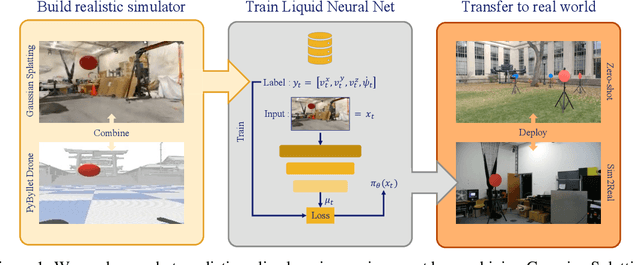
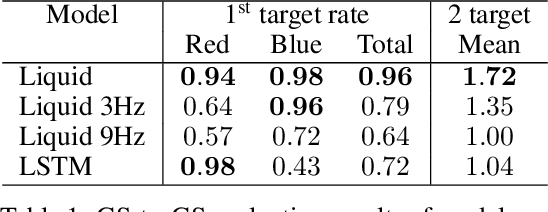
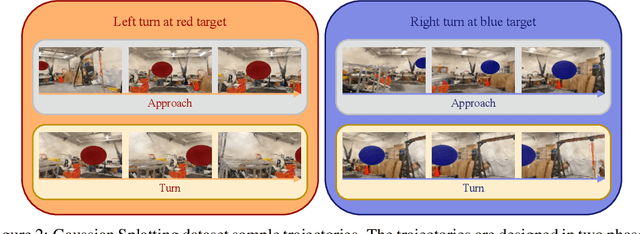
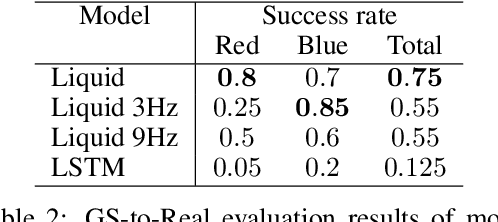
Simulators are powerful tools for autonomous robot learning as they offer scalable data generation, flexible design, and optimization of trajectories. However, transferring behavior learned from simulation data into the real world proves to be difficult, usually mitigated with compute-heavy domain randomization methods or further model fine-tuning. We present a method to improve generalization and robustness to distribution shifts in sim-to-real visual quadrotor navigation tasks. To this end, we first build a simulator by integrating Gaussian Splatting with quadrotor flight dynamics, and then, train robust navigation policies using Liquid neural networks. In this way, we obtain a full-stack imitation learning protocol that combines advances in 3D Gaussian splatting radiance field rendering, crafty programming of expert demonstration training data, and the task understanding capabilities of Liquid networks. Through a series of quantitative flight tests, we demonstrate the robust transfer of navigation skills learned in a single simulation scene directly to the real world. We further show the ability to maintain performance beyond the training environment under drastic distribution and physical environment changes. Our learned Liquid policies, trained on single target manoeuvres curated from a photorealistic simulated indoor flight only, generalize to multi-step hikes onboard a real hardware platform outdoors.
Exploring Latent Pathways: Enhancing the Interpretability of Autonomous Driving with a Variational Autoencoder
Apr 02, 2024Autonomous driving presents a complex challenge, which is usually addressed with artificial intelligence models that are end-to-end or modular in nature. Within the landscape of modular approaches, a bio-inspired neural circuit policy model has emerged as an innovative control module, offering a compact and inherently interpretable system to infer a steering wheel command from abstract visual features. Here, we take a leap forward by integrating a variational autoencoder with the neural circuit policy controller, forming a solution that directly generates steering commands from input camera images. By substituting the traditional convolutional neural network approach to feature extraction with a variational autoencoder, we enhance the system's interpretability, enabling a more transparent and understandable decision-making process. In addition to the architectural shift toward a variational autoencoder, this study introduces the automatic latent perturbation tool, a novel contribution designed to probe and elucidate the latent features within the variational autoencoder. The automatic latent perturbation tool automates the interpretability process, offering granular insights into how specific latent variables influence the overall model's behavior. Through a series of numerical experiments, we demonstrate the interpretative power of the variational autoencoder-neural circuit policy model and the utility of the automatic latent perturbation tool in making the inner workings of autonomous driving systems more transparent.
Toward Efficient Visual Gyroscopes: Spherical Moments, Harmonics Filtering, and Masking Techniques for Spherical Camera Applications
Apr 02, 2024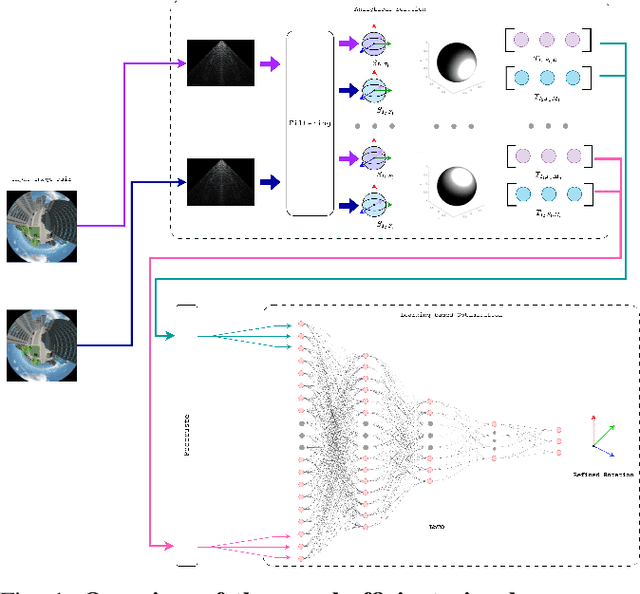
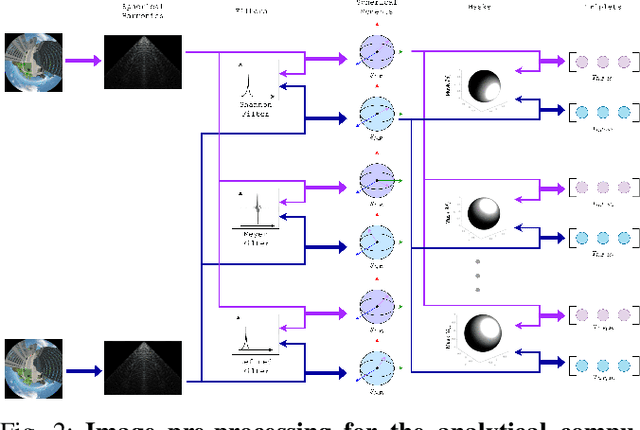
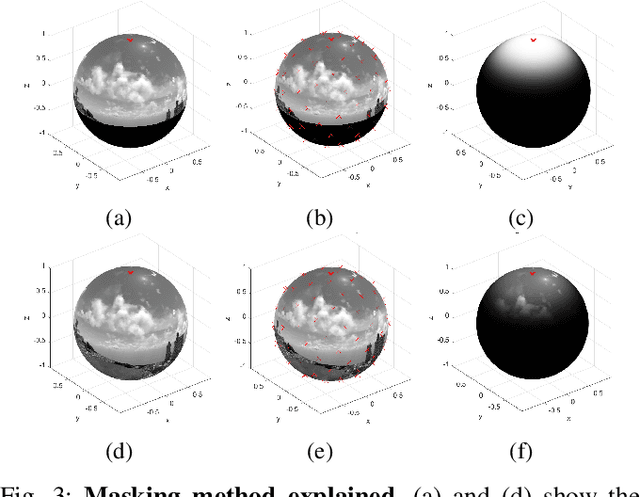
Unlike a traditional gyroscope, a visual gyroscope estimates camera rotation through images. The integration of omnidirectional cameras, offering a larger field of view compared to traditional RGB cameras, has proven to yield more accurate and robust results. However, challenges arise in situations that lack features, have substantial noise causing significant errors, and where certain features in the images lack sufficient strength, leading to less precise prediction results. Here, we address these challenges by introducing a novel visual gyroscope, which combines an analytical method with a neural network approach to provide a more efficient and accurate rotation estimation from spherical images. The presented method relies on three key contributions: an adapted analytical approach to compute the spherical moments coefficients, introduction of masks for better global feature representation, and the use of a multilayer perceptron to adaptively choose the best combination of masks and filters. Experimental results demonstrate superior performance of the proposed approach in terms of accuracy. The paper emphasizes the advantages of integrating machine learning to optimize analytical solutions, discusses limitations, and suggests directions for future research.
Uncertainty-aware Language Modeling for Selective Question Answering
Nov 26, 2023We present an automatic large language model (LLM) conversion approach that produces uncertainty-aware LLMs capable of estimating uncertainty with every prediction. Our approach is model- and data-agnostic, is computationally-efficient, and does not rely on external models or systems. We evaluate converted models on the selective question answering setting -- to answer as many questions as possible while maintaining a given accuracy, forgoing providing predictions when necessary. As part of our results, we test BERT and Llama 2 model variants on the SQuAD extractive QA task and the TruthfulQA generative QA task. We show that using the uncertainty estimates provided by our approach to selectively answer questions leads to significantly higher accuracy over directly using model probabilities.
Drive Anywhere: Generalizable End-to-end Autonomous Driving with Multi-modal Foundation Models
Oct 26, 2023
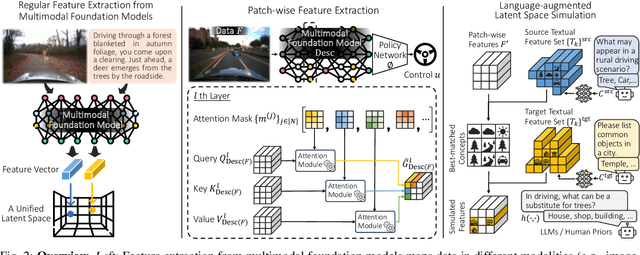


As autonomous driving technology matures, end-to-end methodologies have emerged as a leading strategy, promising seamless integration from perception to control via deep learning. However, existing systems grapple with challenges such as unexpected open set environments and the complexity of black-box models. At the same time, the evolution of deep learning introduces larger, multimodal foundational models, offering multi-modal visual and textual understanding. In this paper, we harness these multimodal foundation models to enhance the robustness and adaptability of autonomous driving systems, enabling out-of-distribution, end-to-end, multimodal, and more explainable autonomy. Specifically, we present an approach to apply end-to-end open-set (any environment/scene) autonomous driving that is capable of providing driving decisions from representations queryable by image and text. To do so, we introduce a method to extract nuanced spatial (pixel/patch-aligned) features from transformers to enable the encapsulation of both spatial and semantic features. Our approach (i) demonstrates unparalleled results in diverse tests while achieving significantly greater robustness in out-of-distribution situations, and (ii) allows the incorporation of latent space simulation (via text) for improved training (data augmentation via text) and policy debugging. We encourage the reader to check our explainer video at https://www.youtube.com/watch?v=4n-DJf8vXxo&feature=youtu.be and to view the code and demos on our project webpage at https://drive-anywhere.github.io/.
Capsa: A Unified Framework for Quantifying Risk in Deep Neural Networks
Aug 01, 2023


The modern pervasiveness of large-scale deep neural networks (NNs) is driven by their extraordinary performance on complex problems but is also plagued by their sudden, unexpected, and often catastrophic failures, particularly on challenging scenarios. Existing algorithms that provide risk-awareness to NNs are complex and ad-hoc. Specifically, these methods require significant engineering changes, are often developed only for particular settings, and are not easily composable. Here we present capsa, a framework for extending models with risk-awareness. Capsa provides a methodology for quantifying multiple forms of risk and composing different algorithms together to quantify different risk metrics in parallel. We validate capsa by implementing state-of-the-art uncertainty estimation algorithms within the capsa framework and benchmarking them on complex perception datasets. We demonstrate capsa's ability to easily compose aleatoric uncertainty, epistemic uncertainty, and bias estimation together in a single procedure, and show how this approach provides a comprehensive awareness of NN risk.
* Neural Information Processing Systems (NeurIPS) 2022. Workshop on Machine Learning for Autonomous Driving (ML4AD)