 Add to Chrome
 Add to Firefox
 Add to Edge
Gleanmer: A 6 mW SoC for Real-Time 3D Gaussian Occupancy Mapping
Mar 30, 2026
High-fidelity 3D occupancy mapping is essential for many edge-based applications (such as AR/VR and autonomous navigation) but is limited by power constraints. We present Gleanmer, a system on chip (SoC) with an accelerator for GMMap, a 3D occupancy map using Gaussians. Through algorithm-hardware co-optimizations for direct computation and efficient reuse of these compact Gaussians, Gleanmer reduces construction and query energy by up to 63% and 81%, respectively. Approximate computation on Gaussians reduces accelerator area by 38%. Using 16nm CMOS, Gleanmer processes 640x480 images in real time beyond 88 fps during map construction and processes over 540K coordinates per second during map query. To our knowledge, Gleanmer is the first fabricated SoC to achieve real-time 3D occupancy mapping under 6 mW for edge-based applications.

DecTrain: Deciding When to Train a DNN Online
Oct 03, 2024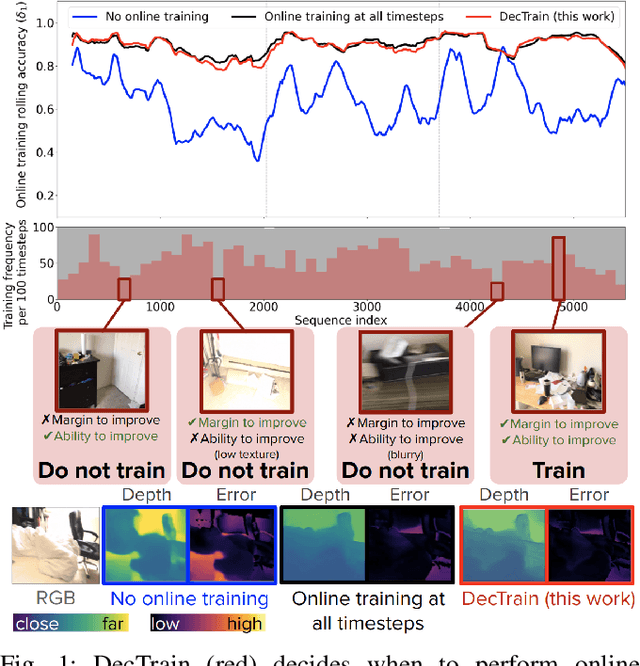
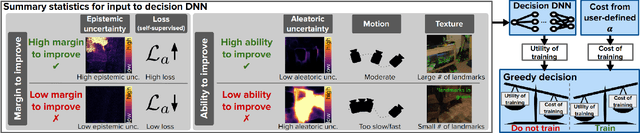
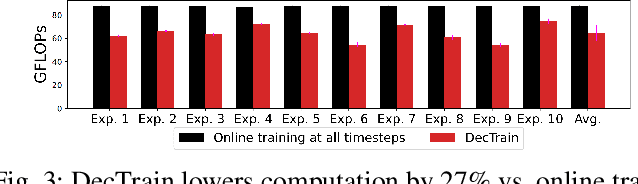
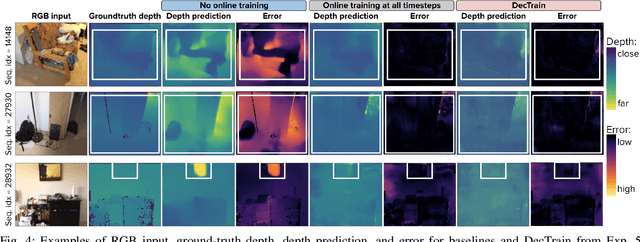
Deep neural networks (DNNs) can deteriorate in accuracy when deployment data differs from training data. While performing online training at all timesteps can improve accuracy, it is computationally expensive. We propose DecTrain, a new algorithm that decides when to train a monocular depth DNN online using self-supervision with low overhead. To make the decision at each timestep, DecTrain compares the cost of training with the predicted accuracy gain. We evaluate DecTrain on out-of-distribution data, and find DecTrain maintains accuracy compared to online training at all timesteps, while training only 44% of the time on average. We also compare the recovery of a low inference cost DNN using DecTrain and a more generalizable high inference cost DNN on various sequences. DecTrain recovers the majority (97%) of the accuracy gain of online training at all timesteps while reducing computation compared to the high inference cost DNN which recovers only 66%. With an even smaller DNN, we achieve 89% recovery while reducing computation by 56%. DecTrain enables low-cost online training for a smaller DNN to have competitive accuracy with a larger, more generalizable DNN at a lower overall computational cost.