 Add to Chrome
 Add to Firefox
 Add to Edge
CII: Novel CSI-RS Metric for Joint Precoder and RIS Reporting in Multi-User NextG Networks
Aug 11, 2026
While reconfigurable intelligent surfaces (RISs) are among the key enablers for next-generation (NextG) wireless networks, efficient feedback reporting for joint base station (BS) precoding and passive RIS configuration remains a major challenge due to the associated signaling overhead. By extending the standard-compliant channel state information reference signal framework, this paper introduces a novel channel information indicator (CII) that jointly represents the active BS precoding matrix and passive RIS configuration within a single feedback metric for multi-user multiple-input single-output systems. Simulation results demonstrate that the proposed unified feedback framework significantly reduces uplink signaling overhead compared with conventional disjoint reporting schemes. Furthermore, despite only a modest increase in the feedback payload, the proposed CII-based scheme outperforms conventional precoding matrix indicator approaches in terms of system performance, offering a practical and standards-compatible solution for RIS integration in NextG wireless networks.

A Novel Stripe-based RIS Optimization for UAV Communications and Sensing in Low-Altitude Wireless Networks
Jun 05, 2026Low-altitude wireless networks (LAWN) envision a reconfigurable 3D network capable of supporting mission-critical aerial operations. This paper presents a reconfigurable intelligent surface (RIS)-assisted LAWN to establish a reliable communication with an unmanned aerial vehicle (UAV) across varying wireless channel conditions and signal blockages. A low complexity stripe-based RIS phase shift optimization framework is proposed to simultaneously enhance communication reliability and provide passive sensing capability for UAV tracking under 3D mobility. Unlike high-complexity optimization approaches, the proposed method leverages the inherent structural phase-gradient of the RIS adjacent elements to significantly reduce the search space for calculating and updating the RIS configuration as the UAV moves. The analysis and simulation results demonstrate that the proposed framework outperforms conventional benchmarks in convergence speed and computational efficiency, while maintaining robust, high signal-to-noise-ratio (SNR) connectivity even in the presence of phase estimation errors and low SNR regimes. In addition, the measurement experiments using a real RIS prototype in an outdoor campus environment are performed to demonstrate the practical viability of the proposed approach.
RIS-Assisted Secure Transmission with Artificial Noise: Element Allocation and Measurements
May 26, 2026Physical layer security in reconfigurable intelligent surface (RIS)-assisted wireless systems can be improved through coordinated control of signal transmission and RIS configuration. In this work, the base station simultaneously transmits the communication signal (CS) and artificial noise (AN) in the presence of a potential eavesdropper. The RIS is partitioned into two groups of reflecting elements, where a portion enhances the desired CS toward the legitimate receiver, while the remaining elements contribute to AN transmission. Two key parameters govern the system design: a transmit power allocation factor between CS and AN, and an RIS element allocation ratio controlling the partitioning of the reflecting elements. An iterative binary phase optimization strategy is employed to enhance the received signal power at Bob while degrading Eve's reception. Simulation and experimental results demonstrate that proper joint design significantly improves the achievable secrecy capacity.
A Novel CSI-RS Reporting Scheme for RIS Optimization in O-RAN-based NextG Networks
Apr 20, 2026Reconfigurable intelligent surface (RIS) technology is a promising enabler for next-generation (NextG) wireless systems, capable of dynamically shaping the propagation environment. Integrating RIS within the open radio access network (O-RAN) architecture enables flexible and intelligent control of wireless links. However, practical RIS-assisted operation requires efficient acquisition and reporting of channel state information (CSI) to support real-time control from the base station side. This paper proposes a CSI reference signal (CSI-RS)-based reporting scheme for downlink complex channel information (CCI) to facilitate RIS optimization in an O-RAN-compliant environment. The proposed framework establishing CCI extraction and CSI-RS reporting procedures is experimentally validated on a real-world testbed integrating an open-source O-RAN system with an RIS prototype operating in the n78 frequency band. Existing channel estimation-based RIS optimization algorithms, including Hadamard and orthogonal matching pursuit (OMP), are tailored for integration into the O-RAN architecture. Experimental results demonstrate notable improvements in received signal power for both near and far users, highlighting the effectiveness and practical viability of the proposed scheme.
Fast Network Recovery from Large-Scale Disasters: A Resilient and Self-Organizing RAN Framework
Aug 16, 2024Extreme natural phenomena are occurring more frequently everyday in the world, challenging, among others, the infrastructure of communication networks. For instance, the devastating earthquakes in Turkiye in early 2023 showcased that, although communications became an imminent priority, existing mobile communication systems fell short with the operational requirements of harsh disaster environments. In this article, we present a novel framework for robust, resilient, adaptive, and open source sixth generation (6G) radio access networks (Open6GRAN) that can provide uninterrupted communication services in the face of natural disasters and other disruptions. Advanced 6G technologies, such as reconfigurable intelligent surfaces (RISs), cell-free multiple-input-multiple-output, and joint communications and sensing with increasingly heterogeneous deployment, consisting of terrestrial and non-terrestrial nodes, are robustly integrated. We advocate that a key enabler to develop service and management orchestration with fast recovery capabilities will rely on an artificial-intelligence-based radio access network (RAN) controller. To support the emergency use case spanning a larger area, the integration of aerial and space segments with the terrestrial network promises a rapid and reliable response in the case of any disaster. A proof-of-concept that rapidly reconfigures an RIS for performance enhancement under an emergency scenario is presented and discussed.
Practical Implementation of RIS-Aided Spectrum Sensing: A Deep Learning-Based Solution
Jul 27, 2023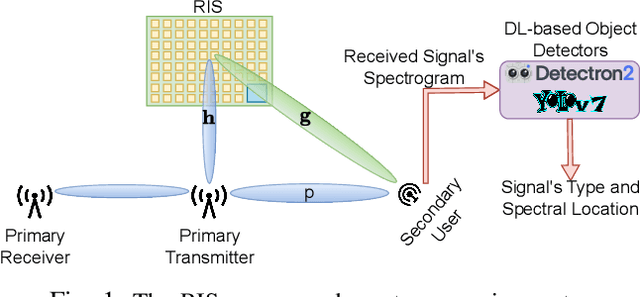
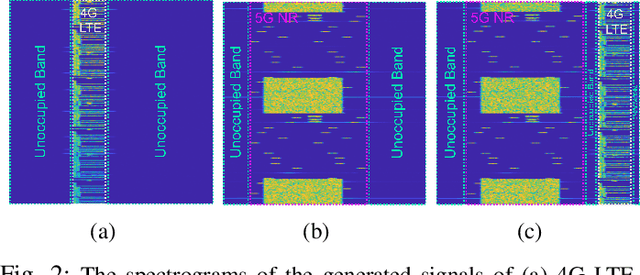
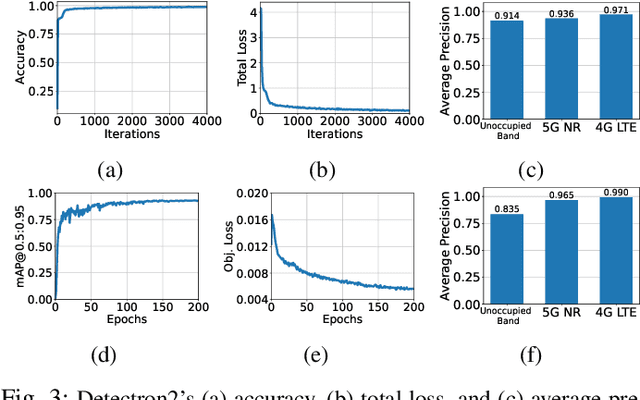
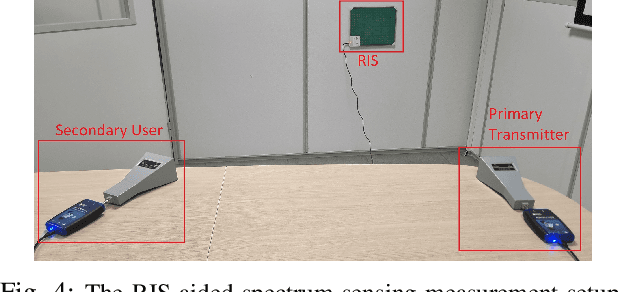
This paper presents reconfigurable intelligent surface (RIS)-aided deep learning (DL)-based spectrum sensing for next-generation cognitive radios. To that end, the secondary user (SU) monitors the primary transmitter (PT) signal, where the RIS plays a pivotal role in increasing the strength of the PT signal at the SU. The spectrograms of the synthesized dataset, including the 4G LTE and 5G NR signals, are mapped to images utilized for training the state-of-art object detection approaches, namely Detectron2 and YOLOv7. By conducting extensive experiments using a real RIS prototype, we demonstrate that the RIS can consistently and significantly improve the performance of the DL detectors to identify the PT signal type along with its time and frequency utilization. This study also paves the way for optimizing spectrum utilization through RIS-assisted CR application in next-generation wireless communication systems.