 Add to Chrome
 Add to Firefox
 Add to Edge
RIS-Assisted Secure Transmission with Artificial Noise: Element Allocation and Measurements
May 26, 2026
Physical layer security in reconfigurable intelligent surface (RIS)-assisted wireless systems can be improved through coordinated control of signal transmission and RIS configuration. In this work, the base station simultaneously transmits the communication signal (CS) and artificial noise (AN) in the presence of a potential eavesdropper. The RIS is partitioned into two groups of reflecting elements, where a portion enhances the desired CS toward the legitimate receiver, while the remaining elements contribute to AN transmission. Two key parameters govern the system design: a transmit power allocation factor between CS and AN, and an RIS element allocation ratio controlling the partitioning of the reflecting elements. An iterative binary phase optimization strategy is employed to enhance the received signal power at Bob while degrading Eve's reception. Simulation and experimental results demonstrate that proper joint design significantly improves the achievable secrecy capacity.

Beam Codebook Refinement for mmWave Devices with Random Orientations: Concept and Experimental Validation
Dec 30, 2024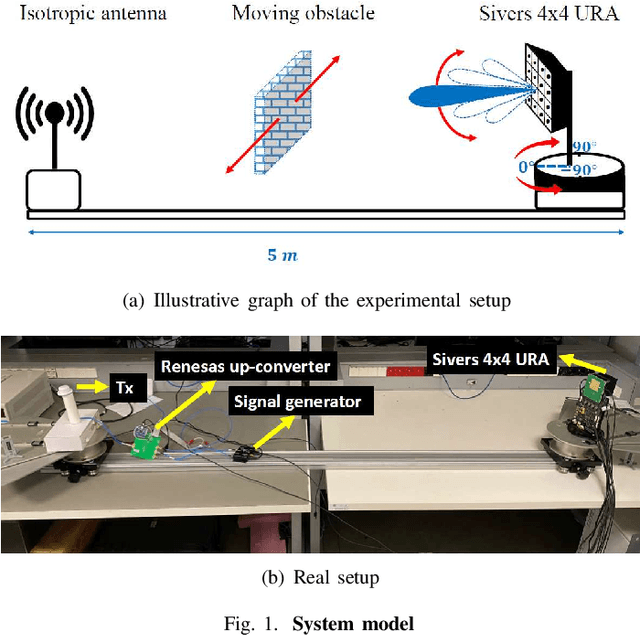

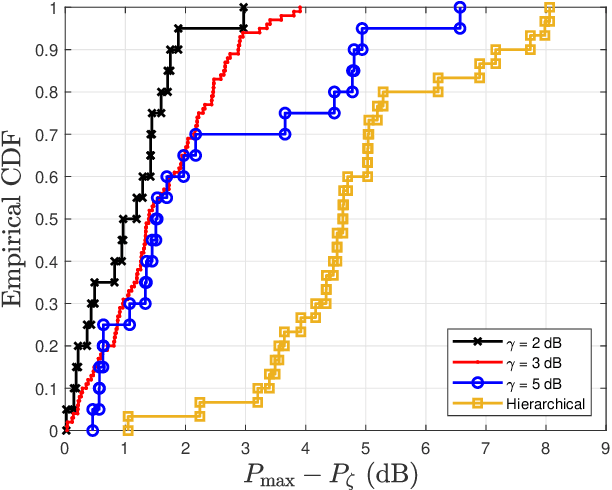
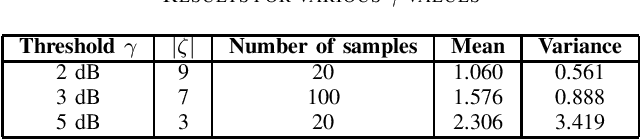
There is a growing interest in codebook-based beam-steering for millimeter-wave (mmWave) systems due to its potential for low complexity and rapid beam search. A key focus of recent research has been the design of codebooks that strike a trade-off between achievable gain and codebook size, which directly impacts beam search time. Statistical approaches have shown promise by leveraging the likelihood that certain beam directions (equivalently, sets of phase-shifter configurations) are more probable than others. Such approaches are shown to be valid for static, non-rotating transmission stations such as base stations. However, for the case of user terminals that are constantly changing orientation, the possible phase-shifter configurations become equally probable, rendering statistical methods less relevant. On the other hand, user terminals come with a large number of possible steering vector configurations, which can span up to six orders of magnitude. Therefore, efficient solutions to reduce the codebook size (set of possible steering vectors) without compromising array gain are needed. We address this challenge by proposing a novel and practical codebook refinement technique, aiming to reduce the codebook size while maintaining array gain within $\gamma$ dB of the maximum achievable gain at any random orientation of the user terminal. We project that a steering vector at a given angle could effectively cover adjacent angles with a small gain loss compared to the maximum achievable gain. We demonstrate experimentally that it is possible to reduce the codebook size from $1024^{16}$ to just a few configurations (e.g., less than ten), covering all angles while maintaining the gain within $\gamma=3$ dB of the maximum achievable gain.