 Add to Chrome
 Add to Firefox
 Add to Edge
A Novel Stripe-based RIS Optimization for UAV Communications and Sensing in Low-Altitude Wireless Networks
Jun 05, 2026
Low-altitude wireless networks (LAWN) envision a reconfigurable 3D network capable of supporting mission-critical aerial operations. This paper presents a reconfigurable intelligent surface (RIS)-assisted LAWN to establish a reliable communication with an unmanned aerial vehicle (UAV) across varying wireless channel conditions and signal blockages. A low complexity stripe-based RIS phase shift optimization framework is proposed to simultaneously enhance communication reliability and provide passive sensing capability for UAV tracking under 3D mobility. Unlike high-complexity optimization approaches, the proposed method leverages the inherent structural phase-gradient of the RIS adjacent elements to significantly reduce the search space for calculating and updating the RIS configuration as the UAV moves. The analysis and simulation results demonstrate that the proposed framework outperforms conventional benchmarks in convergence speed and computational efficiency, while maintaining robust, high signal-to-noise-ratio (SNR) connectivity even in the presence of phase estimation errors and low SNR regimes. In addition, the measurement experiments using a real RIS prototype in an outdoor campus environment are performed to demonstrate the practical viability of the proposed approach.

On Outage Analysis of OTFS Based LEO-Satellite Systems With HAPS Relaying
Feb 27, 2025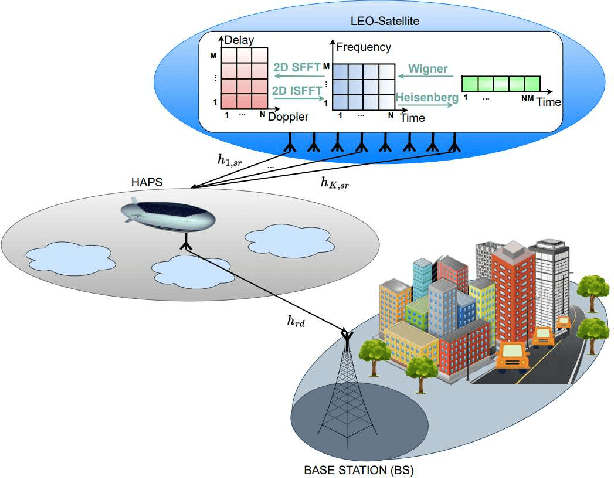
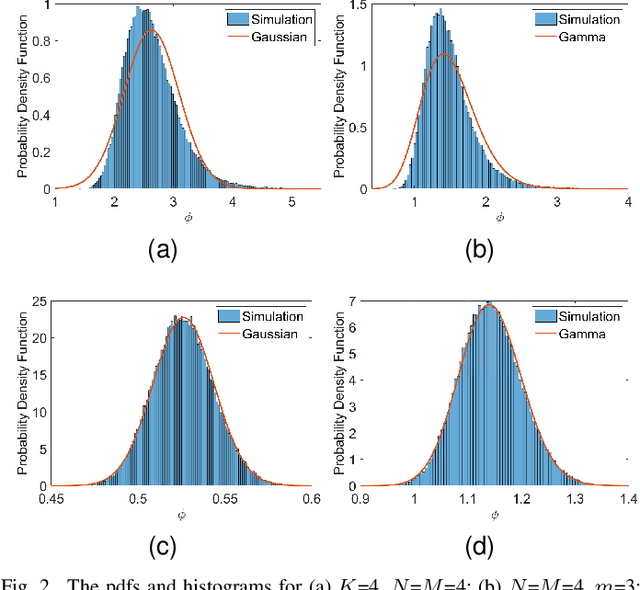
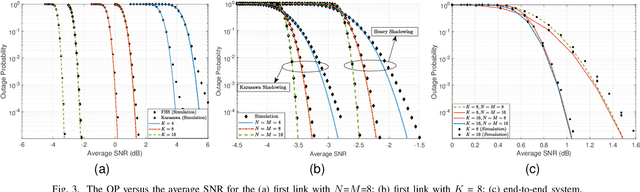
This paper presents an Orthogonal Time Frequency Space (OTFS) waveform application along with a high altitude platform station (HAPS) relaying for remedying severe Doppler effects in non-terrestrial networks (NTNs). Taking practical challenges into consideration, HAPS is exploited as a decode and forward relay node to mitigate the high path loss between a satellite and a base station (BS). In addition, a maximum ratio transmission scheme with multiple antennas at the LEO-satellite is utilized to maximize Signal-to-Noise Ratio (SNR). A shadowed Rician fading model is employed for the channel realization between the LEO-satellite and the HAPS while Nakagami-m is used between the HAPS and the BS. We derive the closed-form expression of the outage probability (OP) for the end-to-end system. The theoretical and simulation results demonstrate that the OP can significantly decrease when the OTFS order and the number of transmit antennas increase.