 Add to Chrome
 Add to Firefox
 Add to Edge
CII: Novel CSI-RS Metric for Joint Precoder and RIS Reporting in Multi-User NextG Networks
Aug 11, 2026
While reconfigurable intelligent surfaces (RISs) are among the key enablers for next-generation (NextG) wireless networks, efficient feedback reporting for joint base station (BS) precoding and passive RIS configuration remains a major challenge due to the associated signaling overhead. By extending the standard-compliant channel state information reference signal framework, this paper introduces a novel channel information indicator (CII) that jointly represents the active BS precoding matrix and passive RIS configuration within a single feedback metric for multi-user multiple-input single-output systems. Simulation results demonstrate that the proposed unified feedback framework significantly reduces uplink signaling overhead compared with conventional disjoint reporting schemes. Furthermore, despite only a modest increase in the feedback payload, the proposed CII-based scheme outperforms conventional precoding matrix indicator approaches in terms of system performance, offering a practical and standards-compatible solution for RIS integration in NextG wireless networks.

Gaussian Process-Based Extended Object Estimation for 6G ISAC at Millimeter-Wave Frequencies
May 26, 2026This paper introduces a Gaussian process (GP)-based method for extended object estimation (EOE) in integrated sensing and communication (ISAC) scenarios, representing a promising approach to enhance environmental awareness beyond the conventional point-scatterer assumption. The suitability of the proposed GP-based method for EOE is investigated through a practical measurement setup compliant with the fifth-generation (5G) New Radio (NR) standard and employing bistatic sensing, with results evaluated for both mapping and simultaneous localization and mapping (SLAM ) cases at millimeter-wave (mmWave) frequencies. The findings reveal that the enhanced capabilities of communication networks, when combined with bistatic sensing and GP-based EOE, enable improved environmental awareness in future wireless systems. Importantly, the results demonstrate that, under practical conditions, GP effectively performs EOE in both mmWave mapping and SLAM scenarios.
A Novel CSI-RS Reporting Scheme for RIS Optimization in O-RAN-based NextG Networks
Apr 20, 2026Reconfigurable intelligent surface (RIS) technology is a promising enabler for next-generation (NextG) wireless systems, capable of dynamically shaping the propagation environment. Integrating RIS within the open radio access network (O-RAN) architecture enables flexible and intelligent control of wireless links. However, practical RIS-assisted operation requires efficient acquisition and reporting of channel state information (CSI) to support real-time control from the base station side. This paper proposes a CSI reference signal (CSI-RS)-based reporting scheme for downlink complex channel information (CCI) to facilitate RIS optimization in an O-RAN-compliant environment. The proposed framework establishing CCI extraction and CSI-RS reporting procedures is experimentally validated on a real-world testbed integrating an open-source O-RAN system with an RIS prototype operating in the n78 frequency band. Existing channel estimation-based RIS optimization algorithms, including Hadamard and orthogonal matching pursuit (OMP), are tailored for integration into the O-RAN architecture. Experimental results demonstrate notable improvements in received signal power for both near and far users, highlighting the effectiveness and practical viability of the proposed scheme.
A Comprehensive Survey of Channel Estimation Techniques for OTFS in 6G and Beyond Wireless Networks
Dec 15, 2025
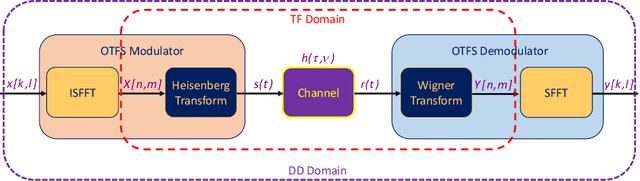
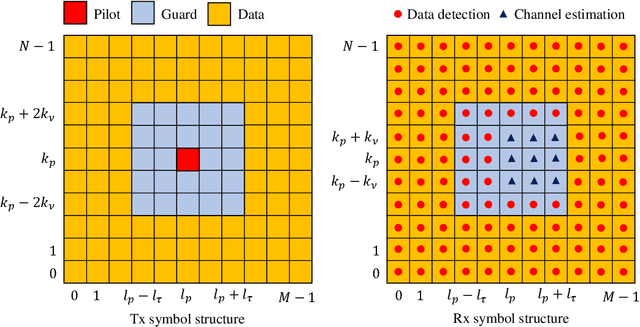
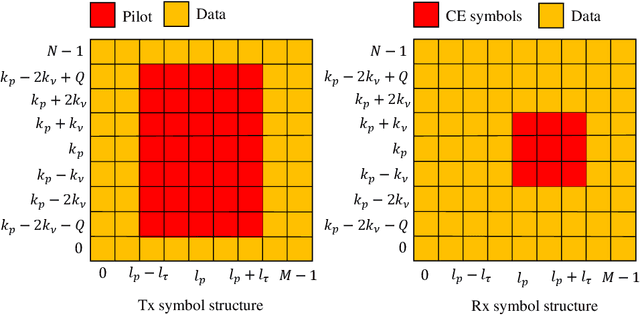
Orthogonal time-frequency space (OTFS) modulation has emerged as a powerful wireless communication technology that is specifically designed to address the challenges of high-mobility scenarios and significant Doppler effects. Unlike conventional modulation schemes that operate in the time-frequency (TF) domain, OTFS projects signals to the delay-Doppler (DD) domain, where wireless channels exhibit sparse and quasi-static characteristics. This fundamental transformation enables superior channel estimation (CE) performance in challenging propagation environments characterized by high-mobility, severe multipath effects, and rapidly time-varying channel conditions. This article provides a systematic examination of CE techniques for OTFS systems, covering the extensive research landscape from foundational methods to cutting-edge approaches. We present a detailed analysis of DD and TF domain CE techniques presented in the literature, including separate pilot, embedded pilot, and superimposed pilot approaches. The article encompasses various algorithmic frameworks including Bayesian learning, matching pursuit-based techniques, message passing algorithms, deep learning (DL)-based methods, and recent CE approaches. Additionally, we explore joint CE and signal detection (SD) strategies, the integration of OTFS with next-generation wireless systems including massive multiple-input multiple-output (MIMO), millimeter wave (mmWave) communications, reconfigurable intelligent surfaces (RISs), and integrated sensing and communication (ISAC) systems. Critical implementation challenges are presented, including leakage suppression, inter-Doppler interference mitigation, impulsive noise handling, signaling overhead reduction, guard space requirements, peak-to-average power ratio (PAPR) management, beam squint effects, and hardware impairments.
A Novel Partitioning Scheme for RIS Identification and Beamforming
Nov 14, 2025This letter introduces a novel partitioning scheme for reconfigurable intelligent surfaces (RISs) that simultaneously consider RIS identification and beamforming. The proposed scheme dynamicly and efficiently allocates RIS elements between identification and beamforming users, considering the different performance metrics associated with each of them. By employing a dynamic partitioning algorithm that efficiently manage the RIS resources (elements), the scheme significantly enhances the signal-to-noise ratio (SNR) while maintaining reliable identification performance. Finally, theoretical analysis and computer simulations are provided to demonstrate the validity of the proposed scheme.
* Accepted for publication in IEEE Wireless Communications Letters
Active RISs: Modeling and Optimization
Jul 22, 2025Reconfigurable Intelligent Surfaces (RIS)-empowered communication has emerged as a transformative technology for next generation wireless networks, enabling the programmable shaping of the propagation environment. However, conventional RISs are fundamentally limited by the double path loss effect, which severely attenuates the reflected signals. To overcome this, active RIS architectures, capable of amplifying impinging signals, have been proposed. This chapter investigates the modeling, performance analysis, and optimization of active RISs, focusing on two hardware designs: a dual-RIS structure with a single Power Amplifier (PA), and a reflection amplification structure at the unit cell level using tunnel diodes. For the PA-based design, a comprehensive mathematical model is developed, and closed-form expressions for the received signal-to-noise ratio, bit error probability, and Energy Efficiency (EE) are derived. An optimization framework for configuring the phase shifts and amplifier gain is proposed to maximize system capacity under power constraints. Regarding the second design, the integration of a tunnel diode into the unit cell is carefully studied by analyzing its I-V characteristic, enabling the derivation of the negative resistance range and the power consumption model. Furthermore, the intrinsic phase-amplitude coupling of the reflection coefficient is characterized through compact linear algebra formulations, enabling practical optimization of active RISs. Extensive numerical simulations validate the theoretical analyses, demonstrating that active RISs can effectively overcome the double path loss limitation and achieve favorable EE trade-offs compared to passive RISs. Finally, the trade-off between the available power budget and the number of active elements is examined, revealing that a higher number of active elements does not always lead to optimal performance.
Flip-KLJN: Random Resistance Flipping for Noise-Driven Secure Communication
Apr 15, 2025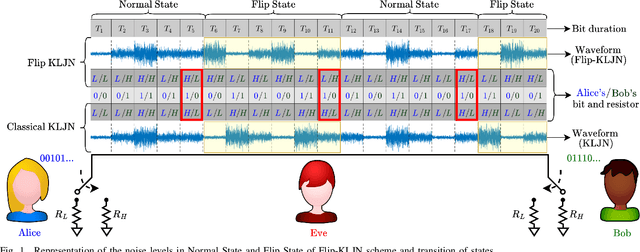
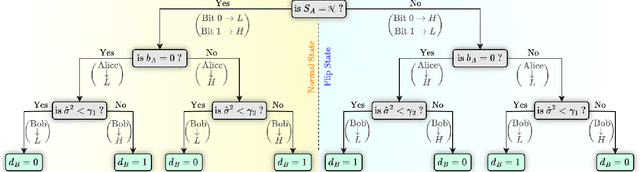
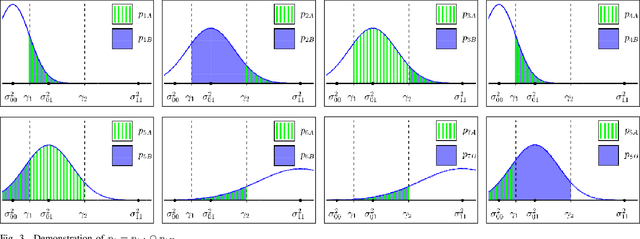
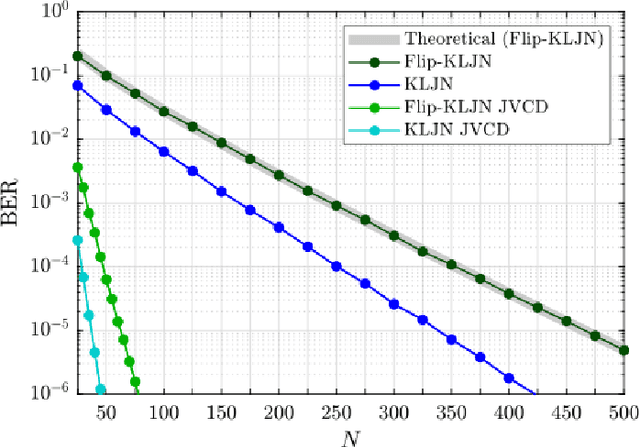
The information-theoretically (unconditionally) secure Kirchhoff-law-Johnson-noise (KLJN) bit exchange protocol uses two identical resistor pairs with high (H) and low (L) resistance values, driven by Gaussian noise generators emulating Johnson noise with a high common temperature. The resulting mean-square noise voltage on the wire connecting Alice and Bob has three levels: low (L/L), intermediate (H/L or L/H), and high (H/H), and secure key sharing is achieved at the intermediate level (L/H or H/L). This paper introduces the Flip-KLJN scheme, where a pre-agreed intermediate level, such as H/L, triggers a flip of the bit map value during the bit exchange period. For Eve, the bit map flips appear random. Thus, the formerly discarded H/H and L/L situations can also have a pre-agreed bit value mapping, which flips together with the original bit mapping. Thus, Flip-KLJN doubles the key rate and ensures that all three levels on the wire are indistinguishable for Eve. Bit error probabilities are addressed through analytic calculations and computer simulations.
A New OTFS-Based Index Modulation System for 6G and Beyond: OTFS-Based Code Index Modulation
Apr 12, 2025This paper proposes the orthogonal time frequency space-based code index modulation (OTFS-CIM) scheme, a novel wireless communication system that combines OTFS modulation, which enhances error performance in high-mobility Rayleigh channels, with CIM technique, which improves spectral and energy efficiency, within a single-input multiple-output (SIMO) architecture. The proposed system is evaluated through Monte Carlo simulations for various system parameters. Results show that increasing the modulation order degrades performance, while more receive antennas enhance it. Comparative analyses of error performance, throughput, spectral efficiency, and energy saving demonstrate that OTFS-CIM outperforms traditional OTFS and OTFS-based spatial modulation (OTFS-SM) systems. Also, the proposed OTFS-CIM system outperforms benchmark systems in many performance metrics under high-mobility scenarios, making it a strong candidate for sixth generation (6G) and beyond.
Orthogonal Time-Frequency Space (OTFS) Aided Media-Based Modulation System For 6G and Beyond Wireless Communications Networks
Apr 12, 2025This paper proposes a new orthogonal time frequency space (OTFS)-based index modulation system called OTFS-aided media-based modulation (MBM) scheme (OTFS-MBM), which is a promising technique for high-mobility wireless communication systems. The OTFS technique transforms information into the delay-Doppler domain, providing robustness against channel variations, while the MBM system utilizes controllable radio frequency (RF) mirrors to enhance spectral efficiency. The combination of these two techniques offers improved bit error rate (BER) performance compared to conventional OTFS and OTFS-based spatial modulation (OTFS-SM) systems. The proposed system is evaluated through Monte Carlo simulations over high-mobility Rayleigh channels for various system parameters. Comparative throughput, spectral efficiency, and energy efficiency analyses are presented, and it is shown that OTFS-MBM outperforms traditional OTFS and OTFS-SM techniques. The proposed OTFS-MBM scheme stands out as a viable solution for sixth generation (6G) and next-generation wireless networks, enabling reliable communication in dynamic wireless environments.
Noise Modulation over Wireless Energy Transfer: JEIH-Noise Mod
Feb 24, 2025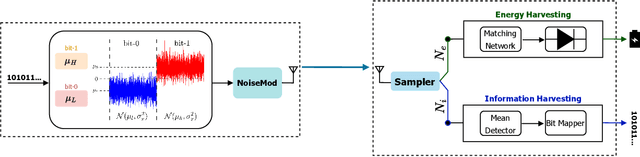
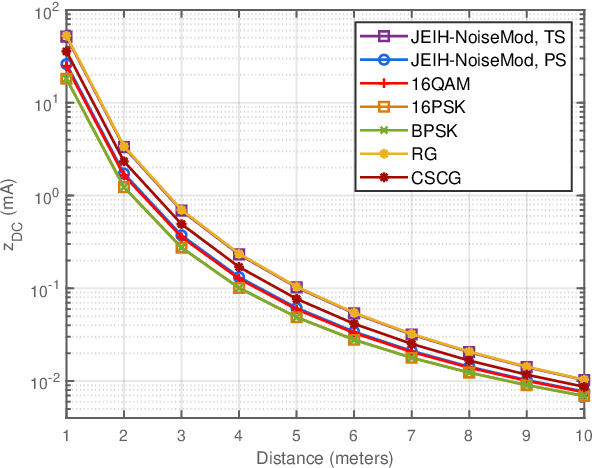
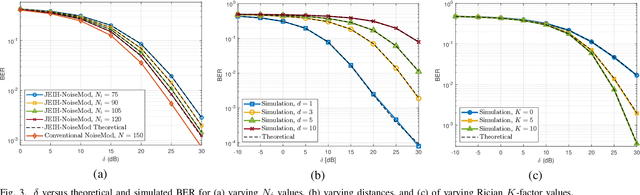
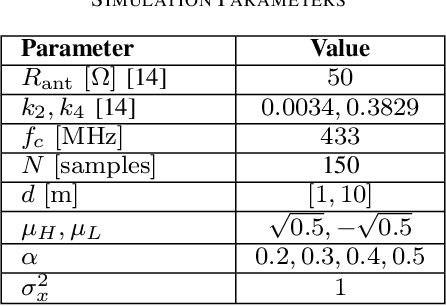
This letter presents an innovative energy harvesting (EH) and communication scheme for Internet of Things (IoT) devices by utilizing the emerging noise modulation (Noise-Mod) technique. Our proposed approach embeds information into the mean value of real Gaussian noise samples, enabling simultaneous power transfer and data transmission. We analyze our system under the Rician fading channels with path loss and derive the bit error probability (BEP) expression. Our simulation results demonstrate that the proposed scheme outperforms conventional modulation schemes in terms of energy harvesting capability across various channel conditions. This scheme offers a novel solution by directly embedding data into the noise-modulated signal to enable information decoding through mean-based detection. Furthermore, it increases energy harvesting capability thanks to the utilized Gaussian waveform.