 Add to Chrome
 Add to Firefox
 Add to Edge
A Novel Stripe-based RIS Optimization for UAV Communications and Sensing in Low-Altitude Wireless Networks
Jun 05, 2026
Low-altitude wireless networks (LAWN) envision a reconfigurable 3D network capable of supporting mission-critical aerial operations. This paper presents a reconfigurable intelligent surface (RIS)-assisted LAWN to establish a reliable communication with an unmanned aerial vehicle (UAV) across varying wireless channel conditions and signal blockages. A low complexity stripe-based RIS phase shift optimization framework is proposed to simultaneously enhance communication reliability and provide passive sensing capability for UAV tracking under 3D mobility. Unlike high-complexity optimization approaches, the proposed method leverages the inherent structural phase-gradient of the RIS adjacent elements to significantly reduce the search space for calculating and updating the RIS configuration as the UAV moves. The analysis and simulation results demonstrate that the proposed framework outperforms conventional benchmarks in convergence speed and computational efficiency, while maintaining robust, high signal-to-noise-ratio (SNR) connectivity even in the presence of phase estimation errors and low SNR regimes. In addition, the measurement experiments using a real RIS prototype in an outdoor campus environment are performed to demonstrate the practical viability of the proposed approach.

RAG-driven Multi-Agent LLM Framework with Task Decomposition for Beyond 5G Auto-Configuration
May 31, 2026While Large Language Models (LLMs) offer a promising path toward intent-driven network management by translating natural language human intents into machine-readable configurations, they often suffer from hallucinations and structural inconsistencies in multi-step and complex tasks. To address these challenges, this paper proposes a retrieval-augmented and task decomposition-based multi-agent LLM framework for Beyond 5G network auto-configuration. The framework employs a semantic retrieval-augmented generation pipeline to ensure that its outputs are aligned with technical standards and vendor-specific manuals. Furthermore, it introduces a modular architecture for configuration generation, closed-loop configuration verification, and network deployment, in which complex tasks are decomposed into smaller sub-tasks handled by specialized agents. In this architecture, hallucinated configuration parameters are identified by the configuration verifier agent and corrected through low computational segment-level regeneration. The performance evaluation experiments with the OpenAirInterface emulator demonstrate that the proposed task decomposition-based configuration and verification approach improves the average success rate by 22.7% over monolithic methods, achieving 94.4% success in network configuration.
RIS Meets O-RAN: A Practical Demonstration of Multi-user RIS Optimization through RIC
Jan 31, 2025Open Radio Access Network (O-RAN) along with artificial intelligence, machine learning, cloud and edge networking, and virtualization are important enablers for designing flexible and software-driven programmable wireless networks. In addition, Reconfigurable Intelligent Surfaces (RIS) represent an innovative technology to direct incoming radio signals toward desired locations by software-controlled passive reflecting antenna elements. Despite their distinctive potential, there has been limited exploration of integrating RIS with the O-RAN framework, an area that holds promise for enhancing next-generation wireless systems. This paper addresses this gap by designing and developing the RIS optimization xApps within an O-RAN-based real-time 5G environment. We perform extensive measurement experiments using an end-to-end 5G testbed including the RIS prototype in a multi-user scenario. The results demonstrate that the RIS can be utilized either to boost the performance of the selected user or to provide the fairness among the users or to balance the tradeoff between the performance and fairness.
A Practical Demonstration of DRL-Based Dynamic Resource Allocation xApp Using OpenAirInterface
Jan 10, 2025Network slicing is a key enabler for providing a differentiated service support to heterogeneous use cases and applications in 5G and beyond networks through creating multiple logical slices. Resource allocation for satisfying diverse requirements of slices is a highly challenging task under time-varying traffic and wireless channel conditions. This paper presents a deep reinforcement learning (DRL) approach for allocating radio resources to slices, where the objective is to meet the latency requirement of the low-latency slice without jeopardizing the performance of the other slice. The proposed DRL approach is implemented within an open source mobile network emulator, namely OpenAirInterface, to create an O-RAN compliant end-to-end 5G network capable of dynamic resource allocation capabilities. The intelligent resource allocation mechanism operates on the RAN Intelligent Controller (RIC) as an xApp, enabling monitoring and dynamic resource control of the gNB through the E2 interface. The results demonstrate that the latency requirement of the low-latency slice is met under extremely loaded traffic scenarios, where the trained DRL model deployed on the near-RT RIC platform is used to dynamically allocate the radio resources to the slices.
Deep Learning Based Detection on RIS Assisted RSM and RSSK Techniques
Oct 18, 2023The reconfigurable intelligent surface (RIS) is considered a crucial technology for the future of wireless communication. Recently, there has been significant interest in combining RIS with spatial modulation (SM) or space shift keying (SSK) to achieve a balance between spectral and energy efficiency. In this paper, we have investigated the use of deep learning techniques for detection in RIS-aided received SM (RSM)/received-SSK (RSSK) systems over Weibull fading channels, specifically by extending the RIS-aided SM/SSK system to a specific case of the conventional SM system. By employing the concept of neural networks, the study focuses on model-driven deep learning detection namely block deep neural networks (B-DNN) for RIS-aided SM systems and compares its performance against maximum likelihood (ML) and greedy detectors. Finally, it has been demonstrated by Monte Carlo simulation that while B-DNN achieved a bit error rate (BER) performance close to that of ML, it gave better results than the Greedy detector.
Space-Time Block Coded Reconfigurable Intelligent Surface-Based Received Spatial Modulation
Mar 28, 2022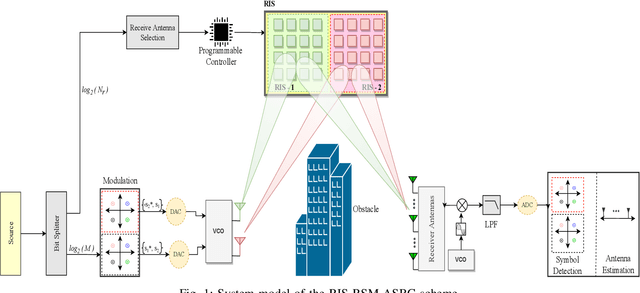
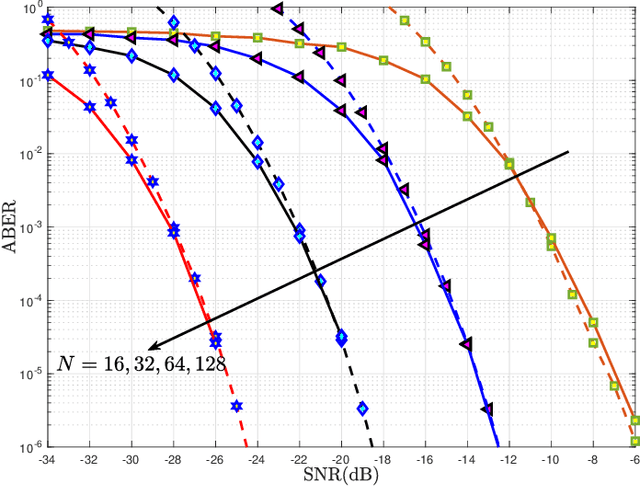
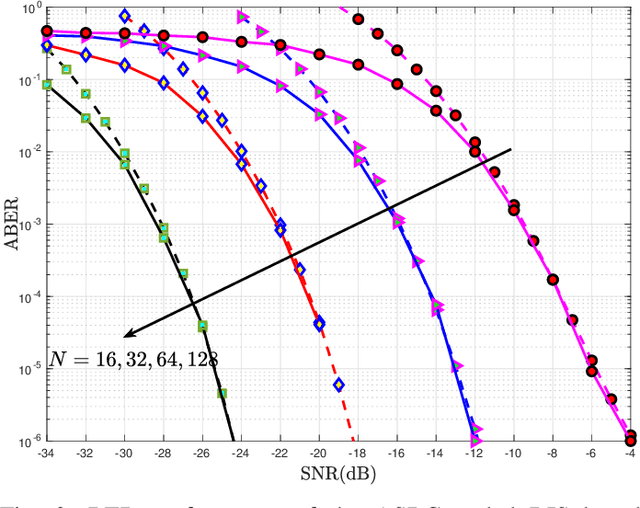
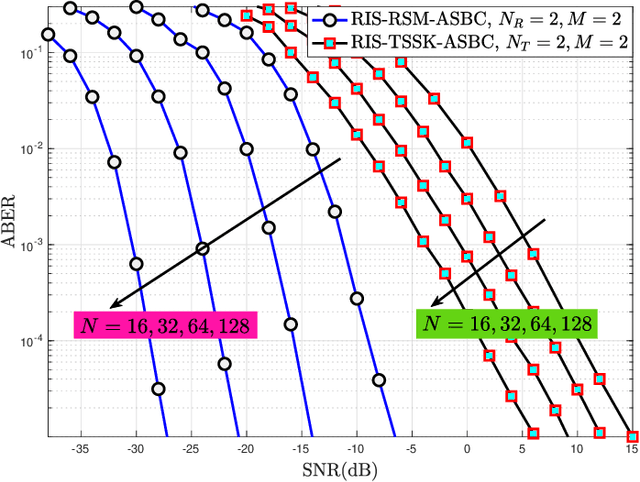
Reconfigurable intelligent surface (RIS) structures reflect the incident signals by adjusting phase adaptively according to the channel condition where doing transmission in order to increase signal quality at the receiver. Besides, the spatial modulation (SM) technique is a possible candidate for future energy-efficient wireless communications due to providing better throughput, low-cost implementation and good error performance. Also, Alamouti's space-time block coding (ASBC) is an important space and time coding technique in terms of diversity gain and simplified ML detection. In this paper, we proposed the RIS assisted received spatial modulation (RSM) scheme with ASBC, namely RIS-RSM-ASBC. The termed RIS is portioned by two parts in the proposed system model. Each one is utilized as an access point (AP) to transmit its Alamouti coded information while reflecting passive signals to the selected received antenna. The optimal maximum likelihood (ML) detector is designed for the proposed RIS-RSM-ASBC scheme. Extensive computer simulations are conducted to corroborate theoretical derivations. Results show that RIS-RSM-ASBC system is highly reliable and provides data rate enhancement in contrast to conventional RIS assisted transmit SM (RIS-TSM), RIS assisted transmit quadrature SM (RIS-TQSM), RIS assisted received SM (RIS-RSM), RIS assisted transmit space shift keying with ASBC (RIS-TSSK-ASBC) and RIS-TSSK-VBLAST schemes.