 Add to Chrome
 Add to Firefox
 Add to Edge
CAIRN: Cross-Room 3D Scene Understanding with Topology-Aware Large Multimodal Models
Jul 07, 2026
Existing 3D scene-grounded Large Language Models (3D-LLMs) focus on answering questions grounded in simplified single-room 3D scenes, lacking the ability to reason over real-world household environments containing multiple interconnected rooms and diverse object categories. We introduce CAIRN, a topology-aware 3D-LLM for multi-room 3D scene understanding. CAIRN aligns transformer attention with scene hierarchy, giving the model explicit awareness of object-level relations and room-level connectivity. It enriches object tokens with room-local relational context via a graph neural network, introduces learned room tokens for room-level abstraction, and applies a hierarchical attention mask with geometric bias to route information according to scene topology. CAIRN is developed on CAIRN-MR, a benchmark we introduce on HM3D for multi-room 3D scene understanding, covering grounding, captioning, and four question-answering tasks that progressively evaluate from intra-room perception to cross-room reasoning. Experiments show that CAIRN outperforms prior 3D-LLMs by a large margin across all CAIRN-MR tasks while remaining competitive on five single-room benchmarks.

A non-invasive video-based method for individual identification of wildlife using gait dynamics
Jul 05, 2026Gait is a distinctive behavioral characteristic that enables non-invasive individual identification without requiring physical interaction with an animal. While gait-based analysis has been extensively studied in humans, its application to wildlife remains limited due to environmental variability and the lack of scalable identification methods. This paper presents a fully automated, video-based pipeline for wildlife gait analysis and individual identification using deep spatiotemporal representation learning. The proposed pipeline uses the Segment Anything Model 3 (SAM3) to generate high-quality RGB and binary silhouette masks, robustly isolating animals from complex natural backgrounds. Segmented video sequences are processed using a convolutional neural network (ResNet18) for spatial feature extraction and a transformer-based video model (VideoPrism) for temporal motion modeling. Both models are fine-tuned using a classification objective and subsequently used as feature extractors to generate discriminative gait representations. Cosine similarity is then used to compare gait signatures, enabling similarity-based clustering of individuals without reliance on physical markings or invasive tagging. Experiments conducted on multi-source wildlife video data across multiple species demonstrate strong intra-individual consistency and clear inter-individual separation. Quantitative results using cosine similarity distributions and silhouette scores confirm the effectiveness of the proposed method. These findings demonstrate that gait dynamics provide a viable, non-invasive approach for individual identification in wildlife and highlight the potential of video-based deep learning pipelines for scalable ecological monitoring.
WildDepth: A Multimodal Dataset for 3D Wildlife Perception and Depth Estimation
Mar 17, 2026Depth estimation and 3D reconstruction have been extensively studied as core topics in computer vision. Starting from rigid objects with relatively simple geometric shapes, such as vehicles, the research has expanded to address general objects, including challenging deformable objects, such as humans and animals. However, for the animal, in particular, the majority of existing models are trained based on datasets without metric scale, which can help validate image-only models. To address this limitation, we present WildDepth, a multimodal dataset and benchmark suite for depth estimation, behavior detection, and 3D reconstruction from diverse categories of animals ranging from domestic to wild environments with synchronized RGB and LiDAR. Experimental results show that the use of multi-modal data improves depth reliability by up to 10% RMSE, while RGB-LiDAR fusion enhances 3D reconstruction fidelity by 12% in Chamfer distance. By releasing WildDepth and its benchmarks, we aim to foster robust multimodal perception systems that generalize across domains.
SoundLoc3D: Invisible 3D Sound Source Localization and Classification Using a Multimodal RGB-D Acoustic Camera
Dec 22, 2024Accurately localizing 3D sound sources and estimating their semantic labels -- where the sources may not be visible, but are assumed to lie on the physical surface of objects in the scene -- have many real applications, including detecting gas leak and machinery malfunction. The audio-visual weak-correlation in such setting poses new challenges in deriving innovative methods to answer if or how we can use cross-modal information to solve the task. Towards this end, we propose to use an acoustic-camera rig consisting of a pinhole RGB-D camera and a coplanar four-channel microphone array~(Mic-Array). By using this rig to record audio-visual signals from multiviews, we can use the cross-modal cues to estimate the sound sources 3D locations. Specifically, our framework SoundLoc3D treats the task as a set prediction problem, each element in the set corresponds to a potential sound source. Given the audio-visual weak-correlation, the set representation is initially learned from a single view microphone array signal, and then refined by actively incorporating physical surface cues revealed from multiview RGB-D images. We demonstrate the efficiency and superiority of SoundLoc3D on large-scale simulated dataset, and further show its robustness to RGB-D measurement inaccuracy and ambient noise interference.
* Accepted by WACV2025
SPEAR: Receiver-to-Receiver Acoustic Neural Warping Field
Jun 16, 2024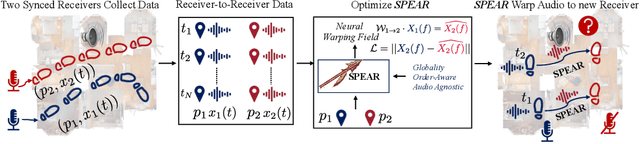

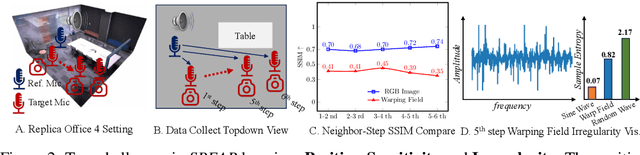
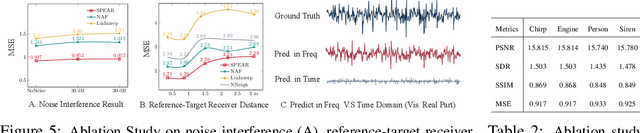
We present SPEAR, a continuous receiver-to-receiver acoustic neural warping field for spatial acoustic effects prediction in an acoustic 3D space with a single stationary audio source. Unlike traditional source-to-receiver modelling methods that require prior space acoustic properties knowledge to rigorously model audio propagation from source to receiver, we propose to predict by warping the spatial acoustic effects from one reference receiver position to another target receiver position, so that the warped audio essentially accommodates all spatial acoustic effects belonging to the target position. SPEAR can be trained in a data much more readily accessible manner, in which we simply ask two robots to independently record spatial audio at different positions. We further theoretically prove the universal existence of the warping field if and only if one audio source presents. Three physical principles are incorporated to guide SPEAR network design, leading to the learned warping field physically meaningful. We demonstrate SPEAR superiority on both synthetic, photo-realistic and real-world dataset, showing the huge potential of SPEAR to various down-stream robotic tasks.
Dusk Till Dawn: Self-supervised Nighttime Stereo Depth Estimation using Visual Foundation Models
May 18, 2024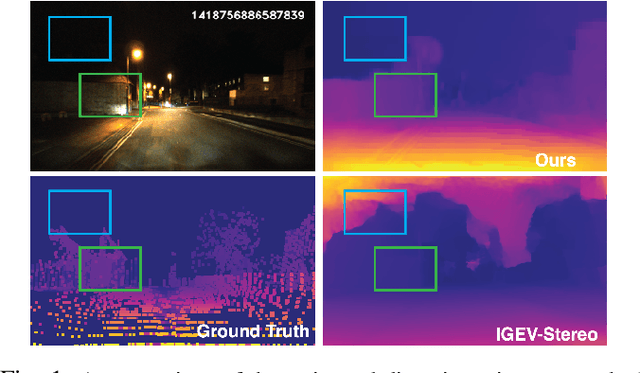
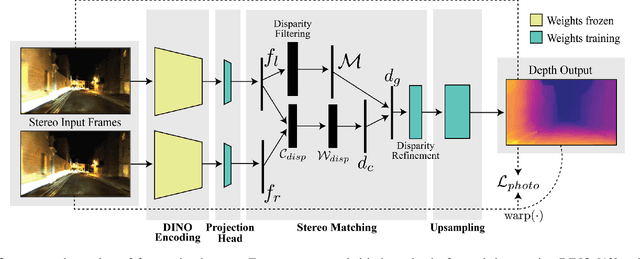
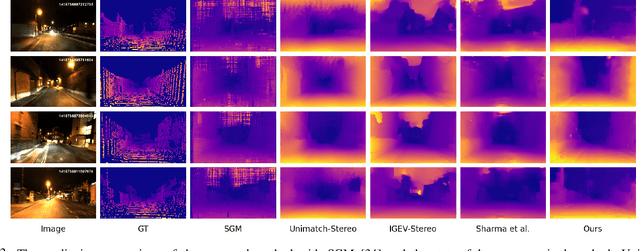
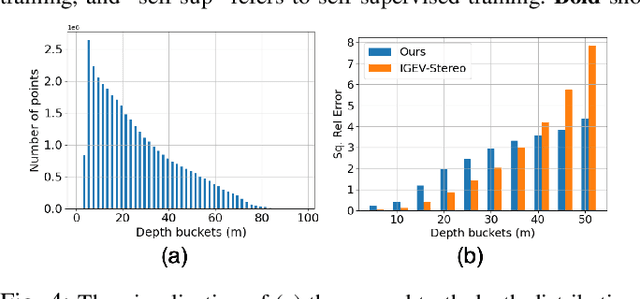
Self-supervised depth estimation algorithms rely heavily on frame-warping relationships, exhibiting substantial performance degradation when applied in challenging circumstances, such as low-visibility and nighttime scenarios with varying illumination conditions. Addressing this challenge, we introduce an algorithm designed to achieve accurate self-supervised stereo depth estimation focusing on nighttime conditions. Specifically, we use pretrained visual foundation models to extract generalised features across challenging scenes and present an efficient method for matching and integrating these features from stereo frames. Moreover, to prevent pixels violating photometric consistency assumption from negatively affecting the depth predictions, we propose a novel masking approach designed to filter out such pixels. Lastly, addressing weaknesses in the evaluation of current depth estimation algorithms, we present novel evaluation metrics. Our experiments, conducted on challenging datasets including Oxford RobotCar and Multi-Spectral Stereo, demonstrate the robust improvements realized by our approach. Code is available at: https://github.com/madhubabuv/dtd
Spherical Mask: Coarse-to-Fine 3D Point Cloud Instance Segmentation with Spherical Representation
Dec 18, 2023Coarse-to-fine 3D instance segmentation methods show weak performances compared to recent Grouping-based, Kernel-based and Transformer-based methods. We argue that this is due to two limitations: 1) Instance size overestimation by axis-aligned bounding box(AABB) 2) False negative error accumulation from inaccurate box to the refinement phase. In this work, we introduce Spherical Mask, a novel coarse-to-fine approach based on spherical representation, overcoming those two limitations with several benefits. Specifically, our coarse detection estimates each instance with a 3D polygon using a center and radial distance predictions, which avoids excessive size estimation of AABB. To cut the error propagation in the existing coarse-to-fine approaches, we virtually migrate points based on the polygon, allowing all foreground points, including false negatives, to be refined. During inference, the proposal and point migration modules run in parallel and are assembled to form binary masks of instances. We also introduce two margin-based losses for the point migration to enforce corrections for the false positives/negatives and cohesion of foreground points, significantly improving the performance. Experimental results from three datasets, such as ScanNetV2, S3DIS, and STPLS3D, show that our proposed method outperforms existing works, demonstrating the effectiveness of the new instance representation with spherical coordinates.
DynPoint: Dynamic Neural Point For View Synthesis
Oct 31, 2023


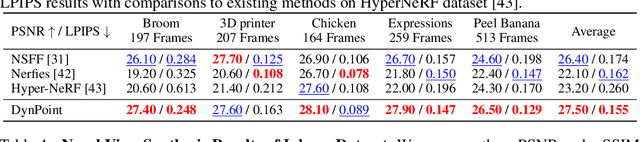
The introduction of neural radiance fields has greatly improved the effectiveness of view synthesis for monocular videos. However, existing algorithms face difficulties when dealing with uncontrolled or lengthy scenarios, and require extensive training time specific to each new scenario. To tackle these limitations, we propose DynPoint, an algorithm designed to facilitate the rapid synthesis of novel views for unconstrained monocular videos. Rather than encoding the entirety of the scenario information into a latent representation, DynPoint concentrates on predicting the explicit 3D correspondence between neighboring frames to realize information aggregation. Specifically, this correspondence prediction is achieved through the estimation of consistent depth and scene flow information across frames. Subsequently, the acquired correspondence is utilized to aggregate information from multiple reference frames to a target frame, by constructing hierarchical neural point clouds. The resulting framework enables swift and accurate view synthesis for desired views of target frames. The experimental results obtained demonstrate the considerable acceleration of training time achieved - typically an order of magnitude - by our proposed method while yielding comparable outcomes compared to prior approaches. Furthermore, our method exhibits strong robustness in handling long-duration videos without learning a canonical representation of video content.
Tighter Variational Bounds are Not Necessarily Better. A Research Report on Implementation, Ablation Study, and Extensions
Sep 23, 2022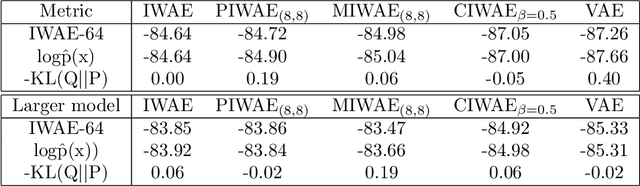
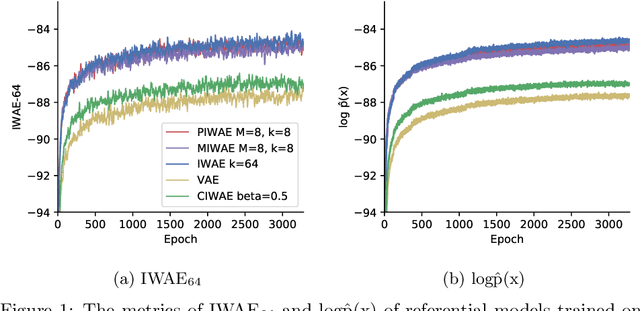
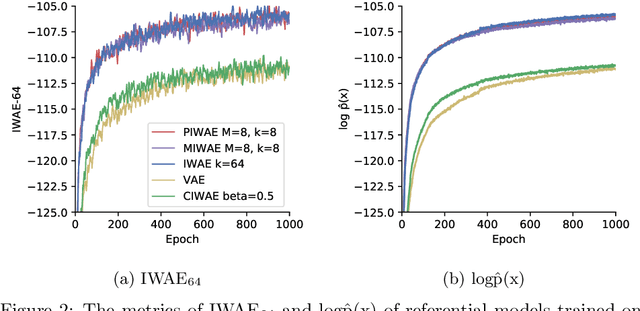

This report explains, implements and extends the works presented in "Tighter Variational Bounds are Not Necessarily Better" (T Rainforth et al., 2018). We provide theoretical and empirical evidence that increasing the number of importance samples $K$ in the importance weighted autoencoder (IWAE) (Burda et al., 2016) degrades the signal-to-noise ratio (SNR) of the gradient estimator in the inference network and thereby affecting the full learning process. In other words, even though increasing $K$ decreases the standard deviation of the gradients, it also reduces the magnitude of the true gradient faster, thereby increasing the relative variance of the gradient updates. Extensive experiments are performed to understand the importance of $K$. These experiments suggest that tighter variational bounds are beneficial for the generative network, whereas looser bounds are preferable for the inference network. With these insights, three methods are implemented and studied: the partially importance weighted autoencoder (PIWAE), the multiply importance weighted autoencoder (MIWAE) and the combination importance weighted autoencoder (CIWAE). Each of these three methods entails IWAE as a special case but employs the importance weights in different ways to ensure a higher SNR of the gradient estimators. In our research study and analysis, the efficacy of these algorithms is tested on multiple datasets such as MNIST and Omniglot. Finally, we demonstrate that the three presented IWAE variations are able to generate approximate posterior distributions that are much closer to the true posterior distribution than for the IWAE, while matching the performance of the IWAE generative network or potentially outperforming it in the case of PIWAE.
Sample, Crop, Track: Self-Supervised Mobile 3D Object Detection for Urban Driving LiDAR
Sep 21, 2022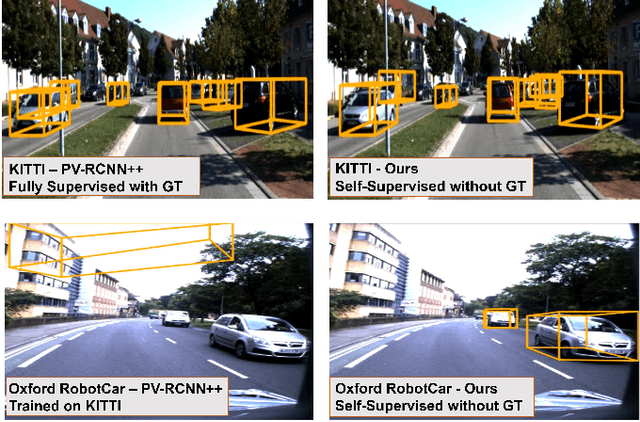
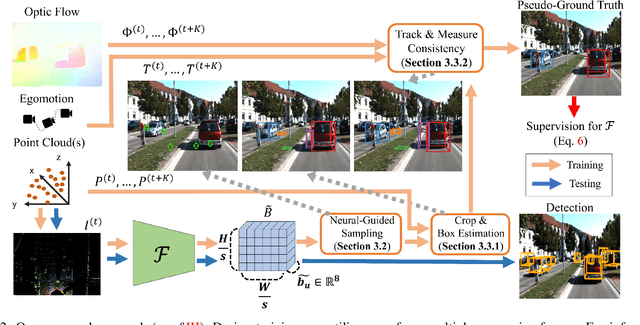
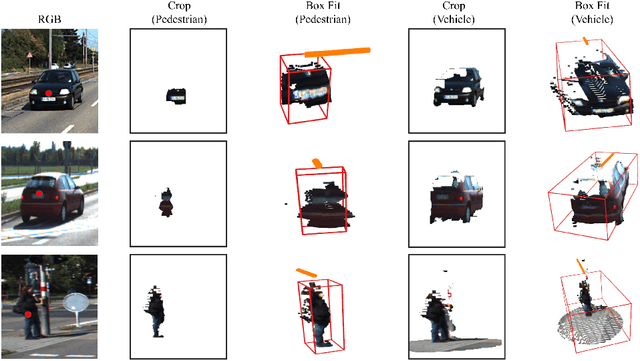
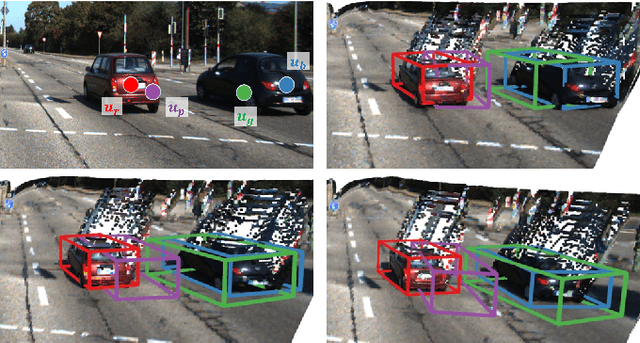
Deep learning has led to great progress in the detection of mobile (i.e. movement-capable) objects in urban driving scenes in recent years. Supervised approaches typically require the annotation of large training sets; there has thus been great interest in leveraging weakly, semi- or self-supervised methods to avoid this, with much success. Whilst weakly and semi-supervised methods require some annotation, self-supervised methods have used cues such as motion to relieve the need for annotation altogether. However, a complete absence of annotation typically degrades their performance, and ambiguities that arise during motion grouping can inhibit their ability to find accurate object boundaries. In this paper, we propose a new self-supervised mobile object detection approach called SCT. This uses both motion cues and expected object sizes to improve detection performance, and predicts a dense grid of 3D oriented bounding boxes to improve object discovery. We significantly outperform the state-of-the-art self-supervised mobile object detection method TCR on the KITTI tracking benchmark, and achieve performance that is within 30% of the fully supervised PV-RCNN++ method for IoUs <= 0.5.