 Add to Chrome
 Add to Firefox
 Add to Edge
Extending RNN-T-based speech recognition systems with emotion and language classification
Jul 28, 2022
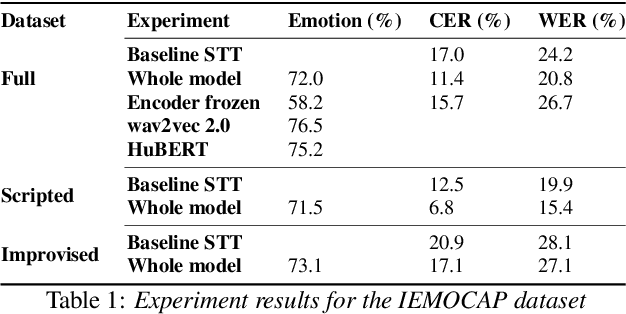
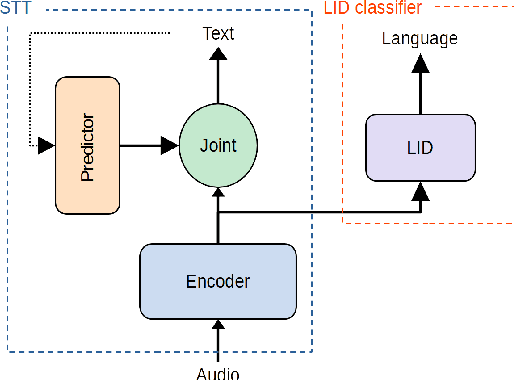
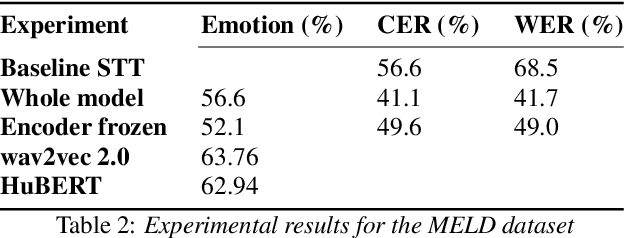
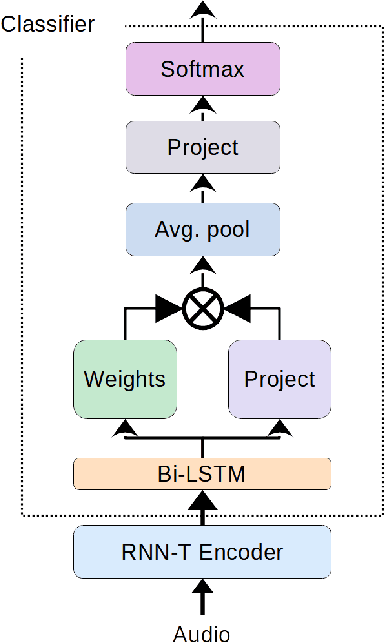
Speech transcription, emotion recognition, and language identification are usually considered to be three different tasks. Each one requires a different model with a different architecture and training process. We propose using a recurrent neural network transducer (RNN-T)-based speech-to-text (STT) system as a common component that can be used for emotion recognition and language identification as well as for speech recognition. Our work extends the STT system for emotion classification through minimal changes, and shows successful results on the IEMOCAP and MELD datasets. In addition, we demonstrate that by adding a lightweight component to the RNN-T module, it can also be used for language identification. In our evaluations, this new classifier demonstrates state-of-the-art accuracy for the NIST-LRE-07 dataset.

Tokenwise Contrastive Pretraining for Finer Speech-to-BERT Alignment in End-to-End Speech-to-Intent Systems
Apr 11, 2022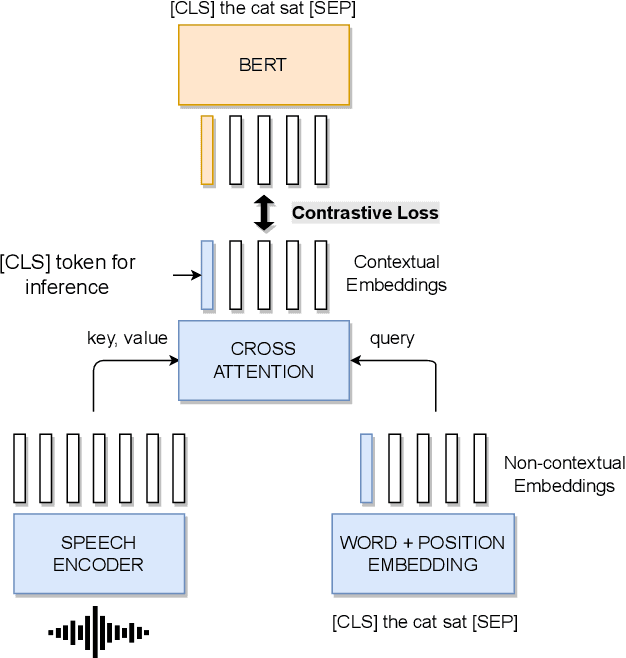
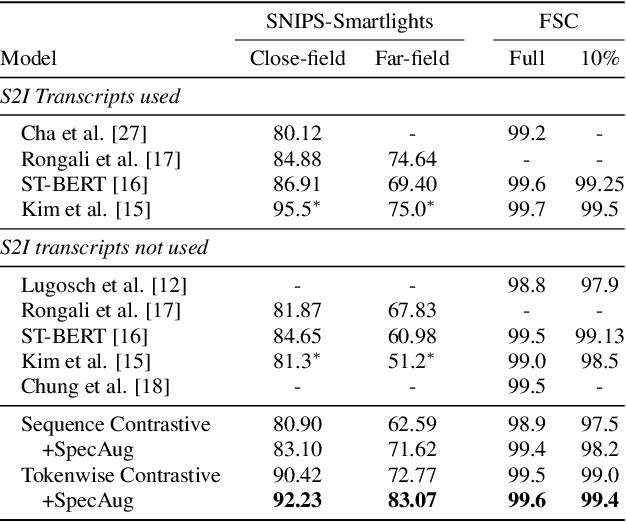
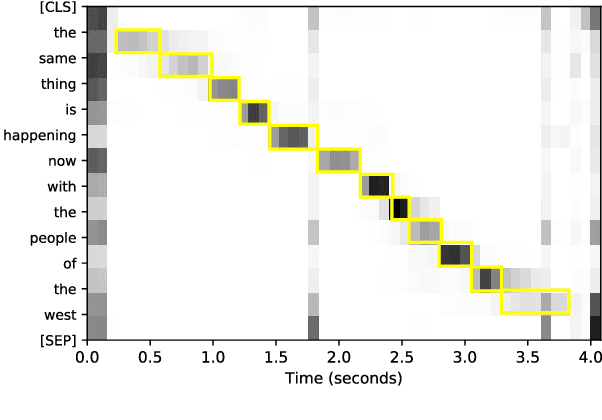
Recent advances in End-to-End (E2E) Spoken Language Understanding (SLU) have been primarily due to effective pretraining of speech representations. One such pretraining paradigm is the distillation of semantic knowledge from state-of-the-art text-based models like BERT to speech encoder neural networks. This work is a step towards doing the same in a much more efficient and fine-grained manner where we align speech embeddings and BERT embeddings on a token-by-token basis. We introduce a simple yet novel technique that uses a cross-modal attention mechanism to extract token-level contextual embeddings from a speech encoder such that these can be directly compared and aligned with BERT based contextual embeddings. This alignment is performed using a novel tokenwise contrastive loss. Fine-tuning such a pretrained model to perform intent recognition using speech directly yields state-of-the-art performance on two widely used SLU datasets. Our model improves further when fine-tuned with additional regularization using SpecAugment especially when speech is noisy, giving an absolute improvement as high as 8% over previous results.
Towards End-to-End Integration of Dialog History for Improved Spoken Language Understanding
Apr 11, 2022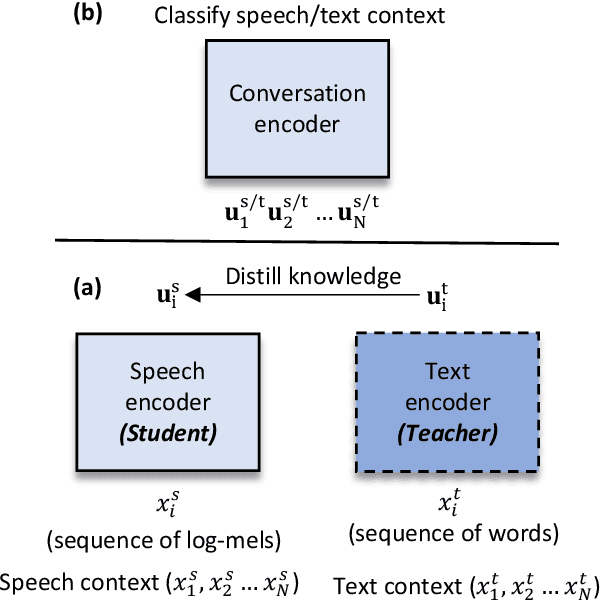
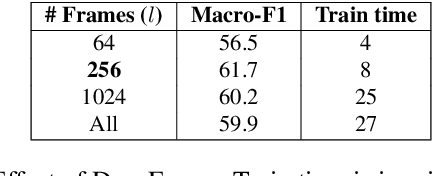
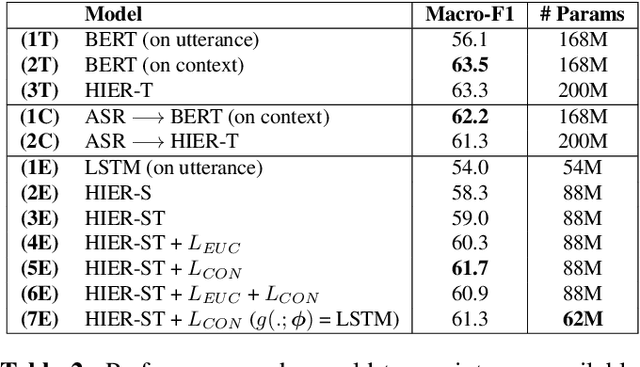
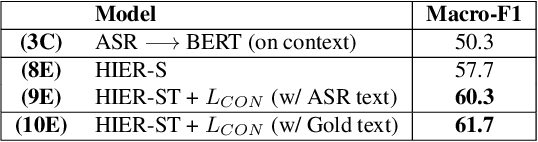
Dialog history plays an important role in spoken language understanding (SLU) performance in a dialog system. For end-to-end (E2E) SLU, previous work has used dialog history in text form, which makes the model dependent on a cascaded automatic speech recognizer (ASR). This rescinds the benefits of an E2E system which is intended to be compact and robust to ASR errors. In this paper, we propose a hierarchical conversation model that is capable of directly using dialog history in speech form, making it fully E2E. We also distill semantic knowledge from the available gold conversation transcripts by jointly training a similar text-based conversation model with an explicit tying of acoustic and semantic embeddings. We also propose a novel technique that we call DropFrame to deal with the long training time incurred by adding dialog history in an E2E manner. On the HarperValleyBank dialog dataset, our E2E history integration outperforms a history independent baseline by 7.7% absolute F1 score on the task of dialog action recognition. Our model performs competitively with the state-of-the-art history based cascaded baseline, but uses 48% fewer parameters. In the absence of gold transcripts to fine-tune an ASR model, our model outperforms this baseline by a significant margin of 10% absolute F1 score.
Towards Reducing the Need for Speech Training Data To Build Spoken Language Understanding Systems
Feb 26, 2022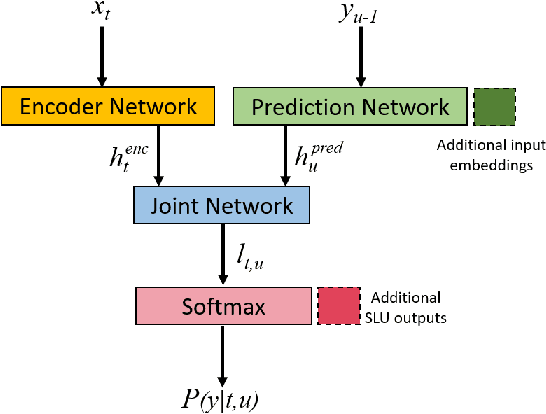
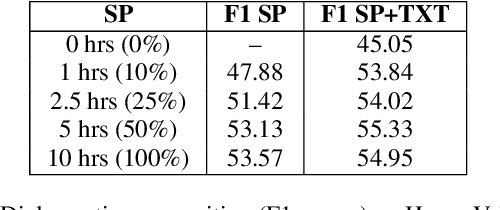
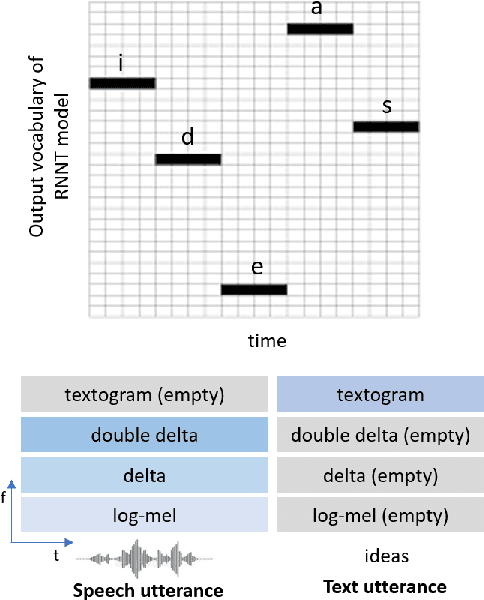
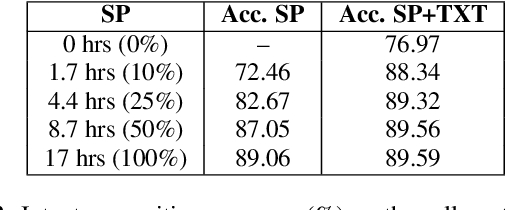
The lack of speech data annotated with labels required for spoken language understanding (SLU) is often a major hurdle in building end-to-end (E2E) systems that can directly process speech inputs. In contrast, large amounts of text data with suitable labels are usually available. In this paper, we propose a novel text representation and training methodology that allows E2E SLU systems to be effectively constructed using these text resources. With very limited amounts of additional speech, we show that these models can be further improved to perform at levels close to similar systems built on the full speech datasets. The efficacy of our proposed approach is demonstrated on both intent and entity tasks using three different SLU datasets. With text-only training, the proposed system achieves up to 90% of the performance possible with full speech training. With just an additional 10% of speech data, these models significantly improve further to 97% of full performance.
Integrating Text Inputs For Training and Adapting RNN Transducer ASR Models
Feb 26, 2022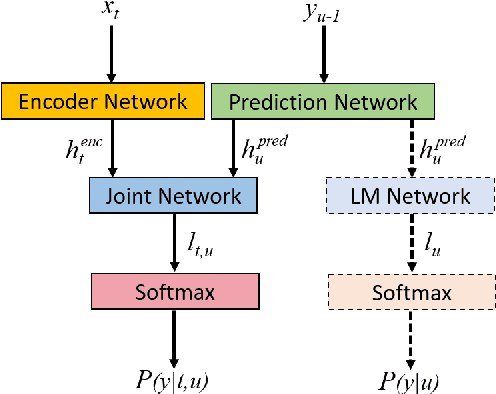
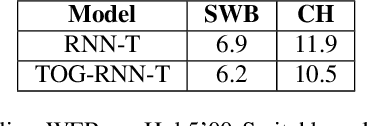
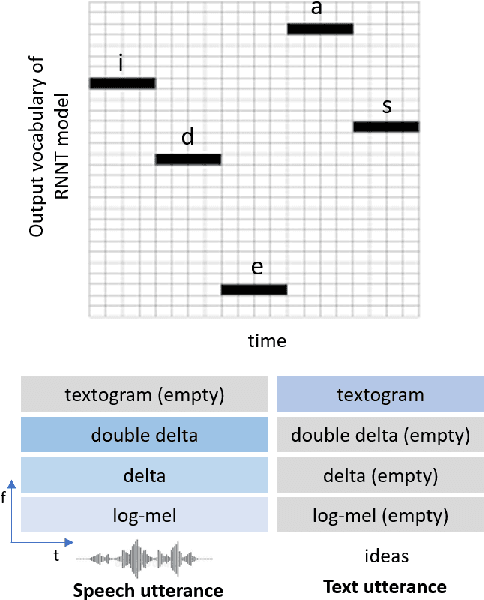
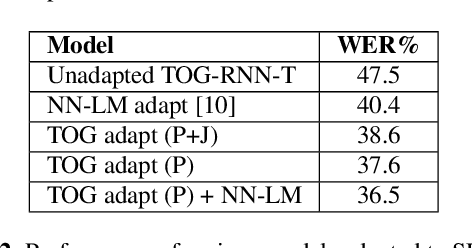
Compared to hybrid automatic speech recognition (ASR) systems that use a modular architecture in which each component can be independently adapted to a new domain, recent end-to-end (E2E) ASR system are harder to customize due to their all-neural monolithic construction. In this paper, we propose a novel text representation and training framework for E2E ASR models. With this approach, we show that a trained RNN Transducer (RNN-T) model's internal LM component can be effectively adapted with text-only data. An RNN-T model trained using both speech and text inputs improves over a baseline model trained on just speech with close to 13% word error rate (WER) reduction on the Switchboard and CallHome test sets of the NIST Hub5 2000 evaluation. The usefulness of the proposed approach is further demonstrated by customizing this general purpose RNN-T model to three separate datasets. We observe 20-45% relative word error rate (WER) reduction in these settings with this novel LM style customization technique using only unpaired text data from the new domains.
A new data augmentation method for intent classification enhancement and its application on spoken conversation datasets
Feb 21, 2022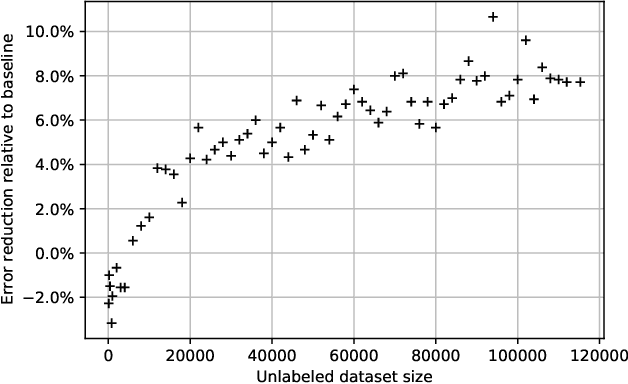
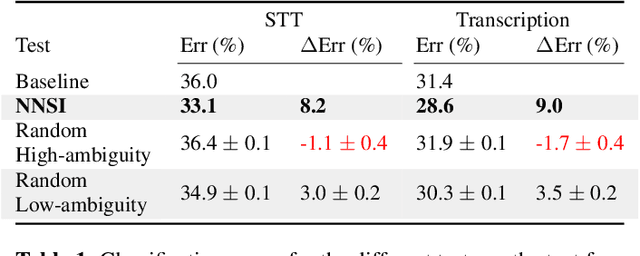
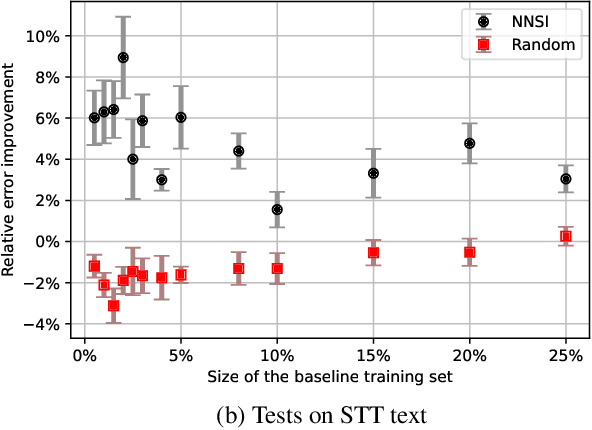
Intent classifiers are vital to the successful operation of virtual agent systems. This is especially so in voice activated systems where the data can be noisy with many ambiguous directions for user intents. Before operation begins, these classifiers are generally lacking in real-world training data. Active learning is a common approach used to help label large amounts of collected user input. However, this approach requires many hours of manual labeling work. We present the Nearest Neighbors Scores Improvement (NNSI) algorithm for automatic data selection and labeling. The NNSI reduces the need for manual labeling by automatically selecting highly-ambiguous samples and labeling them with high accuracy. This is done by integrating the classifier's output from a semantically similar group of text samples. The labeled samples can then be added to the training set to improve the accuracy of the classifier. We demonstrated the use of NNSI on two large-scale, real-life voice conversation systems. Evaluation of our results showed that our method was able to select and label useful samples with high accuracy. Adding these new samples to the training data significantly improved the classifiers and reduced error rates by up to 10%.
Improving End-to-End Models for Set Prediction in Spoken Language Understanding
Jan 28, 2022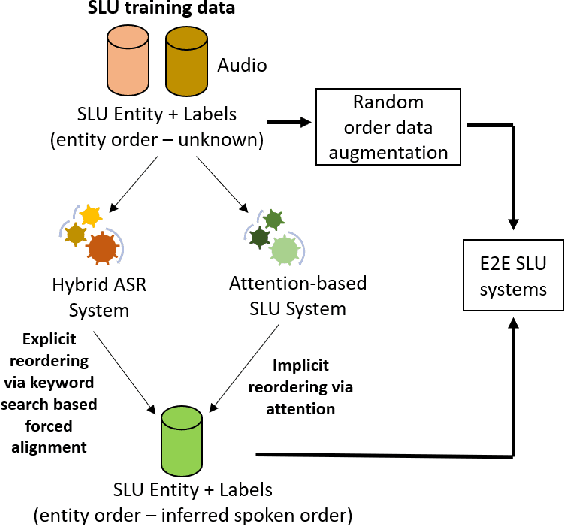
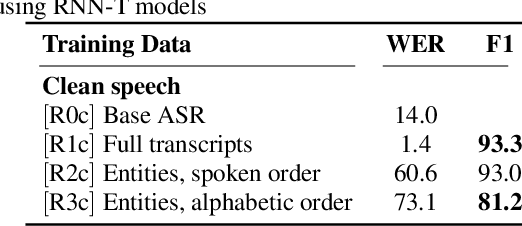
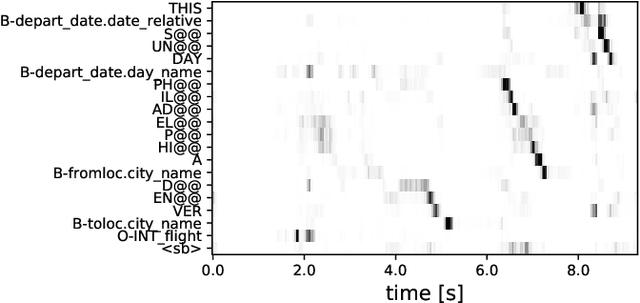
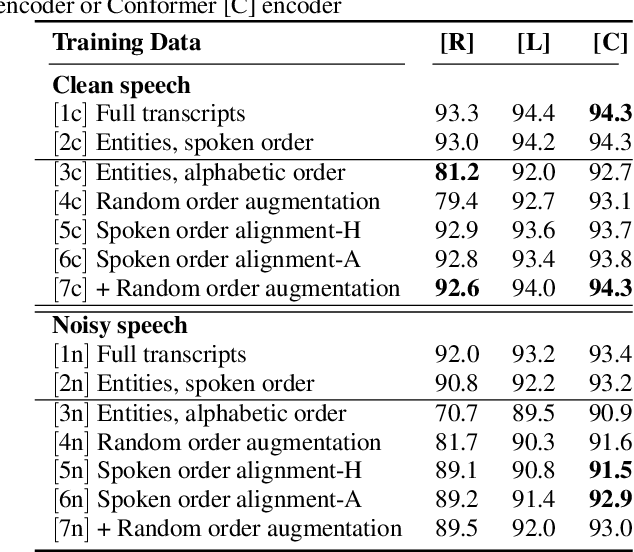
The goal of spoken language understanding (SLU) systems is to determine the meaning of the input speech signal, unlike speech recognition which aims to produce verbatim transcripts. Advances in end-to-end (E2E) speech modeling have made it possible to train solely on semantic entities, which are far cheaper to collect than verbatim transcripts. We focus on this set prediction problem, where entity order is unspecified. Using two classes of E2E models, RNN transducers and attention based encoder-decoders, we show that these models work best when the training entity sequence is arranged in spoken order. To improve E2E SLU models when entity spoken order is unknown, we propose a novel data augmentation technique along with an implicit attention based alignment method to infer the spoken order. F1 scores significantly increased by more than 11% for RNN-T and about 2% for attention based encoder-decoder SLU models, outperforming previously reported results.
Everything at Once -- Multi-modal Fusion Transformer for Video Retrieval
Dec 08, 2021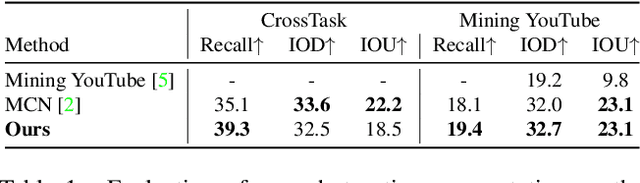
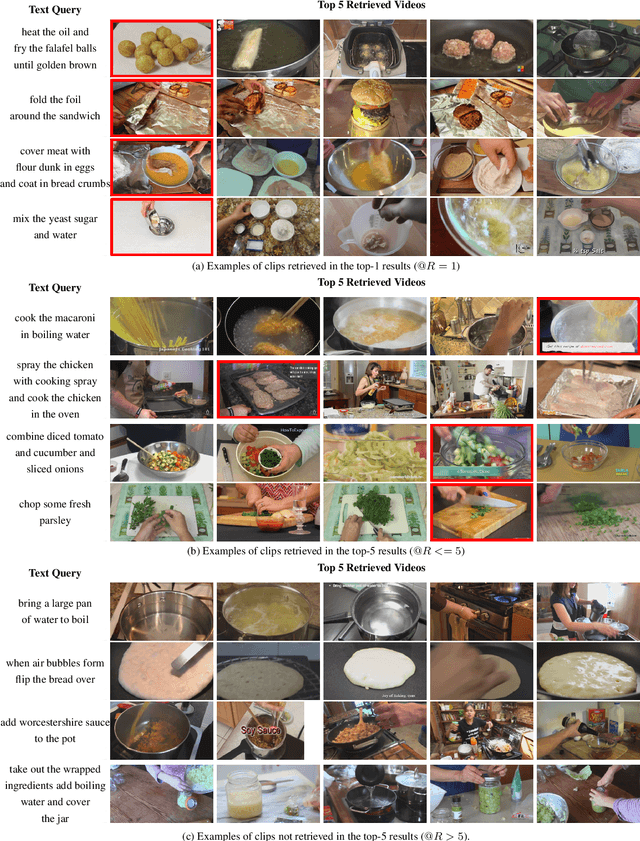
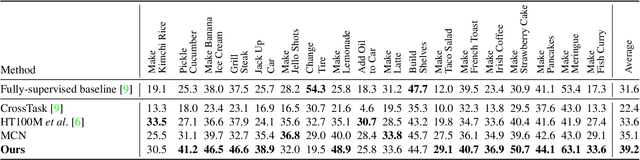
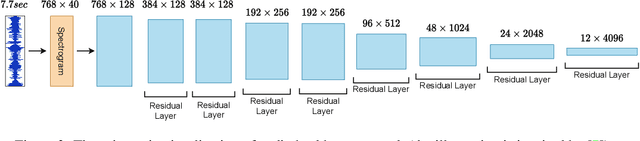
Multi-modal learning from video data has seen increased attention recently as it allows to train semantically meaningful embeddings without human annotation enabling tasks like zero-shot retrieval and classification. In this work, we present a multi-modal, modality agnostic fusion transformer approach that learns to exchange information between multiple modalities, such as video, audio, and text, and integrate them into a joined multi-modal representation to obtain an embedding that aggregates multi-modal temporal information. We propose to train the system with a combinatorial loss on everything at once, single modalities as well as pairs of modalities, explicitly leaving out any add-ons such as position or modality encoding. At test time, the resulting model can process and fuse any number of input modalities. Moreover, the implicit properties of the transformer allow to process inputs of different lengths. To evaluate the proposed approach, we train the model on the large scale HowTo100M dataset and evaluate the resulting embedding space on four challenging benchmark datasets obtaining state-of-the-art results in zero-shot video retrieval and zero-shot video action localization.
Routing with Self-Attention for Multimodal Capsule Networks
Dec 01, 2021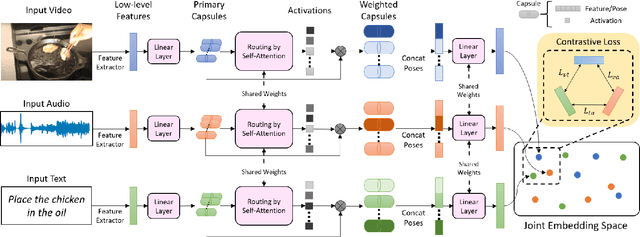
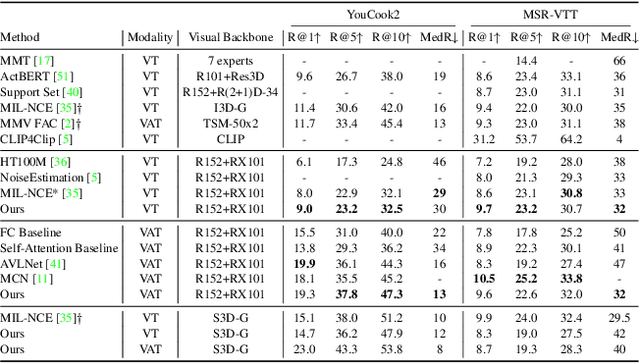
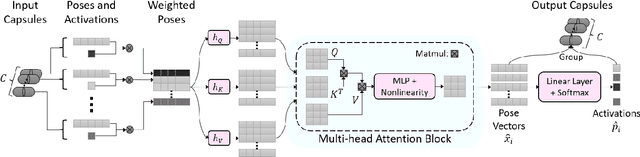
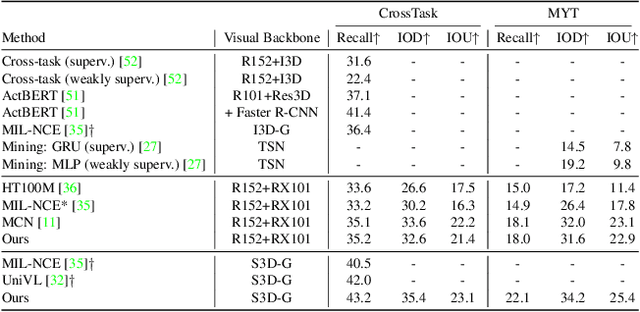
The task of multimodal learning has seen a growing interest recently as it allows for training neural architectures based on different modalities such as vision, text, and audio. One challenge in training such models is that they need to jointly learn semantic concepts and their relationships across different input representations. Capsule networks have been shown to perform well in context of capturing the relation between low-level input features and higher-level concepts. However, capsules have so far mainly been used only in small-scale fully supervised settings due to the resource demand of conventional routing algorithms. We present a new multimodal capsule network that allows us to leverage the strength of capsules in the context of a multimodal learning framework on large amounts of video data. To adapt the capsules to large-scale input data, we propose a novel routing by self-attention mechanism that selects relevant capsules which are then used to generate a final joint multimodal feature representation. This allows not only for robust training with noisy video data, but also to scale up the size of the capsule network compared to traditional routing methods while still being computationally efficient. We evaluate the proposed architecture by pretraining it on a large-scale multimodal video dataset and applying it on four datasets in two challenging downstream tasks. Results show that the proposed multimodal capsule network is not only able to improve results compared to other routing techniques, but also achieves competitive performance on the task of multimodal learning.
Cascaded Multilingual Audio-Visual Learning from Videos
Nov 08, 2021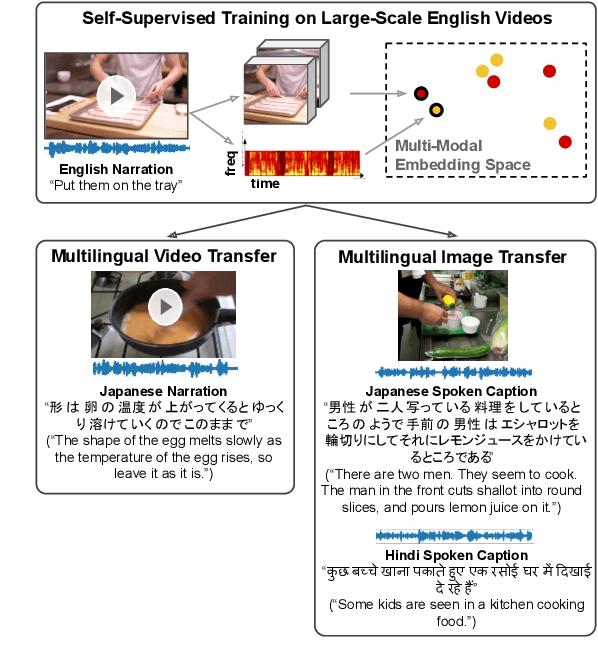
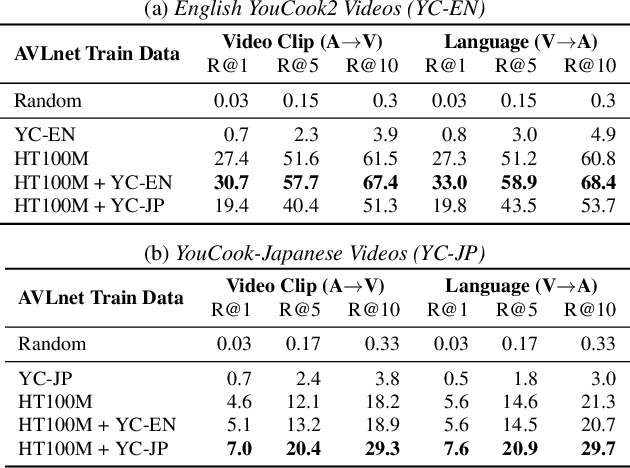
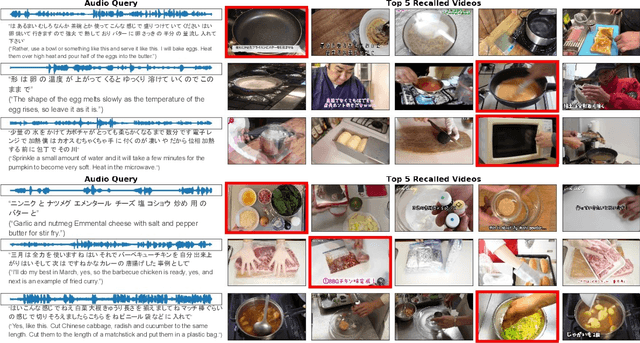
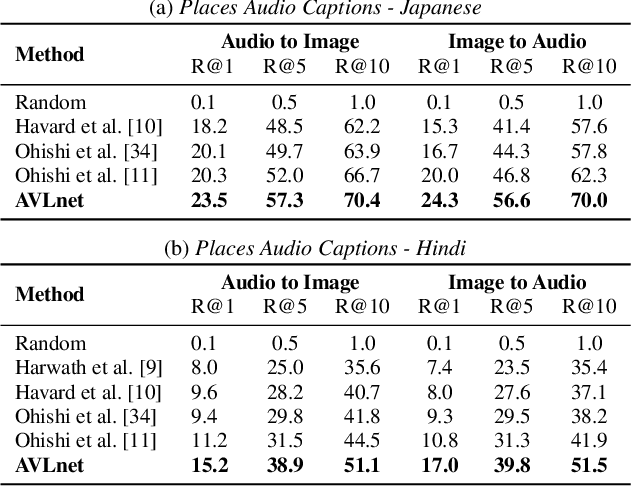
In this paper, we explore self-supervised audio-visual models that learn from instructional videos. Prior work has shown that these models can relate spoken words and sounds to visual content after training on a large-scale dataset of videos, but they were only trained and evaluated on videos in English. To learn multilingual audio-visual representations, we propose a cascaded approach that leverages a model trained on English videos and applies it to audio-visual data in other languages, such as Japanese videos. With our cascaded approach, we show an improvement in retrieval performance of nearly 10x compared to training on the Japanese videos solely. We also apply the model trained on English videos to Japanese and Hindi spoken captions of images, achieving state-of-the-art performance.