 Add to Chrome
 Add to Firefox
 Add to Edge
CLASP: Language-Driven Robot Skill Selection and Composition using Task-Parameterized Learning
Jun 06, 2026
Enabling robots to understand and execute tasks from natural language commands while maintaining data efficiency remains challenging. Foundation models such as vision-language-action (VLA) and vision-language models (VLMs) provide intuitive interaction channels but require extensive data; task-parameterized imitation learning achieves data efficiency but lacks natural language grounding. This work bridges this gap through a modular architecture combining task-parameterized kernelized movement primitives (TP-KMPs) with pretrained VLMs. During learning, skills are acquired from 2 to 5 kinesthetic demonstrations, and the VLM generates skill schemas describing each skill's parameters and preconditions. During execution, the VLM interprets commands to select skills, reason about parameter bindings, and create novel behaviors through covariance-weighted composition. When no skill or composition suffices, the system identifies capability gaps and requests targeted demonstrations, all without fine-tuning. Validation on a 7-DoF manipulator shows success rates of 73.3%-100% in scenarios requiring skill selection, composition, and active learning.

MOMO: A framework for seamless physical, verbal, and graphical robot skill learning and adaptation
Apr 22, 2026Industrial robot applications require increasingly flexible systems that non-expert users can easily adapt for varying tasks and environments. However, different adaptations benefit from different interaction modalities. We present an interactive framework that enables robot skill adaptation through three complementary modalities: kinesthetic touch for precise spatial corrections, natural language for high-level semantic modifications, and a graphical web interface for visualizing geometric relations and trajectories, inspecting and adjusting parameters, and editing via-points by drag-and-drop. The framework integrates five components: energy-based human-intention detection, a tool-based LLM architecture (where the LLM selects and parameterizes predefined functions rather than generating code) for safe natural language adaptation, Kernelized Movement Primitives (KMPs) for motion encoding, probabilistic Virtual Fixtures for guided demonstration recording, and ergodic control for surface finishing. We demonstrate that this tool-based LLM architecture generalizes skill adaptation from KMPs to ergodic control, enabling voice-commanded surface finishing. Validation on a 7-DoF torque-controlled robot at the Automatica 2025 trade fair demonstrates the practical applicability of our approach in industrial settings.
IROSA: Interactive Robot Skill Adaptation using Natural Language
Mar 04, 2026Foundation models have demonstrated impressive capabilities across diverse domains, while imitation learning provides principled methods for robot skill adaptation from limited data. Combining these approaches holds significant promise for direct application to robotics, yet this combination has received limited attention, particularly for industrial deployment. We present a novel framework that enables open-vocabulary skill adaptation through a tool-based architecture, maintaining a protective abstraction layer between the language model and robot hardware. Our approach leverages pre-trained LLMs to select and parameterize specific tools for adapting robot skills without requiring fine-tuning or direct model-to-robot interaction. We demonstrate the framework on a 7-DoF torque-controlled robot performing an industrial bearing ring insertion task, showing successful skill adaptation through natural language commands for speed adjustment, trajectory correction, and obstacle avoidance while maintaining safety, transparency, and interpretability.
Are Foundation Models the Route to Full-Stack Transfer in Robotics?
Feb 25, 2026In humans and robots alike, transfer learning occurs at different levels of abstraction, from high-level linguistic transfer to low-level transfer of motor skills. In this article, we provide an overview of the impact that foundation models and transformer networks have had on these different levels, bringing robots closer than ever to "full-stack transfer". Considering LLMs, VLMs and VLAs from a robotic transfer learning perspective allows us to highlight recurring concepts for transfer, beyond specific implementations. We also consider the challenges of data collection and transfer benchmarks for robotics in the age of foundation models. Are foundation models the route to full-stack transfer in robotics? Our expectation is that they will certainly stay on this route as a key technology.
Model Reconciliation through Explainability and Collaborative Recovery in Assistive Robotics
Jan 10, 2026Whenever humans and robots work together, it is essential that unexpected robot behavior can be explained to the user. Especially in applications such as shared control the user and the robot must share the same model of the objects in the world, and the actions that can be performed on these objects. In this paper, we achieve this with a so-called model reconciliation framework. We leverage a Large Language Model to predict and explain the difference between the robot's and the human's mental models, without the need of a formal mental model of the user. Furthermore, our framework aims to solve the model divergence after the explanation by allowing the human to correct the robot. We provide an implementation in an assistive robotics domain, where we conduct a set of experiments with a real wheelchair-based mobile manipulator and its digital twin.
Open X-Embodiment: Robotic Learning Datasets and RT-X Models
Oct 17, 2023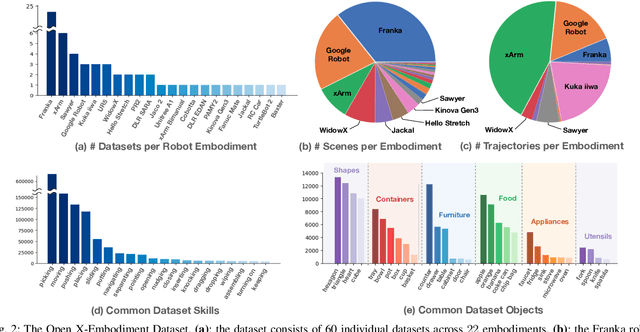
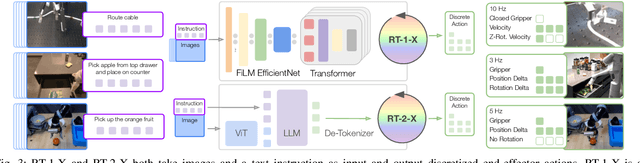


Large, high-capacity models trained on diverse datasets have shown remarkable successes on efficiently tackling downstream applications. In domains from NLP to Computer Vision, this has led to a consolidation of pretrained models, with general pretrained backbones serving as a starting point for many applications. Can such a consolidation happen in robotics? Conventionally, robotic learning methods train a separate model for every application, every robot, and even every environment. Can we instead train generalist X-robot policy that can be adapted efficiently to new robots, tasks, and environments? In this paper, we provide datasets in standardized data formats and models to make it possible to explore this possibility in the context of robotic manipulation, alongside experimental results that provide an example of effective X-robot policies. We assemble a dataset from 22 different robots collected through a collaboration between 21 institutions, demonstrating 527 skills (160266 tasks). We show that a high-capacity model trained on this data, which we call RT-X, exhibits positive transfer and improves the capabilities of multiple robots by leveraging experience from other platforms. More details can be found on the project website $\href{https://robotics-transformer-x.github.io}{\text{robotics-transformer-x.github.io}}$.