 Add to Chrome
 Add to Firefox
 Add to Edge
MOMO: A framework for seamless physical, verbal, and graphical robot skill learning and adaptation
Apr 22, 2026
Industrial robot applications require increasingly flexible systems that non-expert users can easily adapt for varying tasks and environments. However, different adaptations benefit from different interaction modalities. We present an interactive framework that enables robot skill adaptation through three complementary modalities: kinesthetic touch for precise spatial corrections, natural language for high-level semantic modifications, and a graphical web interface for visualizing geometric relations and trajectories, inspecting and adjusting parameters, and editing via-points by drag-and-drop. The framework integrates five components: energy-based human-intention detection, a tool-based LLM architecture (where the LLM selects and parameterizes predefined functions rather than generating code) for safe natural language adaptation, Kernelized Movement Primitives (KMPs) for motion encoding, probabilistic Virtual Fixtures for guided demonstration recording, and ergodic control for surface finishing. We demonstrate that this tool-based LLM architecture generalizes skill adaptation from KMPs to ergodic control, enabling voice-commanded surface finishing. Validation on a 7-DoF torque-controlled robot at the Automatica 2025 trade fair demonstrates the practical applicability of our approach in industrial settings.

Passive Variable Impedance For Shared Control
Apr 22, 2026Shared Control methods often use impedance control to track target poses in a robotic manipulator. The guidance behavior of such controllers is shaped by the used stiffness gains, which can be varying over time to achieve an adaptive guiding. When multiple target poses are tracked at the same time with varying importance, the corresponding output wrenches have to be arbitrated with weightings changing over time. In this work, we study the stabilization of both variable stiffness in impedance control as well as the arbitration of different controllers through a scaled addition of their output wrenches, reformulating both into a holistic framework. We identify passivity violations in the closed loop system and provide methods to passivate the system. The resulting approach can be used to stabilize standard impedance controllers, allowing for the development of novel and flexible shared control methods. We do not constrain the design of stiffness matrices or arbitration factors; both can be matrix-valued including off-diagonal elements and change arbitrarily over time. The proposed methods are furthermore validated in simulation as well as in real robot experiments on different systems, proving their effectiveness and showcasing different behaviors which can be utilized depending on the requirements of the shared control approach.
Locomotion of an Elastic Snake Robot via Natural Dynamics
Apr 20, 2026Nature suggests that exploiting the elasticities and natural dynamics of robotic systems could increase their locomotion efficiency. Prior work on elastic snake robots supports this hypothesis, but has not fully exploited the nonlinear dynamic behavior of the systems. Recent advances in eigenmanifold theory enable a better characterization of the natural dynamics in complex nonlinear systems. This letter investigates if and how the nonlinear natural dynamics of a kinematic elastic snake robot can be used to design efficient gaits. Two types of gaits based on natural dynamics are presented and compared to a state-of-the-art approach using dynamics simulations. The results reveal that a gait generated by switching between two nonlinear normal modes does not improve the locomotion efficiency of the robot. In contrast, gaits based on non-brake periodic trajectories (non-brake orbits) are perfectly efficient in the energy-conservative case. Further simulations with friction reveal that, in a more realistic scenario, non-brake orbit gaits achieve higher efficiency compared to the baseline gait on the rigid system. Overall, the investigation offers promising insights into the design of gaits based on natural dynamics, fostering further research.
IROSA: Interactive Robot Skill Adaptation using Natural Language
Mar 04, 2026Foundation models have demonstrated impressive capabilities across diverse domains, while imitation learning provides principled methods for robot skill adaptation from limited data. Combining these approaches holds significant promise for direct application to robotics, yet this combination has received limited attention, particularly for industrial deployment. We present a novel framework that enables open-vocabulary skill adaptation through a tool-based architecture, maintaining a protective abstraction layer between the language model and robot hardware. Our approach leverages pre-trained LLMs to select and parameterize specific tools for adapting robot skills without requiring fine-tuning or direct model-to-robot interaction. We demonstrate the framework on a 7-DoF torque-controlled robot performing an industrial bearing ring insertion task, showing successful skill adaptation through natural language commands for speed adjustment, trajectory correction, and obstacle avoidance while maintaining safety, transparency, and interpretability.
Are Foundation Models the Route to Full-Stack Transfer in Robotics?
Feb 25, 2026In humans and robots alike, transfer learning occurs at different levels of abstraction, from high-level linguistic transfer to low-level transfer of motor skills. In this article, we provide an overview of the impact that foundation models and transformer networks have had on these different levels, bringing robots closer than ever to "full-stack transfer". Considering LLMs, VLMs and VLAs from a robotic transfer learning perspective allows us to highlight recurring concepts for transfer, beyond specific implementations. We also consider the challenges of data collection and transfer benchmarks for robotics in the age of foundation models. Are foundation models the route to full-stack transfer in robotics? Our expectation is that they will certainly stay on this route as a key technology.
Discovering Optimal Natural Gaits of Dissipative Systems via Virtual Energy Injection
Nov 19, 2025Legged robots offer several advantages when navigating unstructured environments, but they often fall short of the efficiency achieved by wheeled robots. One promising strategy to improve their energy economy is to leverage their natural (unactuated) dynamics using elastic elements. This work explores that concept by designing energy-optimal control inputs through a unified, multi-stage framework. It starts with a novel energy injection technique to identify passive motion patterns by harnessing the system's natural dynamics. This enables the discovery of passive solutions even in systems with energy dissipation caused by factors such as friction or plastic collisions. Building on these passive solutions, we then employ a continuation approach to derive energy-optimal control inputs for the fully actuated, dissipative robotic system. The method is tested on simulated models to demonstrate its applicability in both single- and multi-legged robotic systems. This analysis provides valuable insights into the design and operation of elastic legged robots, offering pathways to improve their efficiency and adaptability by exploiting the natural system dynamics.
A Unified Framework for Probabilistic Dynamic-, Trajectory- and Vision-based Virtual Fixtures
Jun 11, 2025Probabilistic Virtual Fixtures (VFs) enable the adaptive selection of the most suitable haptic feedback for each phase of a task, based on learned or perceived uncertainty. While keeping the human in the loop remains essential, for instance, to ensure high precision, partial automation of certain task phases is critical for productivity. We present a unified framework for probabilistic VFs that seamlessly switches between manual fixtures, semi-automated fixtures (with the human handling precise tasks), and full autonomy. We introduce a novel probabilistic Dynamical System-based VF for coarse guidance, enabling the robot to autonomously complete certain task phases while keeping the human operator in the loop. For tasks requiring precise guidance, we extend probabilistic position-based trajectory fixtures with automation allowing for seamless human interaction as well as geometry-awareness and optimal impedance gains. For manual tasks requiring very precise guidance, we also extend visual servoing fixtures with the same geometry-awareness and impedance behaviour. We validate our approach experimentally on different robots, showcasing multiple operation modes and the ease of programming fixtures.
When do Lyapunov Subcenter Manifolds become Eigenmanifolds?
May 19, 2025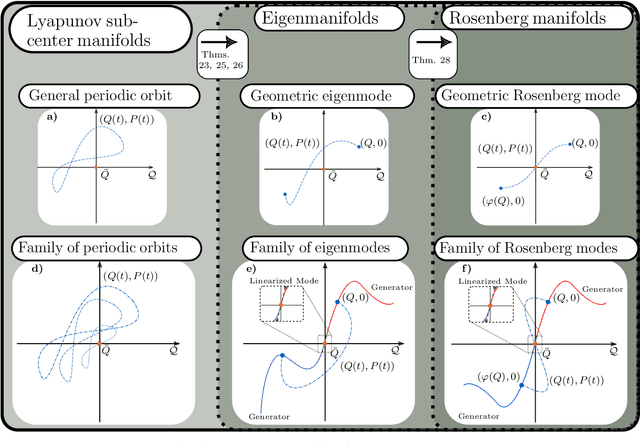
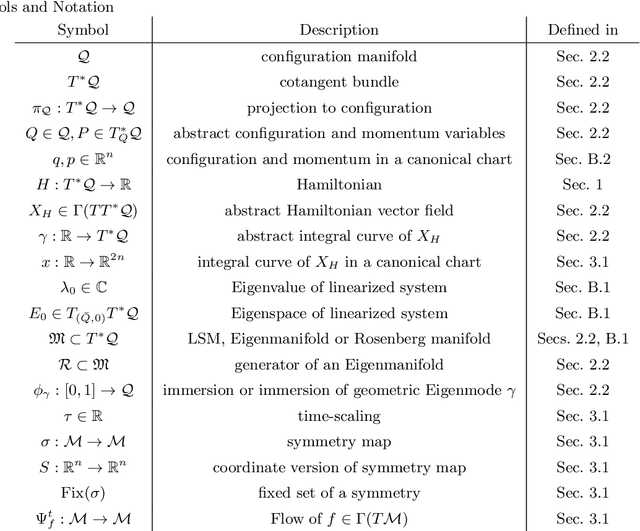
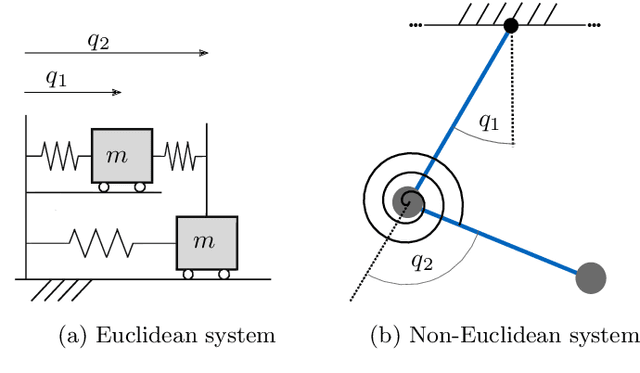
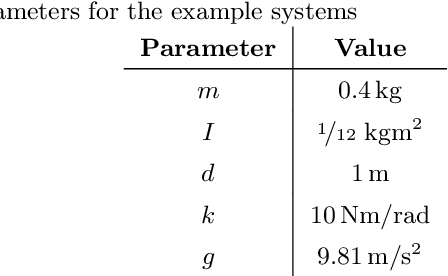
Multi-body mechanical systems have rich internal dynamics, which can be exploited to formulate efficient control targets. For periodic regulation tasks in robotics applications, this motivated the extension of the theory on nonlinear normal modes to Riemannian manifolds, and led to the definition of Eigenmanifolds. This definition is geometric, which is advantageous for generality within robotics but also obscures the connection of Eigenmanifolds to a large body of results from the literature on nonlinear dynamics. We bridge this gap, showing that Eigenmanifolds are instances of Lyapunov subcenter manifolds (LSMs), and that their stronger geometric properties with respect to LSMs follow from a time-symmetry of conservative mechanical systems. This directly leads to local existence and uniqueness results for Eigenmanifolds. Furthermore, we show that an additional spatial symmetry provides Eigenmanifolds with yet stronger properties of Rosenberg manifolds, which can be favorable for control applications, and we present a sufficient condition for their existence and uniqueness. These theoretical results are numerically confirmed on two mechanical systems with a non-constant inertia tensor: a double pendulum and a 5-link pendulum.
Software for the SpaceDREAM Robotic Arm
Sep 26, 2024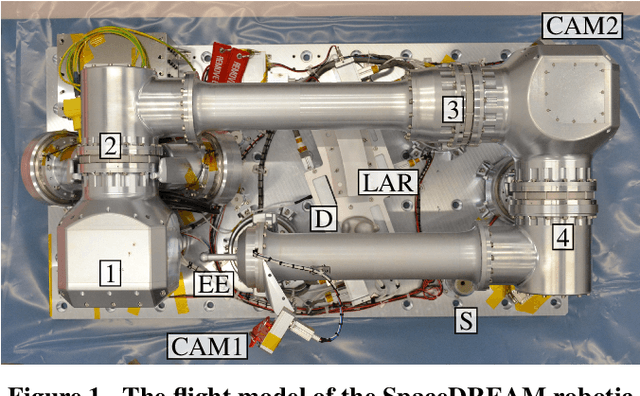
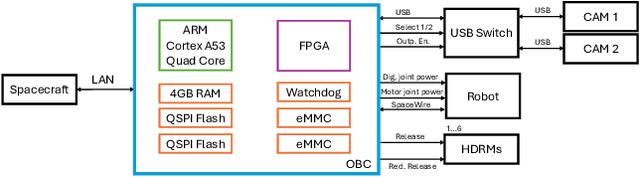
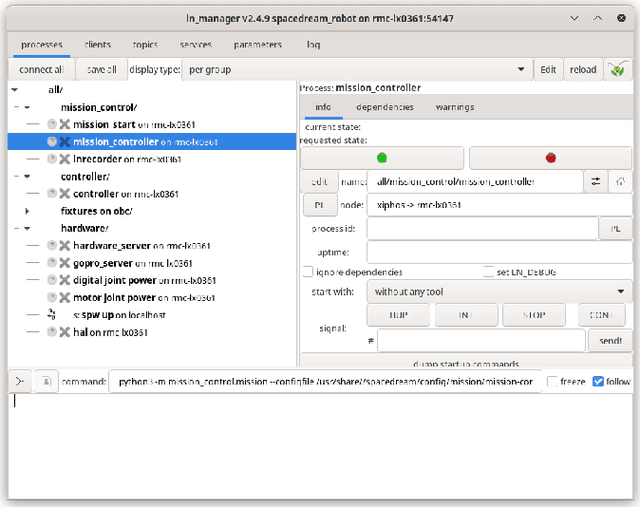
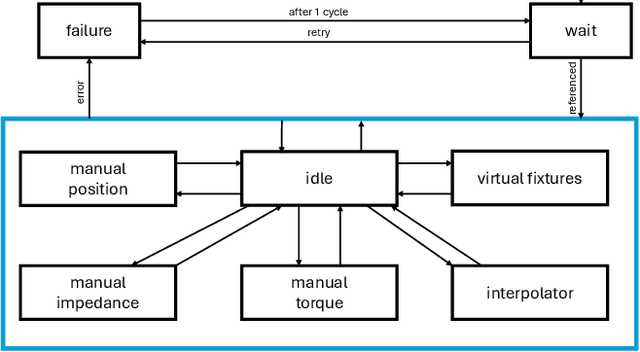
Impedance-controlled robots are widely used on Earth to perform interaction-rich tasks and will be a key enabler for In-Space Servicing, Assembly and Manufacturing (ISAM) activities. This paper introduces the software architecture used on the On-Board Computer (OBC) for the planned SpaceDREAM mission aiming to validate such robotic arm in Lower Earth Orbit (LEO) conducted by the German Aerospace Center (DLR) in cooperation with KINETIK Space GmbH and the Technical University of Munich (TUM). During the mission several free motion as well as contact tasks are to be performed in order to verify proper functionality of the robot in position and impedance control on joint level as well as in cartesian control. The tasks are selected to be representative for subsequent servicing missions e.g. requiring interface docking or precise manipulation. The software on the OBC commands the robot's joints via SpaceWire to perform those mission tasks, reads camera images and data from additional sensors and sends telemetry data through an Ethernet link via the spacecraft down to Earth. It is set up to execute a predefined mission after receiving a start signal from the spacecraft while it should be extendable to receive commands from Earth for later missions. Core design principle was to reuse as much existing software and to stay as close as possible to existing robot software stacks at DLR. This allowed for a quick full operational start of the robot arm compared to a custom development of all robot software, a lower entry barrier for software developers as well as a reuse of existing libraries. While not every line of code can be tested with this design, most of the software has already proven its functionality through daily execution on multiple robot systems.
Interactive incremental learning of generalizable skills with local trajectory modulation
Sep 09, 2024The problem of generalization in learning from demonstration (LfD) has received considerable attention over the years, particularly within the context of movement primitives, where a number of approaches have emerged. Recently, two important approaches have gained recognition. While one leverages via-points to adapt skills locally by modulating demonstrated trajectories, another relies on so-called task-parameterized models that encode movements with respect to different coordinate systems, using a product of probabilities for generalization. While the former are well-suited to precise, local modulations, the latter aim at generalizing over large regions of the workspace and often involve multiple objects. Addressing the quality of generalization by leveraging both approaches simultaneously has received little attention. In this work, we propose an interactive imitation learning framework that simultaneously leverages local and global modulations of trajectory distributions. Building on the kernelized movement primitives (KMP) framework, we introduce novel mechanisms for skill modulation from direct human corrective feedback. Our approach particularly exploits the concept of via-points to incrementally and interactively 1) improve the model accuracy locally, 2) add new objects to the task during execution and 3) extend the skill into regions where demonstrations were not provided. We evaluate our method on a bearing ring-loading task using a torque-controlled, 7-DoF, DLR SARA robot.