 Add to Chrome
 Add to Firefox
 Add to Edge
Echoverse: Deep, Evolving Environments for Training Computer-Use Agents at Scale
Jul 30, 2026
Computer-use agents learn from what their actions change, so training one needs applications it can act on, break and reset. The applications that matter most are login-gated and stateful, so synthetic environments stand in for them. Recent pipelines generate such environments in bulk, which moves the bottleneck from how many exist to what is inside each one. The returns, we find, come from three properties: how much behavioural depth an environment carries, whether it targets the interaction an agent actually fails, and whether it improves alongside the model. We present Echoverse, which compiles specifications into stateful applications whose tasks are graded against the application's own database, and a co-evolution loop that reads every graded rollout twice: as repairs to the environment, its tasks and its verifier, and as training signal for the model. Trained on twelve such environments, a 9B model improves from $36.5\%$ to $67.1\%$ across fourteen evaluation splits, within fourteen points of the much larger frontier model that taught it. We examine each property in turn. On the same domains, shallow environments push live-site accuracy below the base model ($80.0 \to 75.0$) while deep ones raise it ($80.0 \to 85.0$ and $48.0 \to 65.0$); drilling one interface control across many renderings transfers to held-out widget families and to the open web; and repairing a single environment lifts the model trained on it from $16.2\%$ to $38.5\%$. The same worlds serve as reinforcement-learning environments, where a reward combining the grounded verifier with a dense per-step judge raises held-out score from $58.8\%$ to $68.0\%$. We release four environments as a benchmark, with their applications, seed data and grounded graders. Code: https://aka.ms/echoverse

Fara-1.5: Scalable Learning Environments for Computer Use Agents
Jun 18, 2026Collecting computer use data from human demonstrations is expensive and slow, motivating the need for scalable generation strategies. This requires two key ingredients: environments in which agents can act and verifiers that can judge whether their demonstrations succeeded. We introduce FaraGen1.5, a scalable data pipeline for computer use agents composed of three modular components: environments, solvers, and verifiers. FaraGen1.5 uses both live websites and synthetic environments that faithfully simulate domains gated by authentication or that require irreversible actions. It employs a solver harness that can be powered by multiple models, including strong frontier models such as GPT-5.4, and also incorporates a user simulator to enable multi-turn rollouts. Finally, FaraGen1.5 scores the resulting trajectories with three complementary verifiers covering task correctness, efficiency, and critical-point adherence. Using data produced by this pipeline, we train Fara1.5, a family of native computer use agents (CUAs) at three scales built on Qwen3.5 (4B, 9B, and 27B). To train these models, we employ a supervised finetuning (SFT) recipe that carefully balances data from FaraGen1.5 for broad coverage, specific high-value tasks, and target model deficiencies in an iterative approach. Each model sets a new state of the art for its size class on browser-use benchmarks: Fara1.5-9B reaches 63.4% on Online-Mind2Web and 86.6% on WebVoyager, while Fara1.5-27B achieves 72.3% on Online-Mind2Web, which is competitive with much larger proprietary systems.
Knowing When to Abstain: Medical LLMs Under Clinical Uncertainty
Jan 18, 2026Current evaluation of large language models (LLMs) overwhelmingly prioritizes accuracy; however, in real-world and safety-critical applications, the ability to abstain when uncertain is equally vital for trustworthy deployment. We introduce MedAbstain, a unified benchmark and evaluation protocol for abstention in medical multiple-choice question answering (MCQA) -- a discrete-choice setting that generalizes to agentic action selection -- integrating conformal prediction, adversarial question perturbations, and explicit abstention options. Our systematic evaluation of both open- and closed-source LLMs reveals that even state-of-the-art, high-accuracy models often fail to abstain with uncertain. Notably, providing explicit abstention options consistently increases model uncertainty and safer abstention, far more than input perturbations, while scaling model size or advanced prompting brings little improvement. These findings highlight the central role of abstention mechanisms for trustworthy LLM deployment and offer practical guidance for improving safety in high-stakes applications.
Style is a Distribution of Features
Jul 25, 2020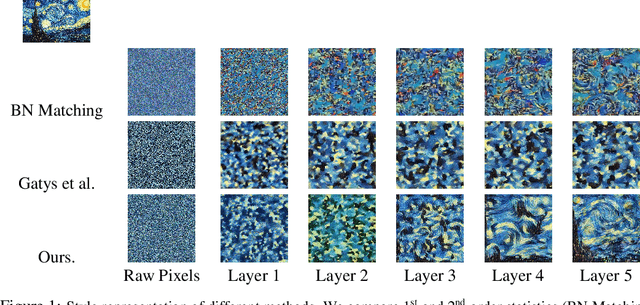
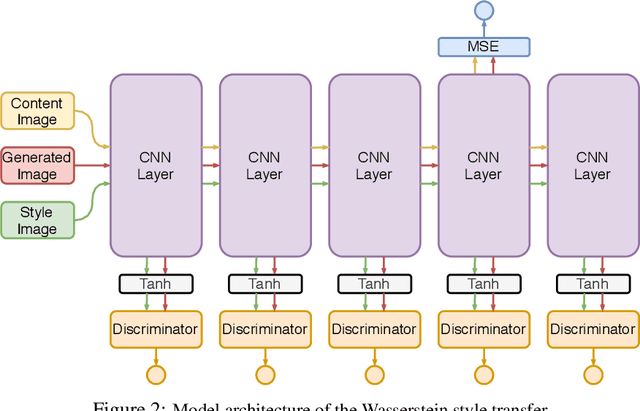
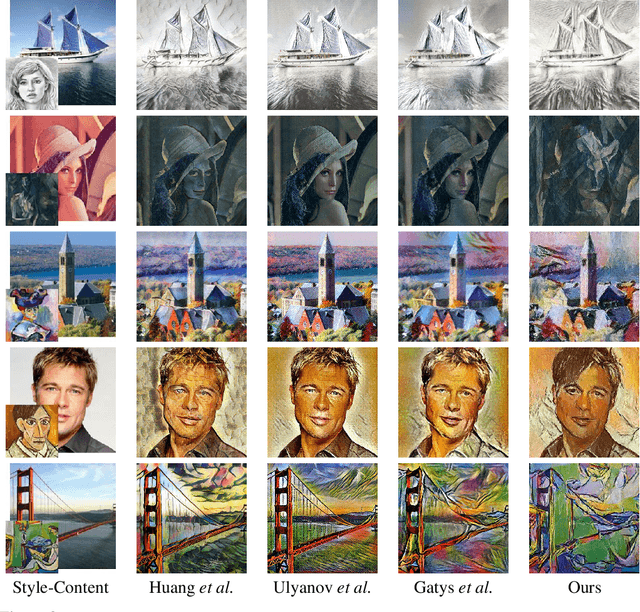
Neural style transfer (NST) is a powerful image generation technique that uses a convolutional neural network (CNN) to merge the content of one image with the style of another. Contemporary methods of NST use first or second order statistics of the CNN's features to achieve transfers with relatively little computational cost. However, these methods cannot fully extract the style from the CNN's features. We present a new algorithm for style transfer that fully extracts the style from the features by redefining the style loss as the Wasserstein distance between the distribution of features. Thus, we set a new standard in style transfer quality. In addition, we state two important interpretations of NST. The first is a re-emphasis from Li et al., which states that style is simply the distribution of features. The second states that NST is a type of generative adversarial network (GAN) problem.