 Add to Chrome
 Add to Firefox
 Add to Edge
NVAITC AI Scientist: A Governed End-to-End Research System -- A Hypertension GWAS Case Study
Jul 13, 2026
Agentic research systems are emerging as a new paradigm for coordinating scientific workflows beyond isolated model inference, code generation, or statistical analysis. However, deployment in institutional biomedical environments requires governed mechanisms for research planning, data access, workflow orchestration, evidence tracking, reproducibility, and human oversight. We present NVAITC AI Scientist (NAIS), a governed end-to-end agentic research system designed to support domain-general scientific workflows while keeping protected data within institutional privacy boundaries. NAIS integrates proposal review, execution planning, governed computational routing, reproducible workflow orchestration, evidence generation, and scientist-in-the-loop oversight. We validate NAIS in a real-world hypertension genome-wide association study (GWAS) using hospital-linked genotype and electronic health record (EHR) data from 286,422 individuals under an aggregate-only data policy. The agent planned cohort extraction, orchestrated GWAS execution, generated quality-control summaries, and drafted publication-oriented outputs. Human-AI review identified phenotype discrepancies and enabled iterative refinement of the hypertension definition. After reconciliation, the agent-orchestrated GWAS reproduced established hypertension loci, including FGF5, ATP2B1, CNNM2, FTO, and GRB14, with the strongest signal at FGF5 reaching $-\log_{10}(p) \sim 70$. As a secondary demonstration, NAIS also supported a drug-induced liver injury prediction workflow, achieving a multimodal graph neural network AUC of 0.842. These results demonstrate that governed agentic research systems can support scalable AI-assisted biomedical discovery while producing outputs comparable to expert-led workflows.

Graph Coarsening via Convolution Matching for Scalable Graph Neural Network Training
Dec 24, 2023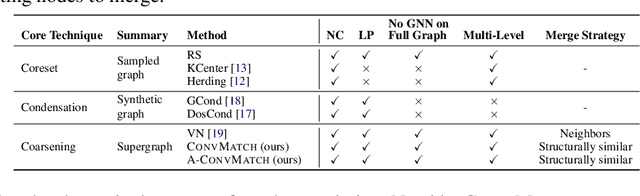
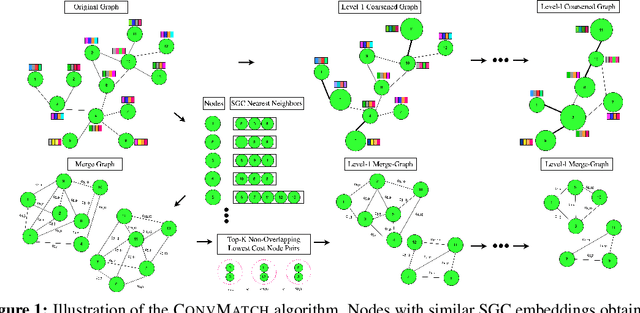
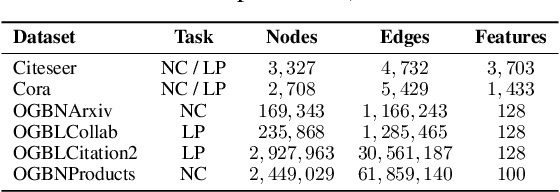
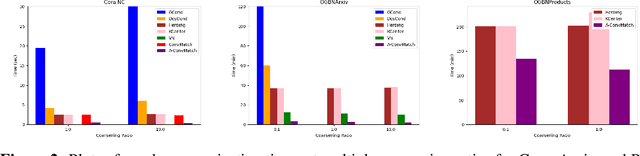
Graph summarization as a preprocessing step is an effective and complementary technique for scalable graph neural network (GNN) training. In this work, we propose the Coarsening Via Convolution Matching (CONVMATCH) algorithm and a highly scalable variant, A-CONVMATCH, for creating summarized graphs that preserve the output of graph convolution. We evaluate CONVMATCH on six real-world link prediction and node classification graph datasets, and show it is efficient and preserves prediction performance while significantly reducing the graph size. Notably, CONVMATCH achieves up to 95% of the prediction performance of GNNs on node classification while trained on graphs summarized down to 1% the size of the original graph. Furthermore, on link prediction tasks, CONVMATCH consistently outperforms all baselines, achieving up to a 2x improvement.
Deep Perceptual Image Quality Assessment for Compression
Mar 01, 2021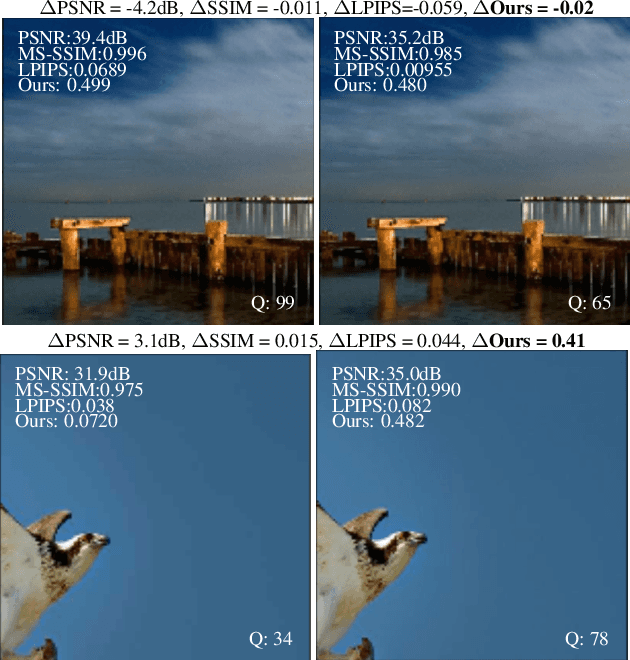

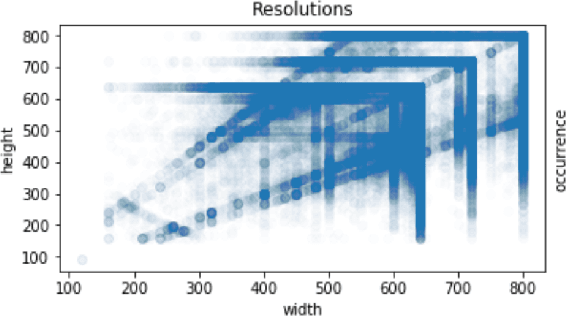
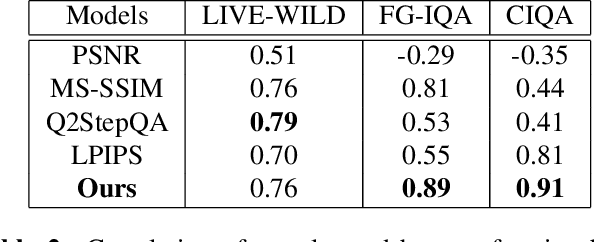
Lossy Image compression is necessary for efficient storage and transfer of data. Typically the trade-off between bit-rate and quality determines the optimal compression level. This makes the image quality metric an integral part of any imaging system. While the existing full-reference metrics such as PSNR and SSIM may be less sensitive to perceptual quality, the recently introduced learning methods may fail to generalize to unseen data. In this paper we propose the largest image compression quality dataset to date with human perceptual preferences, enabling the use of deep learning, and we develop a full reference perceptual quality assessment metric for lossy image compression that outperforms the existing state-of-the-art methods. We show that the proposed model can effectively learn from thousands of examples available in the new dataset, and consequently it generalizes better to other unseen datasets of human perceptual preference.
Style is a Distribution of Features
Jul 25, 2020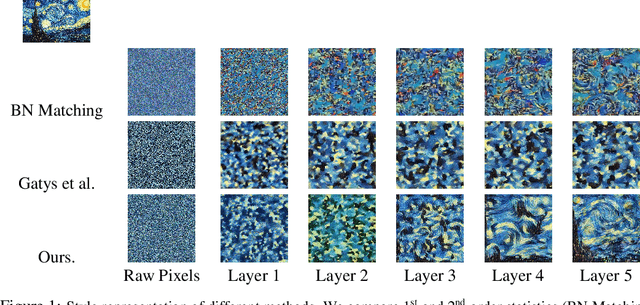
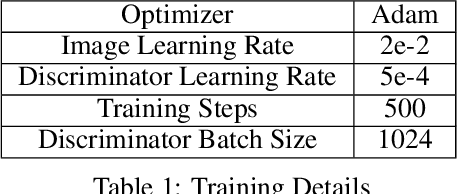
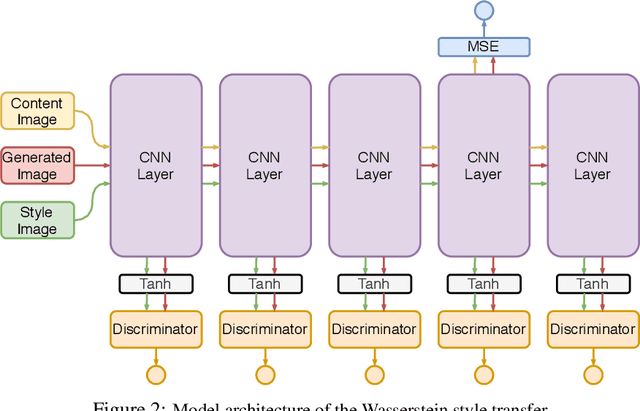
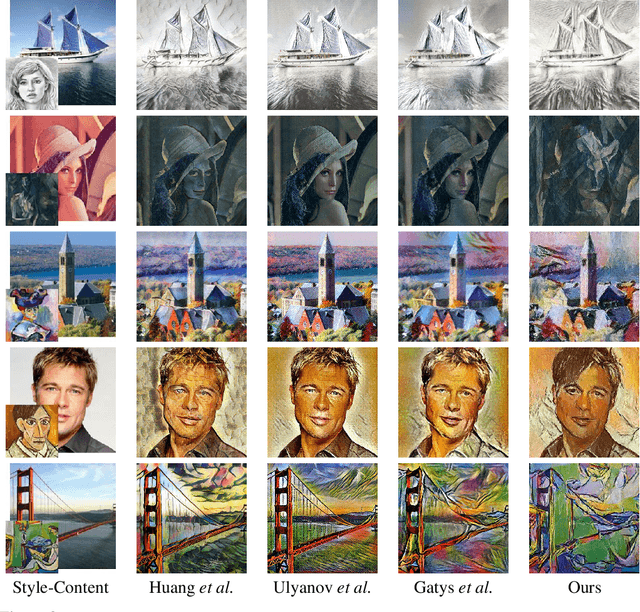
Neural style transfer (NST) is a powerful image generation technique that uses a convolutional neural network (CNN) to merge the content of one image with the style of another. Contemporary methods of NST use first or second order statistics of the CNN's features to achieve transfers with relatively little computational cost. However, these methods cannot fully extract the style from the CNN's features. We present a new algorithm for style transfer that fully extracts the style from the features by redefining the style loss as the Wasserstein distance between the distribution of features. Thus, we set a new standard in style transfer quality. In addition, we state two important interpretations of NST. The first is a re-emphasis from Li et al., which states that style is simply the distribution of features. The second states that NST is a type of generative adversarial network (GAN) problem.