 Add to Chrome
 Add to Firefox
 Add to Edge
Automated binary classification of hazelnut X-ray images: A deep-learning benchmark for quality assessment
Aug 12, 2026
Non-destructive X-ray imaging can reveal internal hazelnut defects that are difficult to detect by external inspection alone; however, automated interpretation remains challenging because of subtle radiographic differences among classes, marked class imbalance, and limited annotated data. Here, we present a benchmark for binary hazelnut quality classification (healthy versus defective) based on 799 segmented single-kernel X-ray images (224 x 224 pixels, grayscale), grouped into 101 acquisition units. Seven single-model configurations and ten probability-aggregation ensembles were evaluated using a group-wise split-rotation protocol across five data splits generated using different random seeds. Decision thresholds were selected on the validation set, and performance was assessed deterministically on validation and test sets. Under the expert-reassessed annotation condition, the average-probability ensemble of the binary cross-entropy-trained convolutional neural network and frozen Swin Transformer achieved the highest mean balanced accuracy (86.3% +/- 1.8%, five seeds), with several other ensembles providing comparable performance. Across methods, substantial split-to-split variability was observed, indicating that multi-split evaluation is essential for reliable model comparison at this dataset scale. Expert reassessment of ambiguous samples improved the performance of all 17 evaluated methods by 2.8-8.1 percentage points, while having only a limited effect on cross-split variance. The results highlight both the potential of deep learning for automated X-ray-based hazelnut quality assessment and the importance of rigorous evaluation and label curation in small, imbalanced agricultural imaging datasets.

Knowing When to Abstain: Medical LLMs Under Clinical Uncertainty
Jan 18, 2026Current evaluation of large language models (LLMs) overwhelmingly prioritizes accuracy; however, in real-world and safety-critical applications, the ability to abstain when uncertain is equally vital for trustworthy deployment. We introduce MedAbstain, a unified benchmark and evaluation protocol for abstention in medical multiple-choice question answering (MCQA) -- a discrete-choice setting that generalizes to agentic action selection -- integrating conformal prediction, adversarial question perturbations, and explicit abstention options. Our systematic evaluation of both open- and closed-source LLMs reveals that even state-of-the-art, high-accuracy models often fail to abstain with uncertain. Notably, providing explicit abstention options consistently increases model uncertainty and safer abstention, far more than input perturbations, while scaling model size or advanced prompting brings little improvement. These findings highlight the central role of abstention mechanisms for trustworthy LLM deployment and offer practical guidance for improving safety in high-stakes applications.
MedReadCtrl: Personalizing medical text generation with readability-controlled instruction learning
Jul 10, 2025Generative AI has demonstrated strong potential in healthcare, from clinical decision support to patient-facing chatbots that improve outcomes. A critical challenge for deployment is effective human-AI communication, where content must be both personalized and understandable. We introduce MedReadCtrl, a readability-controlled instruction tuning framework that enables LLMs to adjust output complexity without compromising meaning. Evaluations of nine datasets and three tasks across medical and general domains show that MedReadCtrl achieves significantly lower readability instruction-following errors than GPT-4 (e.g., 1.39 vs. 1.59 on ReadMe, p<0.001) and delivers substantial gains on unseen clinical tasks (e.g., +14.7 ROUGE-L, +6.18 SARI on MTSamples). Experts consistently preferred MedReadCtrl (71.7% vs. 23.3%), especially at low literacy levels. These gains reflect MedReadCtrl's ability to restructure clinical content into accessible, readability-aligned language while preserving medical intent, offering a scalable solution to support patient education and expand equitable access to AI-enabled care.
Enhancing LLMs for Identifying and Prioritizing Important Medical Jargons from Electronic Health Record Notes Utilizing Data Augmentation
Feb 25, 2025OpenNotes enables patients to access EHR notes, but medical jargon can hinder comprehension. To improve understanding, we evaluated closed- and open-source LLMs for extracting and prioritizing key medical terms using prompting, fine-tuning, and data augmentation. We assessed LLMs on 106 expert-annotated EHR notes, experimenting with (i) general vs. structured prompts, (ii) zero-shot vs. few-shot prompting, (iii) fine-tuning, and (iv) data augmentation. To enhance open-source models in low-resource settings, we used ChatGPT for data augmentation and applied ranking techniques. We incrementally increased the augmented dataset size (10 to 10,000) and conducted 5-fold cross-validation, reporting F1 score and Mean Reciprocal Rank (MRR). Our result show that fine-tuning and data augmentation improved performance over other strategies. GPT-4 Turbo achieved the highest F1 (0.433), while Mistral7B with data augmentation had the highest MRR (0.746). Open-source models, when fine-tuned or augmented, outperformed closed-source models. Notably, the best F1 and MRR scores did not always align. Few-shot prompting outperformed zero-shot in vanilla models, and structured prompts yielded different preferences across models. Fine-tuning improved zero-shot performance but sometimes degraded few-shot performance. Data augmentation performed comparably or better than other methods. Our evaluation highlights the effectiveness of prompting, fine-tuning, and data augmentation in improving model performance for medical jargon extraction in low-resource scenarios.
Machine Learning Approaches on Crop Pattern Recognition a Comparative Analysis
Nov 19, 2024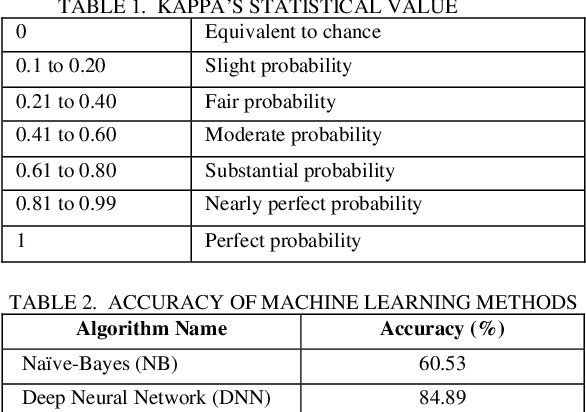
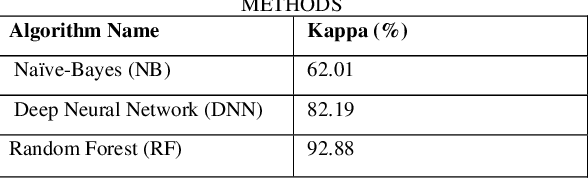
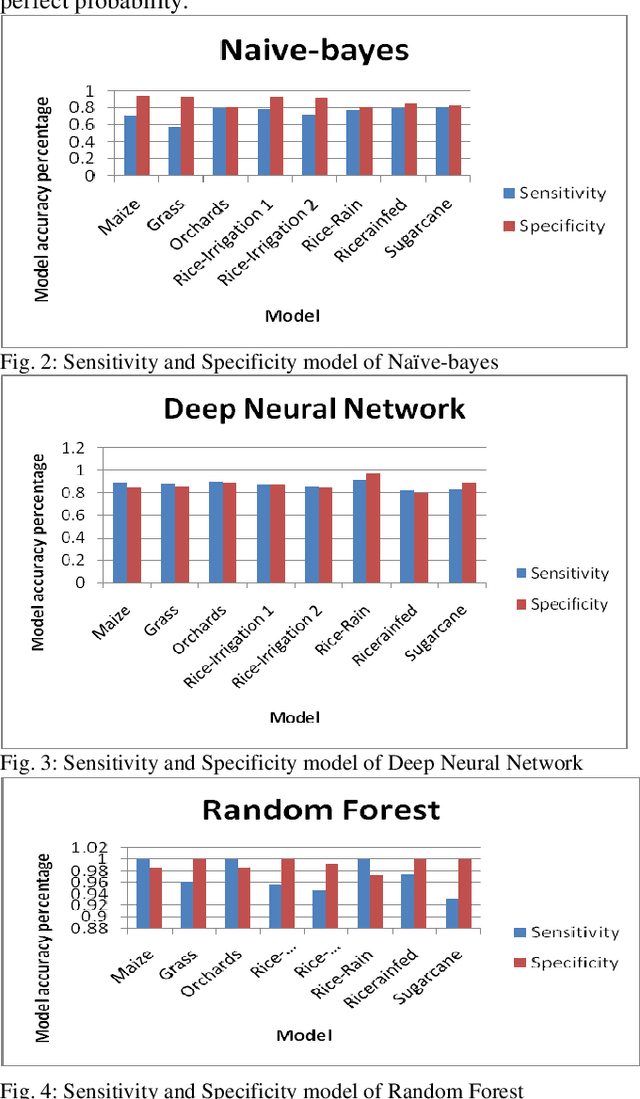
Monitoring agricultural activities is important to ensure food security. Remote sensing plays a significant role for large-scale continuous monitoring of cultivation activities. Time series remote sensing data were used for the generation of the cropping pattern. Classification algorithms are used to classify crop patterns and mapped agriculture land used. Some conventional classification methods including support vector machine (SVM) and decision trees were applied for crop pattern recognition. However, in this paper, we are proposing Deep Neural Network (DNN) based classification to improve the performance of crop pattern recognition and make a comparative analysis with two (2) other machine learning approaches including Naive Bayes and Random Forest.
Unbiased Pain Assessment through Wearables and EHR Data: Multi-attribute Fairness Loss-based CNN Approach
Jul 03, 2023The combination of diverse health data (IoT, EHR, and clinical surveys) and scalable-adaptable Artificial Intelligence (AI), has enabled the discovery of physical, behavioral, and psycho-social indicators of pain status. Despite the hype and promise to fundamentally alter the healthcare system with technological advancements, much AI adoption in clinical pain evaluation has been hampered by the heterogeneity of the problem itself and other challenges, such as personalization and fairness. Studies have revealed that many AI (i.e., machine learning or deep learning) models display biases and discriminate against specific population segments (such as those based on gender or ethnicity), which breeds skepticism among medical professionals about AI adaptability. In this paper, we propose a Multi-attribute Fairness Loss (MAFL) based CNN model that aims to account for any sensitive attributes included in the data and fairly predict patients' pain status while attempting to minimize the discrepancies between privileged and unprivileged groups. In order to determine whether the trade-off between accuracy and fairness can be satisfied, we compare the proposed model with well-known existing mitigation procedures, and studies reveal that the implemented model performs favorably in contrast to state-of-the-art methods. Utilizing NIH All-Of-US data, where a cohort of 868 distinct individuals with wearables and EHR data gathered over 1500 days has been taken into consideration to analyze our suggested fair pain assessment system.