 Add to Chrome
 Add to Firefox
 Add to Edge
Seedance 2.0: Advancing Video Generation for World Complexity
Apr 15, 2026
Seedance 2.0 is a new native multi-modal audio-video generation model, officially released in China in early February 2026. Compared with its predecessors, Seedance 1.0 and 1.5 Pro, Seedance 2.0 adopts a unified, highly efficient, and large-scale architecture for multi-modal audio-video joint generation. This allows it to support four input modalities: text, image, audio, and video, by integrating one of the most comprehensive suites of multi-modal content reference and editing capabilities available in the industry to date. It delivers substantial, well-rounded improvements across all key sub-dimensions of video and audio generation. In both expert evaluations and public user tests, the model has demonstrated performance on par with the leading levels in the field. Seedance 2.0 supports direct generation of audio-video content with durations ranging from 4 to 15 seconds, with native output resolutions of 480p and 720p. For multi-modal inputs as reference, its current open platform supports up to 3 video clips, 9 images, and 3 audio clips. In addition, we provide Seedance 2.0 Fast version, an accelerated variant of Seedance 2.0 designed to boost generation speed for low-latency scenarios. Seedance 2.0 has delivered significant improvements to its foundational generation capabilities and multi-modal generation performance, bringing an enhanced creative experience for end users.

Seedance 1.5 pro: A Native Audio-Visual Joint Generation Foundation Model
Dec 23, 2025Recent strides in video generation have paved the way for unified audio-visual generation. In this work, we present Seedance 1.5 pro, a foundational model engineered specifically for native, joint audio-video generation. Leveraging a dual-branch Diffusion Transformer architecture, the model integrates a cross-modal joint module with a specialized multi-stage data pipeline, achieving exceptional audio-visual synchronization and superior generation quality. To ensure practical utility, we implement meticulous post-training optimizations, including Supervised Fine-Tuning (SFT) on high-quality datasets and Reinforcement Learning from Human Feedback (RLHF) with multi-dimensional reward models. Furthermore, we introduce an acceleration framework that boosts inference speed by over 10X. Seedance 1.5 pro distinguishes itself through precise multilingual and dialect lip-syncing, dynamic cinematic camera control, and enhanced narrative coherence, positioning it as a robust engine for professional-grade content creation. Seedance 1.5 pro is now accessible on Volcano Engine at https://console.volcengine.com/ark/region:ark+cn-beijing/experience/vision?type=GenVideo.
MindShift: Leveraging Large Language Models for Mental-States-Based Problematic Smartphone Use Intervention
Sep 28, 2023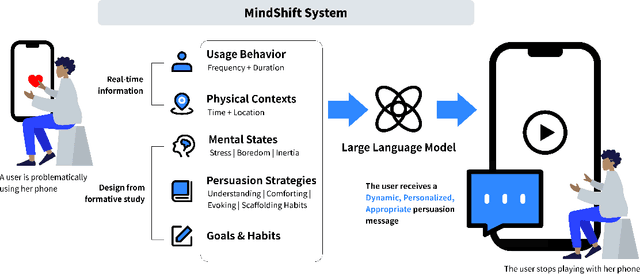
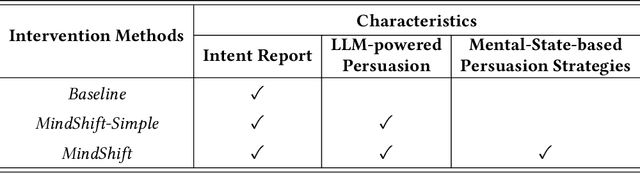
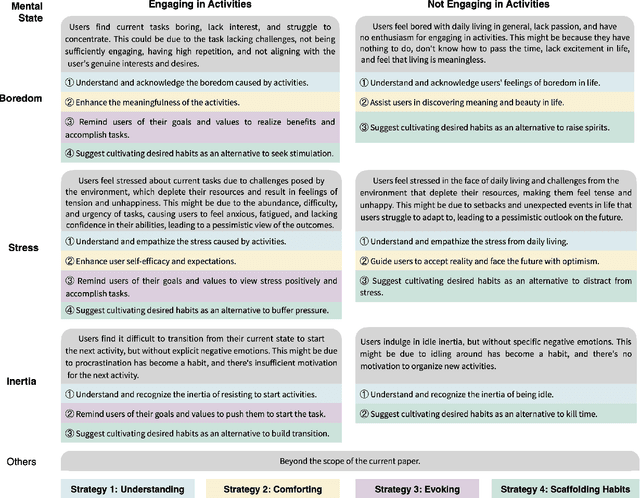
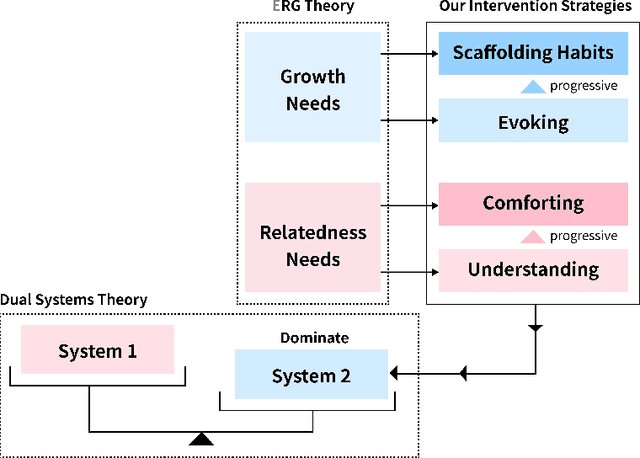
Problematic smartphone use negatively affects physical and mental health. Despite the wide range of prior research, existing persuasive techniques are not flexible enough to provide dynamic persuasion content based on users' physical contexts and mental states. We first conduct a Wizard-of-Oz study (N=12) and an interview study (N=10) to summarize the mental states behind problematic smartphone use: boredom, stress, and inertia. This informs our design of four persuasion strategies: understanding, comforting, evoking, and scaffolding habits. We leverage large language models (LLMs) to enable the automatic and dynamic generation of effective persuasion content. We develop MindShift, a novel LLM-powered problematic smartphone use intervention technique. MindShift takes users' in-the-moment physical contexts, mental states, app usage behaviors, users' goals & habits as input, and generates high-quality and flexible persuasive content with appropriate persuasion strategies. We conduct a 5-week field experiment (N=25) to compare MindShift with baseline techniques. The results show that MindShift significantly improves intervention acceptance rates by 17.8-22.5% and reduces smartphone use frequency by 12.1-14.4%. Moreover, users have a significant drop in smartphone addiction scale scores and a rise in self-efficacy. Our study sheds light on the potential of leveraging LLMs for context-aware persuasion in other behavior change domains.