 Add to Chrome
 Add to Firefox
 Add to Edge
RMSWeb: Reflection, Failure-Mode Mining, and Salvage-DS for Web Agent Reinforcement Learning
Jul 31, 2026
Compact web agents can reduce deployment cost, but training them poses challenges in both data collection and post-SFT reinforcement learning (RL). Successful trajectories are expensive to collect and often contain inefficient detours. After supervised fine-tuning (SFT), full trajectory corpora are dominated by routine states; moreover, when group-relative RL is applied to web actions, inadequately designed action-level rewards can yield weak or misleading relative updates, while groups rejected as unsuitable for such updates receive no fallback learning signal. We present RMSWeb, a three-part recipe for Qwen3-VL-Instruct at 8B and 32B. Reflection-conditioned retries increase collection yield and shorten successful trajectories; failure-mode mining concentrates offline RL on critical states exposed by the SFT policy; and Salvage-DS combines an action-semantic polarized reward, contrast-and-competence-gated dynamic sampling, and an action-only anchor for rejected groups. Policies trained with reflection-collected data use up to 19.7% fewer action steps on solved tasks. On WebVoyager, Online-Mind2Web, and WebTailBench, RMSWeb improves over SFT by 2.4-7.0 points at 8B and 1.2-7.7 points at 32B. Our 8B model also achieves the strongest reported Online-Mind2Web result among similarly sized open-weight models in our comparison and a leading reported accuracy-cost trade-off on WebVoyager and WebTailBench, with the caveat that external evaluation protocols differ.

Towards Generalized Models for Task-oriented Dialogue Modeling on Spoken Conversations
Mar 08, 2022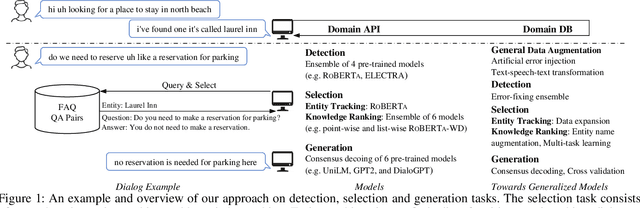

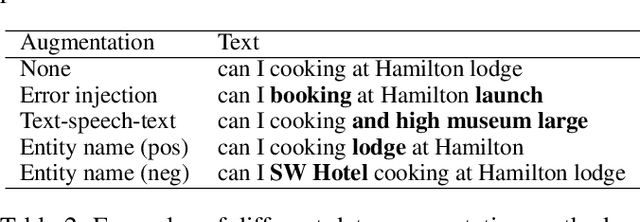
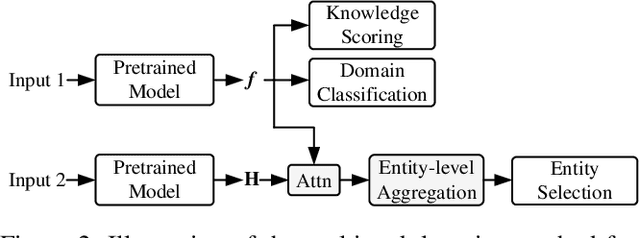
Building robust and general dialogue models for spoken conversations is challenging due to the gap in distributions of spoken and written data. This paper presents our approach to build generalized models for the Knowledge-grounded Task-oriented Dialogue Modeling on Spoken Conversations Challenge of DSTC-10. In order to mitigate the discrepancies between spoken and written text, we mainly employ extensive data augmentation strategies on written data, including artificial error injection and round-trip text-speech transformation. To train robust models for spoken conversations, we improve pre-trained language models, and apply ensemble algorithms for each sub-task. Typically, for the detection task, we fine-tune \roberta and ELECTRA, and run an error-fixing ensemble algorithm. For the selection task, we adopt a two-stage framework that consists of entity tracking and knowledge ranking, and propose a multi-task learning method to learn multi-level semantic information by domain classification and entity selection. For the generation task, we adopt a cross-validation data process to improve pre-trained generative language models, followed by a consensus decoding algorithm, which can add arbitrary features like relative \rouge metric, and tune associated feature weights toward \bleu directly. Our approach ranks third on the objective evaluation and second on the final official human evaluation.
Primitive Representation Learning for Scene Text Recognition
May 10, 2021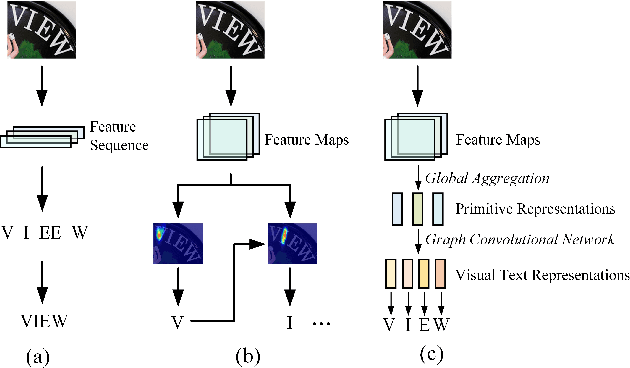
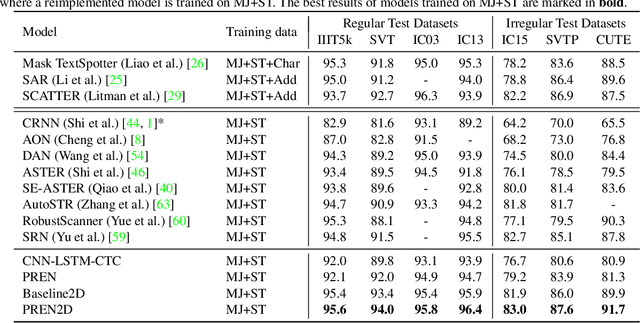
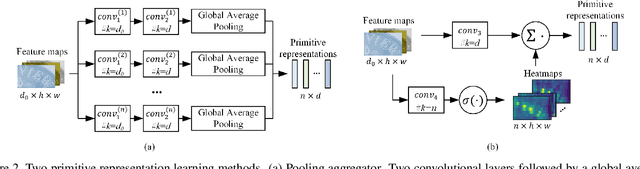
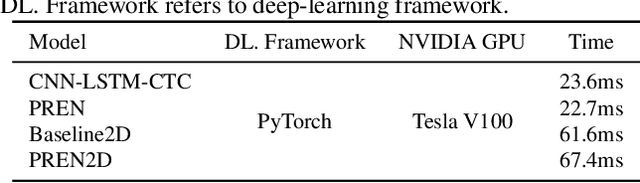
Scene text recognition is a challenging task due to diverse variations of text instances in natural scene images. Conventional methods based on CNN-RNN-CTC or encoder-decoder with attention mechanism may not fully investigate stable and efficient feature representations for multi-oriented scene texts. In this paper, we propose a primitive representation learning method that aims to exploit intrinsic representations of scene text images. We model elements in feature maps as the nodes of an undirected graph. A pooling aggregator and a weighted aggregator are proposed to learn primitive representations, which are transformed into high-level visual text representations by graph convolutional networks. A Primitive REpresentation learning Network (PREN) is constructed to use the visual text representations for parallel decoding. Furthermore, by integrating visual text representations into an encoder-decoder model with the 2D attention mechanism, we propose a framework called PREN2D to alleviate the misalignment problem in attention-based methods. Experimental results on both English and Chinese scene text recognition tasks demonstrate that PREN keeps a balance between accuracy and efficiency, while PREN2D achieves state-of-the-art performance.