 Add to Chrome
 Add to Firefox
 Add to Edge
RMSWeb: Reflection, Failure-Mode Mining, and Salvage-DS for Web Agent Reinforcement Learning
Jul 31, 2026
Compact web agents can reduce deployment cost, but training them poses challenges in both data collection and post-SFT reinforcement learning (RL). Successful trajectories are expensive to collect and often contain inefficient detours. After supervised fine-tuning (SFT), full trajectory corpora are dominated by routine states; moreover, when group-relative RL is applied to web actions, inadequately designed action-level rewards can yield weak or misleading relative updates, while groups rejected as unsuitable for such updates receive no fallback learning signal. We present RMSWeb, a three-part recipe for Qwen3-VL-Instruct at 8B and 32B. Reflection-conditioned retries increase collection yield and shorten successful trajectories; failure-mode mining concentrates offline RL on critical states exposed by the SFT policy; and Salvage-DS combines an action-semantic polarized reward, contrast-and-competence-gated dynamic sampling, and an action-only anchor for rejected groups. Policies trained with reflection-collected data use up to 19.7% fewer action steps on solved tasks. On WebVoyager, Online-Mind2Web, and WebTailBench, RMSWeb improves over SFT by 2.4-7.0 points at 8B and 1.2-7.7 points at 32B. Our 8B model also achieves the strongest reported Online-Mind2Web result among similarly sized open-weight models in our comparison and a leading reported accuracy-cost trade-off on WebVoyager and WebTailBench, with the caveat that external evaluation protocols differ.

DeepFusion: Accelerating MoE Training via Federated Knowledge Distillation from Heterogeneous Edge Devices
Feb 15, 2026Recent Mixture-of-Experts (MoE)-based large language models (LLMs) such as Qwen-MoE and DeepSeek-MoE are transforming generative AI in natural language processing. However, these models require vast and diverse training data. Federated learning (FL) addresses this challenge by leveraging private data from heterogeneous edge devices for privacy-preserving MoE training. Nonetheless, traditional FL approaches require devices to host local MoE models, which is impractical for resource-constrained devices due to large model sizes. To address this, we propose DeepFusion, the first scalable federated MoE training framework that enables the fusion of heterogeneous on-device LLM knowledge via federated knowledge distillation, yielding a knowledge-abundant global MoE model. Specifically, DeepFusion features each device to independently configure and train an on-device LLM tailored to its own needs and hardware limitations. Furthermore, we propose a novel View-Aligned Attention (VAA) module that integrates multi-stage feature representations from the global MoE model to construct a predictive perspective aligned with on-device LLMs, thereby enabling effective cross-architecture knowledge distillation. By explicitly aligning predictive perspectives, VAA resolves the view-mismatch problem in traditional federated knowledge distillation, which arises from heterogeneity in model architectures and prediction behaviors between on-device LLMs and the global MoE model. Experiments with industry-level MoE models (Qwen-MoE and DeepSeek-MoE) and real-world datasets (medical and finance) demonstrate that DeepFusion achieves performance close to centralized MoE training. Compared with key federated MoE baselines, DeepFusion reduces communication costs by up to 71% and improves token perplexity by up to 5.28%.
Dynamic Pricing for On-Demand DNN Inference in the Edge-AI Market
Mar 06, 2025The convergence of edge computing and AI gives rise to Edge-AI, which enables the deployment of real-time AI applications and services at the network edge. One of the fundamental research issues in Edge-AI is edge inference acceleration, which aims to realize low-latency high-accuracy DNN inference services by leveraging the fine-grained offloading of partitioned inference tasks from end devices to edge servers. However, existing research has yet to adopt a practical Edge-AI market perspective, which would systematically explore the personalized inference needs of AI users (e.g., inference accuracy, latency, and task complexity), the revenue incentives for AI service providers that offer edge inference services, and multi-stakeholder governance within a market-oriented context. To bridge this gap, we propose an Auction-based Edge Inference Pricing Mechanism (AERIA) for revenue maximization to tackle the multi-dimensional optimization problem of DNN model partition, edge inference pricing, and resource allocation. We investigate the multi-exit device-edge synergistic inference scheme for on-demand DNN inference acceleration, and analyse the auction dynamics amongst the AI service providers, AI users and edge infrastructure provider. Owing to the strategic mechanism design via randomized consensus estimate and cost sharing techniques, the Edge-AI market attains several desirable properties, including competitiveness in revenue maximization, incentive compatibility, and envy-freeness, which are crucial to maintain the effectiveness, truthfulness, and fairness of our auction outcomes. The extensive simulation experiments based on four representative DNN inference workloads demonstrate that our AERIA mechanism significantly outperforms several state-of-the-art approaches in revenue maximization, demonstrating the efficacy of AERIA for on-demand DNN inference in the Edge-AI market.
Incentivizing Multi-Tenant Split Federated Learning for Foundation Models at the Network Edge
Mar 06, 2025Foundation models (FMs) such as GPT-4 exhibit exceptional generative capabilities across diverse downstream tasks through fine-tuning. Split Federated Learning (SFL) facilitates privacy-preserving FM fine-tuning on resource-constrained local devices by offloading partial FM computations to edge servers, enabling device-edge synergistic fine-tuning. Practical edge networks often host multiple SFL tenants to support diversified downstream tasks. However, existing research primarily focuses on single-tenant SFL scenarios, and lacks tailored incentive mechanisms for multi-tenant settings, which are essential to effectively coordinate self-interested local devices for participation in various downstream tasks, ensuring that each SFL tenant's distinct FM fine-tuning requirements (e.g., FM types, performance targets, and fine-tuning deadlines) are met. To address this gap, we propose a novel Price-Incentive Mechanism (PRINCE) that guides multiple SFL tenants to offer strategic price incentives, which solicit high-quality device participation for efficient FM fine-tuning. Specifically, we first develop a bias-resilient global SFL model aggregation scheme to eliminate model biases caused by independent device participation. We then derive a rigorous SFL convergence bound to evaluate the contributions of heterogeneous devices to FM performance improvements, guiding the incentive strategies of SFL tenants. Furthermore, we model inter-tenant device competition as a congestion game for Stackelberg equilibrium (SE) analysis, deriving each SFL tenant's optimal incentive strategy. Extensive simulations involving four representative SFL tenant types (ViT, BERT, Whisper, and LLaMA) across diverse data modalities (text, images, and audio) demonstrate that PRINCE accelerates FM fine-tuning by up to 3.07x compared to state-of-the-art approaches, while consistently meeting fine-tuning performance targets.
On the Robustness of ChatGPT: An Adversarial and Out-of-distribution Perspective
Mar 02, 2023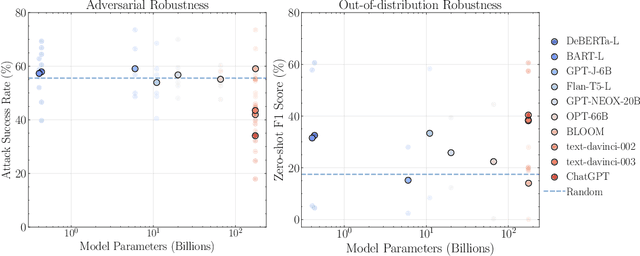
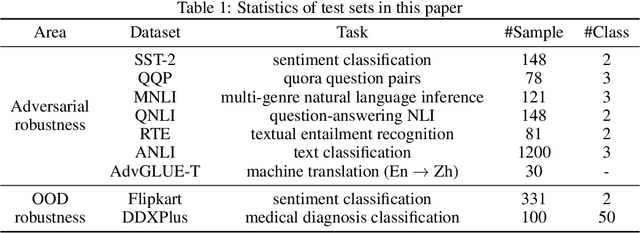
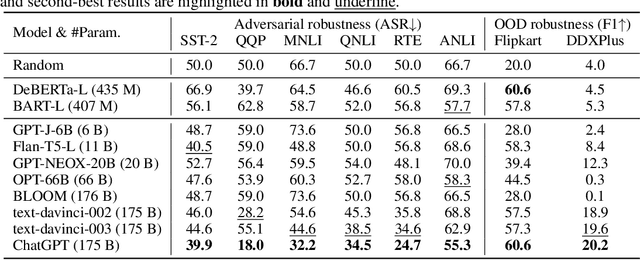

ChatGPT is a recent chatbot service released by OpenAI and is receiving increasing attention over the past few months. While evaluations of various aspects of ChatGPT have been done, its robustness, i.e., the performance to unexpected inputs, is still unclear to the public. Robustness is of particular concern in responsible AI, especially for safety-critical applications. In this paper, we conduct a thorough evaluation of the robustness of ChatGPT from the adversarial and out-of-distribution (OOD) perspective. To do so, we employ the AdvGLUE and ANLI benchmarks to assess adversarial robustness and the Flipkart review and DDXPlus medical diagnosis datasets for OOD evaluation. We select several popular foundation models as baselines. Results show that ChatGPT shows consistent advantages on most adversarial and OOD classification and translation tasks. However, the absolute performance is far from perfection, which suggests that adversarial and OOD robustness remains a significant threat to foundation models. Moreover, ChatGPT shows astounding performance in understanding dialogue-related texts and we find that it tends to provide informal suggestions for medical tasks instead of definitive answers. Finally, we present in-depth discussions of possible research directions.