 Add to Chrome
 Add to Firefox
 Add to Edge
RMSWeb: Reflection, Failure-Mode Mining, and Salvage-DS for Web Agent Reinforcement Learning
Jul 31, 2026
Compact web agents can reduce deployment cost, but training them poses challenges in both data collection and post-SFT reinforcement learning (RL). Successful trajectories are expensive to collect and often contain inefficient detours. After supervised fine-tuning (SFT), full trajectory corpora are dominated by routine states; moreover, when group-relative RL is applied to web actions, inadequately designed action-level rewards can yield weak or misleading relative updates, while groups rejected as unsuitable for such updates receive no fallback learning signal. We present RMSWeb, a three-part recipe for Qwen3-VL-Instruct at 8B and 32B. Reflection-conditioned retries increase collection yield and shorten successful trajectories; failure-mode mining concentrates offline RL on critical states exposed by the SFT policy; and Salvage-DS combines an action-semantic polarized reward, contrast-and-competence-gated dynamic sampling, and an action-only anchor for rejected groups. Policies trained with reflection-collected data use up to 19.7% fewer action steps on solved tasks. On WebVoyager, Online-Mind2Web, and WebTailBench, RMSWeb improves over SFT by 2.4-7.0 points at 8B and 1.2-7.7 points at 32B. Our 8B model also achieves the strongest reported Online-Mind2Web result among similarly sized open-weight models in our comparison and a leading reported accuracy-cost trade-off on WebVoyager and WebTailBench, with the caveat that external evaluation protocols differ.

SDSAT: Accelerating LLM Inference through Speculative Decoding with Semantic Adaptive Tokens
Apr 01, 2024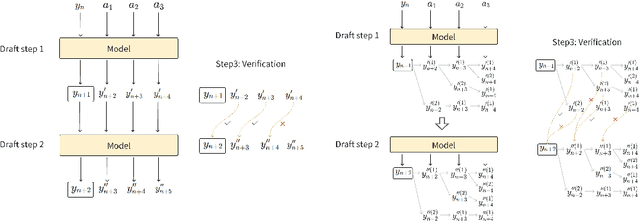
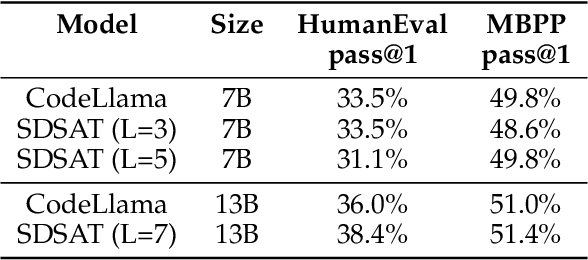
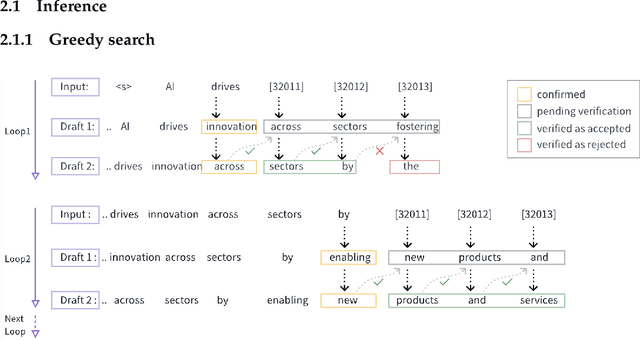
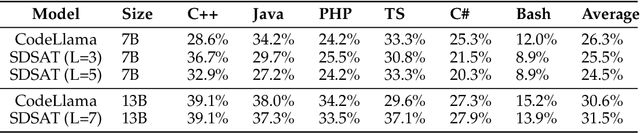
We propose an acceleration scheme for large language models (LLMs) through Speculative Decoding with Semantic Adaptive Tokens (SDSAT). The primary objective of this design is to enhance the LLM model's ability to generate draft tokens more accurately without compromising the model's accuracy. The core strategies involve: 1) Fine-tune the model by incorporating semantic adaptive tokens that possess flexible decoding capabilities without changing its structure, allowing them to generate high-quality draft tokens. 2) By employing a training method that does not affect the standard tokens, the model can acquire parallel decoding abilities atop its original framework with minimal training overhead. 3) We have designed the "two-step-draft-then-verify" generation strategies using both greedy search and nucleus sampling. Experiments conducted on the CodeLlama-13B and 7B models have yielded speed increases of over 3.5X and 3.0X, respectively. Please refer to https://github.com/hasuoshenyun/SDSAT.