 Add to Chrome
 Add to Firefox
 Add to Edge
AudioCapBench: Quick Evaluation on Audio Captioning across Sound, Music, and Speech
Feb 27, 2026
We introduce AudioCapBench, a benchmark for evaluating audio captioning capabilities of large multimodal models. \method covers three distinct audio domains, including environmental sound, music, and speech, with 1,000 curated evaluation samples drawn from established datasets. We evaluate 13 models across two providers (OpenAI, Google Gemini) using both reference-based metrics (METEOR, BLEU, ROUGE-L) and an LLM-as-Judge framework that scores predictions on three orthogonal dimensions: \textit{accuracy} (semantic correctness), \textit{completeness} (coverage of reference content), and \textit{hallucination} (absence of fabricated content). Our results reveal that Gemini models generally outperform OpenAI models on overall captioning quality, with Gemini~3~Pro achieving the highest overall score (6.00/10), while OpenAI models exhibit lower hallucination rates. All models perform best on speech captioning and worst on music captioning. We release the benchmark as well as evaluation code to facilitate reproducible audio understanding research.

LoCoBench-Agent: An Interactive Benchmark for LLM Agents in Long-Context Software Engineering
Nov 17, 2025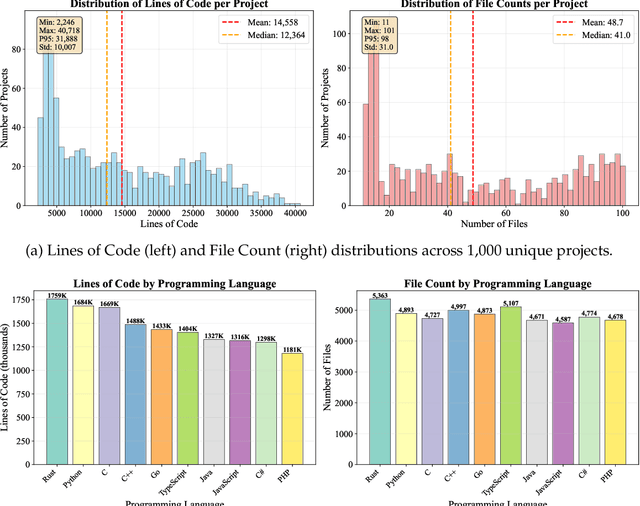
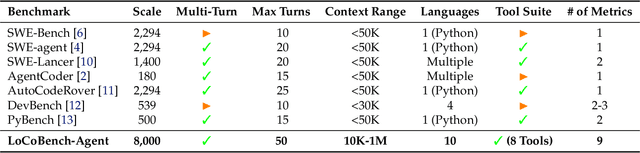
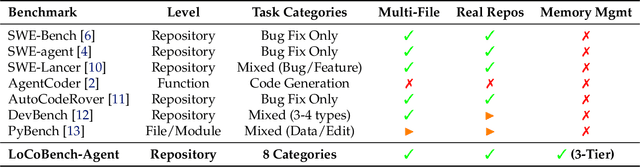
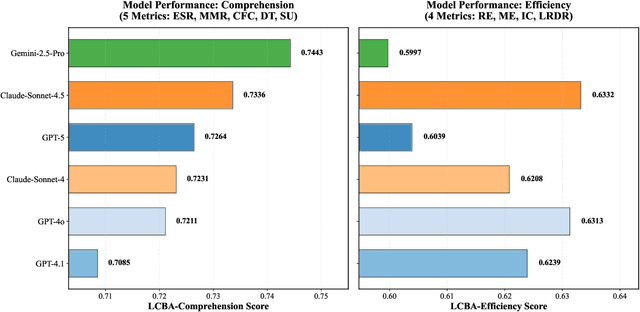
As large language models (LLMs) evolve into sophisticated autonomous agents capable of complex software development tasks, evaluating their real-world capabilities becomes critical. While existing benchmarks like LoCoBench~\cite{qiu2025locobench} assess long-context code understanding, they focus on single-turn evaluation and cannot capture the multi-turn interactive nature, tool usage patterns, and adaptive reasoning required by real-world coding agents. We introduce \textbf{LoCoBench-Agent}, a comprehensive evaluation framework specifically designed to assess LLM agents in realistic, long-context software engineering workflows. Our framework extends LoCoBench's 8,000 scenarios into interactive agent environments, enabling systematic evaluation of multi-turn conversations, tool usage efficiency, error recovery, and architectural consistency across extended development sessions. We also introduce an evaluation methodology with 9 metrics across comprehension and efficiency dimensions. Our framework provides agents with 8 specialized tools (file operations, search, code analysis) and evaluates them across context lengths ranging from 10K to 1M tokens, enabling precise assessment of long-context performance. Through systematic evaluation of state-of-the-art models, we reveal several key findings: (1) agents exhibit remarkable long-context robustness; (2) comprehension-efficiency trade-off exists with negative correlation, where thorough exploration increases comprehension but reduces efficiency; and (3) conversation efficiency varies dramatically across models, with strategic tool usage patterns differentiating high-performing agents. As the first long-context LLM agent benchmark for software engineering, LoCoBench-Agent establishes a rigorous foundation for measuring agent capabilities, identifying performance gaps, and advancing autonomous software development at scale.