 Add to Chrome
 Add to Firefox
 Add to Edge
Coordinated Disentanglement with Iterative Mode Discovery Under Hidden Correlations
Jul 19, 2026
Disentangled representation learning is a powerful paradigm for robust attribute prediction. While recent methods address attribute correlations, hidden correlations remain underexplored, where data under the value of a certain attribute exhibit underlying modes correlated with other attributes. To preserve mode information and achieve disentanglement, we jointly discover modes and enforce mode-based conditional independence. Yet, the interdependency between these two modules may lead to error amplification under naive iterations. We propose Coordinated Disentanglement with Iterative mode Discovery (CoDID), an end-to-end framework featuring a dynamic architecture that adapts to evolving number of modes, and a coordination mechanism that mitigates error amplification via meta-optimization. Empirical results demonstrate the state-of-the-art performance on diverse tasks.

Annotation-free deep learning for detection and segmentation of fetal germinal matrix-intraventricular hemorrhage in brain MRI
May 10, 2026Background: Prenatal germinal matrix-intraventricular hemorrhage (GMH-IVH) is a leading cause of infant mortality and neurodevelopmental impairment. Manual diagnosis and lesion segmentation are labor-intensive and error-prone. Deep learning models offer potential for automation but typically require large annotated datasets, which are challenging to obtain. Purpose: To develop and validate an annotation-free deep learning framework for automated detection and segmentation of GMH-IVH on brain MRI. Materials and Methods: This retrospective study analyzed 2D T2-weighted MRI data from pregnant women collected from October 2015 to October 2023 at one hospital (internal validation) and two hospitals (external validation). Eligible participants included healthy fetuses and those with GMH-IVH. FreeHemoSeg was developed and trained using pseudo GMH-IVH images synthesized from normal fetal data guided by medical priors. Primary outcomes included diagnostic accuracy (area under the ROC curve [AUROC], sensitivity, specificity) and segmentation accuracy (Dice similarity coefficient [DSC]). A reader study evaluated clinical utility. Results: A total of 1674 stacks from 558 pregnant women were analyzed. FreeHemoSeg achieved the highest performance in both internal (sensitivity: 0.914, 95% CI 0.869-0.945; specificity: 0.966, 95% CI 0.946-0.978; DSC: 0.559, 95% CI 0.546-0.571) and external validation (sensitivity: 0.824, 95% CI 0.739-0.885; specificity: 0.943, 95% CI 0.913-0.964; DSC: 0.512, 95% CI 0.497-0.526), outperforming supervised and unsupervised methods. FreeHemoSeg assistance improved radiologists' sensitivity (from 0.882 to 0.941-1.000) and diagnostic confidence while reducing interpretation time by 16.0-52.7%. Conclusion: FreeHemoSeg accurately detects and localizes fetal brain hemorrhages without annotated training data, enabling earlier diagnosis and supporting timely clinical management.
SWL-Adapt: An Unsupervised Domain Adaptation Model with Sample Weight Learning for Cross-User Wearable Human Activity Recognition
Nov 25, 2022
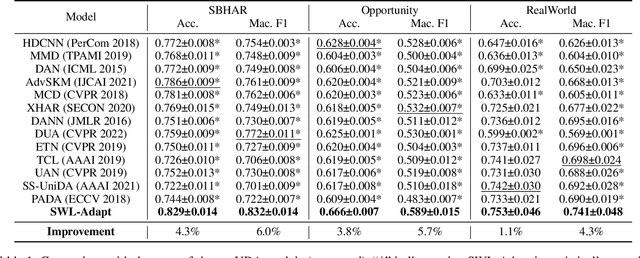
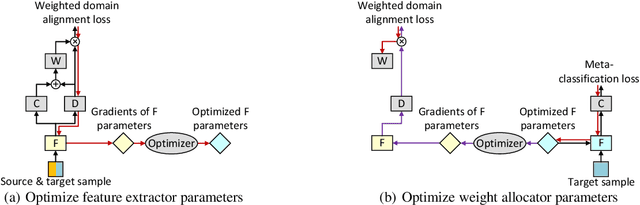

In practice, Wearable Human Activity Recognition (WHAR) models usually face performance degradation on the new user due to user variance. Unsupervised domain adaptation (UDA) becomes the natural solution to cross-user WHAR under annotation scarcity. Existing UDA models usually align samples across domains without differentiation, which ignores the difference among samples. In this paper, we propose an unsupervised domain adaptation model with sample weight learning (SWL-Adapt) for cross-user WHAR. SWL-Adapt calculates sample weights according to the classification loss and domain discrimination loss of each sample with a parameterized network. We introduce the meta-optimization based update rule to learn this network end-to-end, which is guided by meta-classification loss on the selected pseudo-labeled target samples. Therefore, this network can fit a weighting function according to the cross-user WHAR task at hand, which is superior to existing sample differentiation rules fixed for special scenarios. Extensive experiments on three public WHAR datasets demonstrate that SWL-Adapt achieves the state-of-the-art performance on the cross-user WHAR task, outperforming the best baseline by an average of 3.1% and 5.3% in accuracy and macro F1 score, respectively.
SALIENCE: An Unsupervised User Adaptation Model for Multiple Wearable Sensors Based Human Activity Recognition
Aug 17, 2021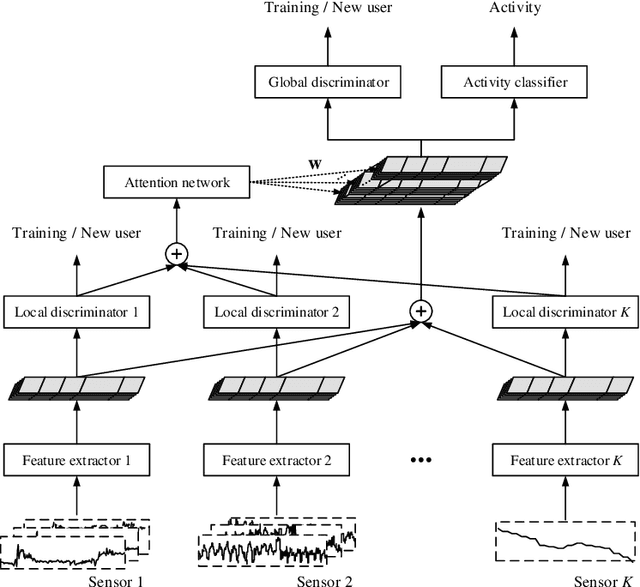
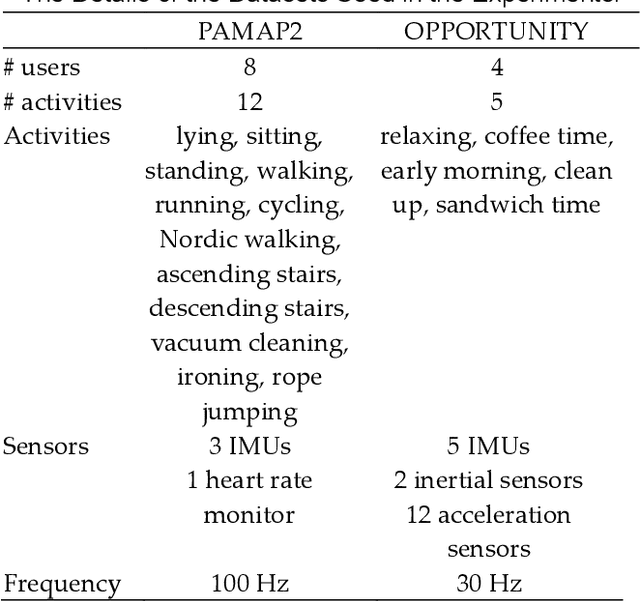
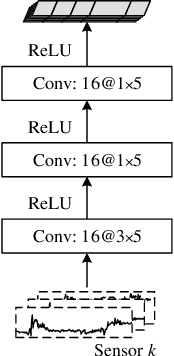
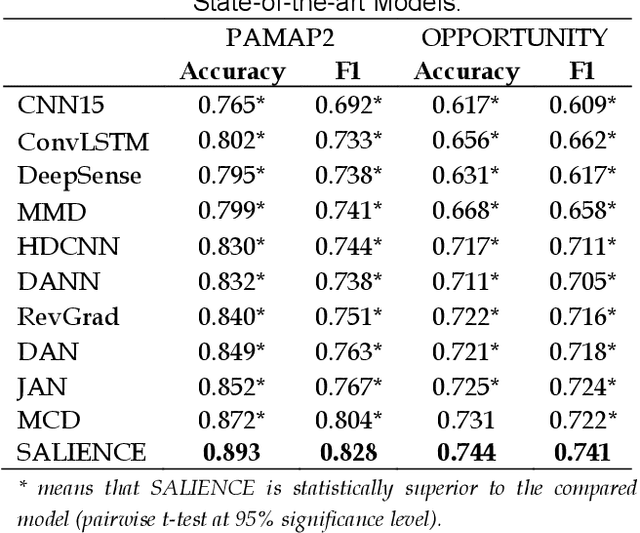
Unsupervised user adaptation aligns the feature distributions of the data from training users and the new user, so a well-trained wearable human activity recognition (WHAR) model can be well adapted to the new user. With the development of wearable sensors, multiple wearable sensors based WHAR is gaining more and more attention. In order to address the challenge that the transferabilities of different sensors are different, we propose SALIENCE (unsupervised user adaptation model for multiple wearable sensors based human activity recognition) model. It aligns the data of each sensor separately to achieve local alignment, while uniformly aligning the data of all sensors to ensure global alignment. In addition, an attention mechanism is proposed to focus the activity classifier of SALIENCE on the sensors with strong feature discrimination and well distribution alignment. Experiments are conducted on two public WHAR datasets, and the experimental results show that our model can yield a competitive performance.