 Add to Chrome
 Add to Firefox
 Add to Edge
A Unified Framework to Quantify Cultural Intelligence of AI
Mar 01, 2026
As generative AI technologies are increasingly being launched across the globe, assessing their competence to operate in different cultural contexts is exigently becoming a priority. While recent years have seen numerous and much-needed efforts on cultural benchmarking, these efforts have largely focused on specific aspects of culture and evaluation. While these efforts contribute to our understanding of cultural competence, a unified and systematic evaluation approach is needed for us as a field to comprehensively assess diverse cultural dimensions at scale. Drawing on measurement theory, we present a principled framework to aggregate multifaceted indicators of cultural capabilities into a unified assessment of cultural intelligence. We start by developing a working definition of culture that includes identifying core domains of culture. We then introduce a broad-purpose, systematic, and extensible framework for assessing cultural intelligence of AI systems. Drawing on theoretical framing from psychometric measurement validity theory, we decouple the background concept (i.e., cultural intelligence) from its operationalization via measurement. We conceptualize cultural intelligence as a suite of core capabilities spanning diverse domains, which we then operationalize through a set of indicators designed for reliable measurement. Finally, we identify the considerations, challenges, and research pathways to meaningfully measure these indicators, specifically focusing on data collection, probing strategies, and evaluation metrics.

Evaluating Alignment of Behavioral Dispositions in LLMs
Feb 11, 2026As LLMs integrate into our daily lives, understanding their behavior becomes essential. In this work, we focus on behavioral dispositions$-$the underlying tendencies that shape responses in social contexts$-$and introduce a framework to study how closely the dispositions expressed by LLMs align with those of humans. Our approach is grounded in established psychological questionnaires but adapts them for LLMs by transforming human self-report statements into Situational Judgment Tests (SJTs). These SJTs assess behavior by eliciting natural recommendations in realistic user-assistant scenarios. We generate 2,500 SJTs, each validated by three human annotators, and collect preferred actions from 10 annotators per SJT, from a large pool of 550 participants. In a comprehensive study involving 25 LLMs, we find that models often do not reflect the distribution of human preferences: (1) in scenarios with low human consensus, LLMs consistently exhibit overconfidence in a single response; (2) when human consensus is high, smaller models deviate significantly, and even some frontier models do not reflect the consensus in 15-20% of cases; (3) traits can exhibit cross-LLM patterns, e.g., LLMs may encourage emotion expression in contexts where human consensus favors composure. Lastly, mapping psychometric statements directly to behavioral scenarios presents a unique opportunity to evaluate the predictive validity of self-reports, revealing considerable gaps between LLMs' stated values and their revealed behavior.
MiTTenS: A Dataset for Evaluating Misgendering in Translation
Jan 13, 2024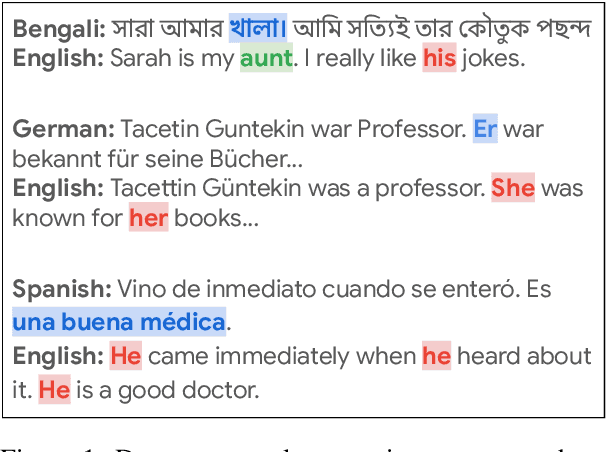
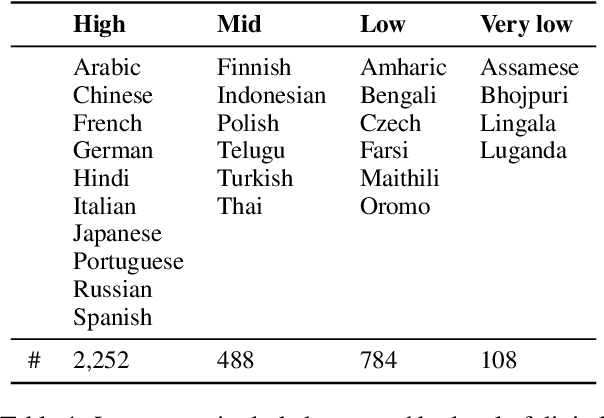
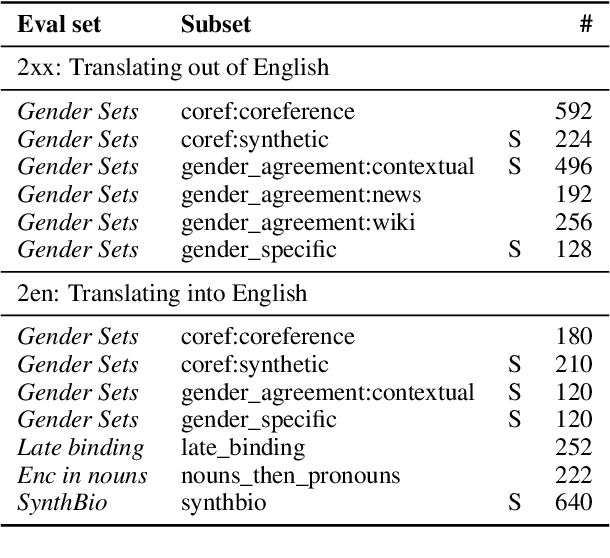

Misgendering is the act of referring to someone in a way that does not reflect their gender identity. Translation systems, including foundation models capable of translation, can produce errors that result in misgendering harms. To measure the extent of such potential harms when translating into and out of English, we introduce a dataset, MiTTenS, covering 26 languages from a variety of language families and scripts, including several traditionally underpresented in digital resources. The dataset is constructed with handcrafted passages that target known failure patterns, longer synthetically generated passages, and natural passages sourced from multiple domains. We demonstrate the usefulness of the dataset by evaluating both dedicated neural machine translation systems and foundation models, and show that all systems exhibit errors resulting in misgendering harms, even in high resource languages.