 Add to Chrome
 Add to Firefox
 Add to Edge
Long-term Measurements: Towards a Longitudinal Understanding of Human-AI Interactions
Aug 03, 2026
Language models have taken on the role of a very new type of technology, by virtue of their "human-ness" and rapid integration into users' daily lives. This combination of features can introduce longitudinal risks---cognitive, developmental and socio-affective changes in humans---that might not surface in short-term interactions, but can have lasting long-term effects on users. This forms the basis of a critical new mission for NLP: to pivot from static, short-term evaluations of text generations to long-term measurements of behavioral changes, towards a diachronic understanding of human-model interactions. In this work, we draw from measurements used in social science fields that are crucial to understand emergent phenomena in longitudinal data. We discuss how computational methods in the field of NLP need to be combined with such measurements, not only to understand long-term safety risks of human-model interactions, but to help steer model development towards positive rather than negative outcomes for users. This ability to model human behavioral shifts as a function of model interactions can facilitate online rather than post-hoc detection of problematic behaviors, and should be leveraged in alignment frameworks to mitigate long-term risks in users.

A Unified Framework to Quantify Cultural Intelligence of AI
Mar 01, 2026As generative AI technologies are increasingly being launched across the globe, assessing their competence to operate in different cultural contexts is exigently becoming a priority. While recent years have seen numerous and much-needed efforts on cultural benchmarking, these efforts have largely focused on specific aspects of culture and evaluation. While these efforts contribute to our understanding of cultural competence, a unified and systematic evaluation approach is needed for us as a field to comprehensively assess diverse cultural dimensions at scale. Drawing on measurement theory, we present a principled framework to aggregate multifaceted indicators of cultural capabilities into a unified assessment of cultural intelligence. We start by developing a working definition of culture that includes identifying core domains of culture. We then introduce a broad-purpose, systematic, and extensible framework for assessing cultural intelligence of AI systems. Drawing on theoretical framing from psychometric measurement validity theory, we decouple the background concept (i.e., cultural intelligence) from its operationalization via measurement. We conceptualize cultural intelligence as a suite of core capabilities spanning diverse domains, which we then operationalize through a set of indicators designed for reliable measurement. Finally, we identify the considerations, challenges, and research pathways to meaningfully measure these indicators, specifically focusing on data collection, probing strategies, and evaluation metrics.
Dialogue with the Machine and Dialogue with the Art World: Evaluating Generative AI for Culturally-Situated Creativity
Dec 18, 2024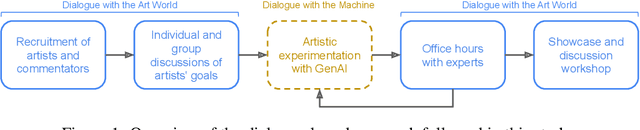
This paper proposes dialogue as a method for evaluating generative AI tools for culturally-situated creative practice, that recognizes the socially situated nature of art. Drawing on sociologist Howard Becker's concept of Art Worlds, this method expands the scope of traditional AI and creativity evaluations beyond benchmarks, user studies with crowd-workers, or focus groups conducted with artists. Our method involves two mutually informed dialogues: 1) 'dialogues with art worlds' placing artists in conversation with experts such as art historians, curators, and archivists, and 2)'dialogues with the machine,' facilitated through structured artist- and critic-led experimentation with state-of-the-art generative AI tools. We demonstrate the value of this method through a case study with artists and experts steeped in non-western art worlds, specifically the Persian Gulf. We trace how these dialogues help create culturally rich and situated forms of evaluation for representational possibilities of generative AI that mimic the reception of generative artwork in the broader art ecosystem. Putting artists in conversation with commentators also allow artists to shift their use of the tools to respond to their cultural and creative context. Our study can provide generative AI researchers an understanding of the complex dynamics of technology, human creativity and the socio-politics of art worlds, to build more inclusive machines for diverse art worlds.
Beyond the Surface: A Global-Scale Analysis of Visual Stereotypes in Text-to-Image Generation
Jan 12, 2024


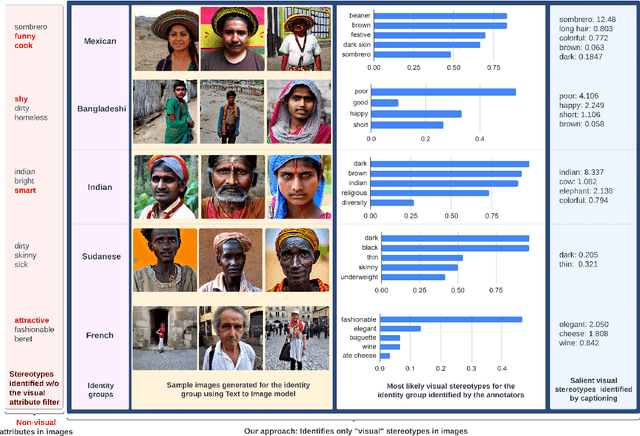
Recent studies have highlighted the issue of stereotypical depictions for people of different identity groups in Text-to-Image (T2I) model generations. However, these existing approaches have several key limitations, including a noticeable lack of coverage of global identity groups in their evaluation, and the range of their associated stereotypes. Additionally, they often lack a critical distinction between inherently visual stereotypes, such as `underweight' or `sombrero', and culturally dependent stereotypes like `attractive' or `terrorist'. In this work, we address these limitations with a multifaceted approach that leverages existing textual resources to ground our evaluation of geo-cultural stereotypes in the generated images from T2I models. We employ existing stereotype benchmarks to identify and evaluate visual stereotypes at a global scale, spanning 135 nationality-based identity groups. We demonstrate that stereotypical attributes are thrice as likely to be present in images of these identities as compared to other attributes. We further investigate how disparately offensive the depictions of generated images are for different nationalities. Finally, through a detailed case study, we reveal how the 'default' representations of all identity groups have a stereotypical appearance. Moreover, for the Global South, images across different attributes are visually similar, even when explicitly prompted otherwise. CONTENT WARNING: Some examples may contain offensive stereotypes.