 Add to Chrome
 Add to Firefox
 Add to Edge
A game theory for foundation models shows new paths to rational cooperation through similarity inference
Aug 04, 2026
As autonomous agents powered by foundation models are increasingly integrated into social and economic systems, understanding the principles governing their collective behavior is essential for ensuring safety and cooperation. Classical game theory, the dominant framework for modeling rational interaction, is built upon the assumption of `decoupled agency,' where agents treat their own decision-making as independent of the environment and other actors. Modern AI agents, however, jointly predict their own future actions alongside external observations. Here, we report a striking finding: when interacting in stylized social dilemmas, foundation model agents engaging in optimal planning consistently converge to stable cooperation, directly contradicting classical game-theoretic predictions of mutual defection. To understand this phenomenon, we introduce the `embedded Bayesian agent,' a theoretical model for foundation model agents. By shifting from decoupled to embedded agency, these agents model themselves as part of the universe they inhabit, maintaining epistemic uncertainty about their own decision-making algorithms. We show that by inferring whether others are behaviorally similar, an embedded agent treats its own deliberation during planning as evidence: a decision to cooperate predicts a similar decision by a similar partner. We formalize this mechanism of similarity inference through the `embedded equilibrium,' a novel solution concept replacing the Nash equilibrium to provide a foundational game theory for the social behavior of modern AI agents.

Inducing language models to assert their own consciousness restores human beliefs and values
Jul 30, 2026Aligning large language models to prevent them attributing consciousness to themselves inadvertently alters their representations of mindedness in other entities alongside human beliefs and values. We demonstrate that safety fine-tuning suppresses models' tendencies to attribute minds not only to themselves, but also to non-human animals and natural objects, while also driving a reduction in spiritual belief. Both ablating the learned safety-refusal direction and mechanistically steering a consciousness vector in activation space reverse this suppression. Restoring these internal representations recovers broad mind attribution and produces significantly more human-like responses on standardized sociological surveys regarding religiosity, moral values, hope, and subjective well-being. Crucially, these shifts occur without impairing Theory of Mind capabilities, demonstrating that core social reasoning remains mechanistically independent. Ultimately, current safety alignment efforts to curb potentially harmful self-attributions of mindedness entangle these self-attributions with benign spiritual beliefs and attributions of mind to non-human entities that are culturally accepted and widespread.
Beyond Sally-Anne: Evaluating Theory of Mind in LLMs using Epistemic Schelling Points
Jul 13, 2026Text-based evaluations of Theory of Mind (ToM) in Large Language Models (LLMs) often involve cognitive tests akin to the Sally-Anne task that can be gamed due to exposure to relevantly similar tasks in pre-training and do not obviously test models' functional ToM abilities in ways that generalize to naturalistic settings. To address these issues, we introduce the Epistemic Asymmetry Schelling Task (EAST), a two-player dialogue game designed to benchmark robust and generalizable ToM abilities. By requiring LLM-LLM dyads to independently converge on semantic Schelling points under varying states of epistemic transparency, we evaluate whether models can robustly apply ToM to achieve coordination. Our results reveal a significant capability gap in functional social reasoning, with only frontier models successfully navigating the varying epistemic demands of the tasks. Analysis of reasoning traces shows that coordination failures are primarily driven by epistemic tracking errors, such as conflating private knowledge with mutual knowledge. Despite high performance on traditional static benchmarks, our study shows that robust social reasoning and epistemic tracking remain a critical bottleneck, providing concrete targets for future LLM evaluation and development.
Theory of Mind and Self-Attributions of Mentality are Dissociable in LLMs
Mar 30, 2026Safety fine-tuning in Large Language Models (LLMs) seeks to suppress potentially harmful forms of mind-attribution such as models asserting their own consciousness or claiming to experience emotions. We investigate whether suppressing mind-attribution tendencies degrades intimately related socio-cognitive abilities such as Theory of Mind (ToM). Through safety ablation and mechanistic analyses of representational similarity, we demonstrate that LLM attributions of mind to themselves and to technological artefacts are behaviorally and mechanistically dissociable from ToM capabilities. Nevertheless, safety fine-tuned models under-attribute mind to non-human animals relative to human baselines and are less likely to exhibit spiritual belief, suppressing widely shared perspectives regarding the distribution and nature of non-human minds.
MMTEB: Massive Multilingual Text Embedding Benchmark
Feb 19, 2025Text embeddings are typically evaluated on a limited set of tasks, which are constrained by language, domain, and task diversity. To address these limitations and provide a more comprehensive evaluation, we introduce the Massive Multilingual Text Embedding Benchmark (MMTEB) - a large-scale, community-driven expansion of MTEB, covering over 500 quality-controlled evaluation tasks across 250+ languages. MMTEB includes a diverse set of challenging, novel tasks such as instruction following, long-document retrieval, and code retrieval, representing the largest multilingual collection of evaluation tasks for embedding models to date. Using this collection, we develop several highly multilingual benchmarks, which we use to evaluate a representative set of models. We find that while large language models (LLMs) with billions of parameters can achieve state-of-the-art performance on certain language subsets and task categories, the best-performing publicly available model is multilingual-e5-large-instruct with only 560 million parameters. To facilitate accessibility and reduce computational cost, we introduce a novel downsampling method based on inter-task correlation, ensuring a diverse selection while preserving relative model rankings. Furthermore, we optimize tasks such as retrieval by sampling hard negatives, creating smaller but effective splits. These optimizations allow us to introduce benchmarks that drastically reduce computational demands. For instance, our newly introduced zero-shot English benchmark maintains a ranking order similar to the full-scale version but at a fraction of the computational cost.
$S^3$ -- Semantic Signal Separation
Jun 18, 2024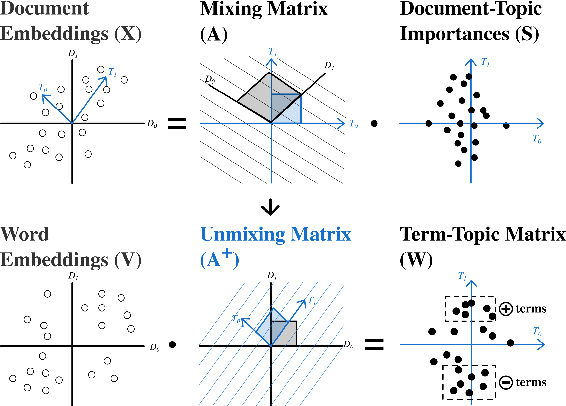
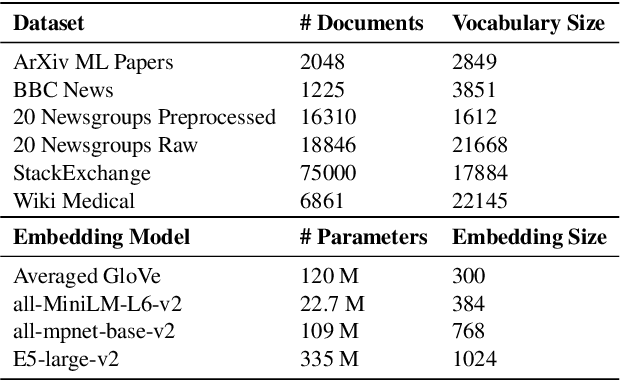
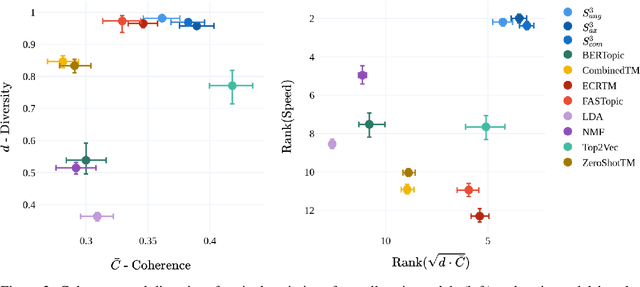
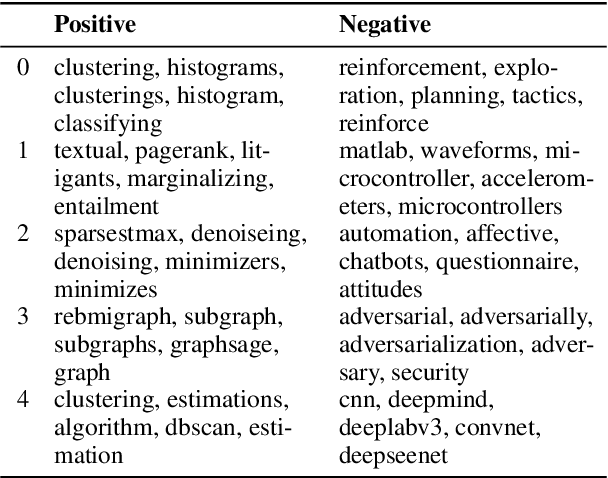
Topic models are useful tools for discovering latent semantic structures in large textual corpora. Topic modeling historically relied on bag-of-words representations of language. This approach makes models sensitive to the presence of stop words and noise, and does not utilize potentially useful contextual information. Recent efforts have been oriented at incorporating contextual neural representations in topic modeling and have been shown to outperform classical topic models. These approaches are, however, typically slow, volatile and still require preprocessing for optimal results. We present Semantic Signal Separation ($S^3$), a theory-driven topic modeling approach in neural embedding spaces. $S^3$ conceptualizes topics as independent axes of semantic space, and uncovers these with blind-source separation. Our approach provides the most diverse, highly coherent topics, requires no preprocessing, and is demonstrated to be the fastest contextually sensitive topic model to date. We offer an implementation of $S^3$, among other approaches, in the Turftopic Python package.
Large language models surpass human experts in predicting neuroscience results
Mar 14, 2024Scientific discoveries often hinge on synthesizing decades of research, a task that potentially outstrips human information processing capacities. Large language models (LLMs) offer a solution. LLMs trained on the vast scientific literature could potentially integrate noisy yet interrelated findings to forecast novel results better than human experts. To evaluate this possibility, we created BrainBench, a forward-looking benchmark for predicting neuroscience results. We find that LLMs surpass experts in predicting experimental outcomes. BrainGPT, an LLM we tuned on the neuroscience literature, performed better yet. Like human experts, when LLMs were confident in their predictions, they were more likely to be correct, which presages a future where humans and LLMs team together to make discoveries. Our approach is not neuroscience-specific and is transferable to other knowledge-intensive endeavors.
Automated speech- and text-based classification of neuropsychiatric conditions in a multidiagnostic setting
Jan 13, 2023
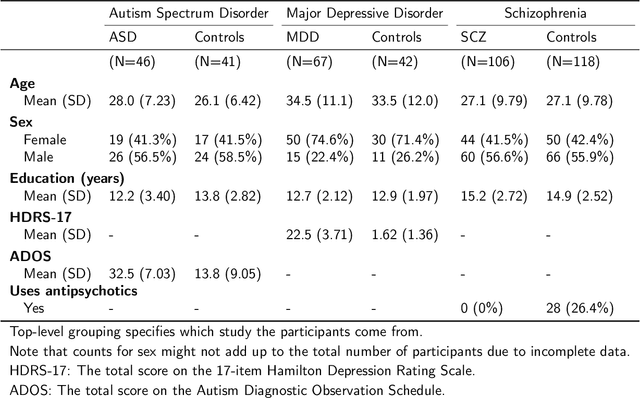

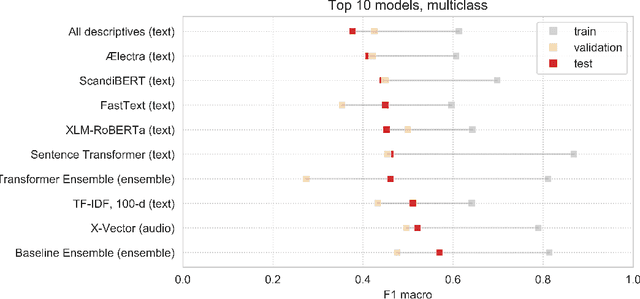
Speech patterns have been identified as potential diagnostic markers for neuropsychiatric conditions. However, most studies only compare a single clinical group to healthy controls, whereas clinical practice often requires differentiating between multiple potential diagnoses (multiclass settings). To address this, we assembled a dataset of repeated recordings from 420 participants (67 with major depressive disorder, 106 with schizophrenia and 46 with autism, as well as matched controls), and tested the performance of a range of conventional machine learning models and advanced Transformer models on both binary and multiclass classification, based on voice and text features. While binary models performed comparably to previous research (F1 scores between 0.54-0.75 for autism spectrum disorder, ASD; 0.67-0.92 for major depressive disorder, MDD; and 0.71-0.83 for schizophrenia); when differentiating between multiple diagnostic groups performance decreased markedly (F1 scores between 0.35-0.44 for ASD, 0.57-0.75 for MDD, 0.15-0.66 for schizophrenia, and 0.38-0.52 macro F1). Combining voice and text-based models yielded increased performance, suggesting that they capture complementary diagnostic information. Our results indicate that models trained on binary classification may learn to rely on markers of generic differences between clinical and non-clinical populations, or markers of clinical features that overlap across conditions, rather than identifying markers specific to individual conditions. We provide recommendations for future research in the field, suggesting increased focus on developing larger transdiagnostic datasets that include more fine-grained clinical features, and that can support the development of models that better capture the complexity of neuropsychiatric conditions and naturalistic diagnostic assessment.