 Add to Chrome
 Add to Firefox
 Add to Edge
Multi-Large Language Model Orchestrated Severity Assessment of Clinical Records (MOSAIC)
Jul 06, 2026
Background: Disease severity is a multidimensional construct difficult to capture with rule-based approaches in Electronic Healthcare Records (EHR). Agentic large language model (LLM) systems could synthesise clinical evidence and reason over EHRs, but remain unevaluated for this task. Methods: MOSAIC is a two-phase agentic LLM framework for severity phenotyping, using type 2 diabetes (T2D) as a proof-of-concept. MOSAIC was evaluated on a synthetic cohort (SyntheticMass; open-weight N = 4,886; closed-weight N = 200) against three algorithmic ground truths (DCSI, DiSSCo, Cooper) and against all-cause mortality and incident complications. Open-weight (locally deployable) and proprietary pipelines were also compared. Results: The generated framework spanned domains absent from the comparators, including biomarker-based glycaemic staging, beta-cell function, and social determinants of health. Open-weight MOSAIC matched the proprietary pipeline (closed- vs open-weight weighted kappa = 0.773) and reached moderate agreement with Cooper (kappa = 0.597) and DCSI (kappa = 0.534) and fair agreement with DiSSCo (kappa = 0.320). Agent-based (Type 1) tiers showed significant separation of all-cause mortality (log-rank p < 0.001; crude hazard ratios 1.6-2.4 for non-Baseline tiers), with non-monotonic separation at the upper tiers, and an inverse gradient for incident complications (log-rank p < 0.001) consistent with depletion of susceptibles. Agentic classification also diverged from deterministic execution of the same rubric (MOSAIC Frozen; kappa = 0.428), indicating reasoning beyond fixed rules. Conclusion: MOSAIC shows agentic LLM systems can generate and apply clinically meaningful severity phenotypes from structured EHR data in T2D. Extending it to other diseases with similarly multidimensional severity warrants further research.

$S^3$ -- Semantic Signal Separation
Jun 18, 2024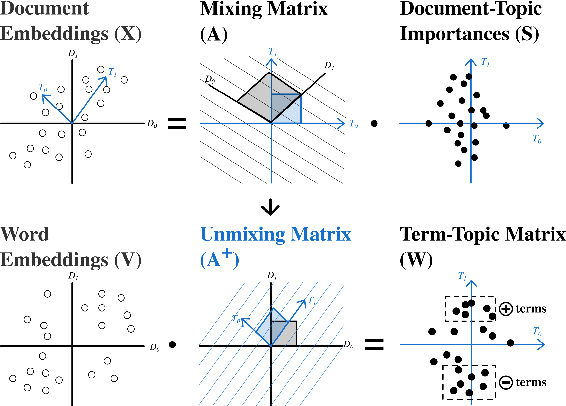
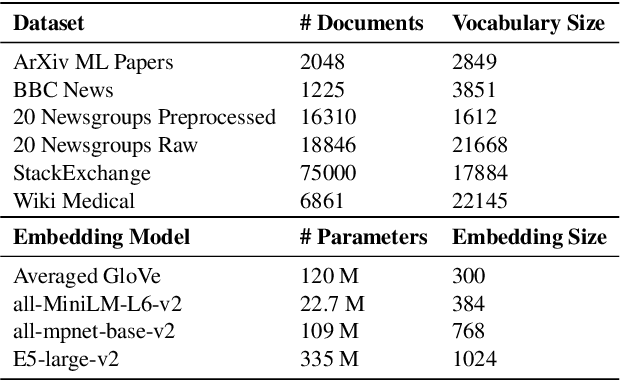
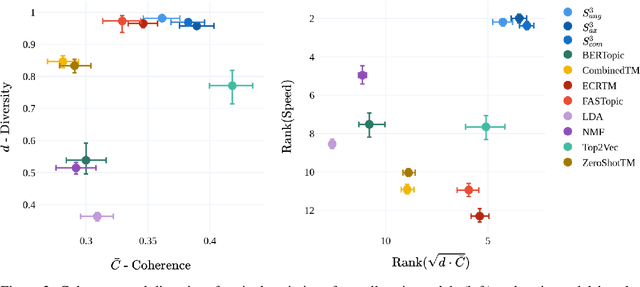
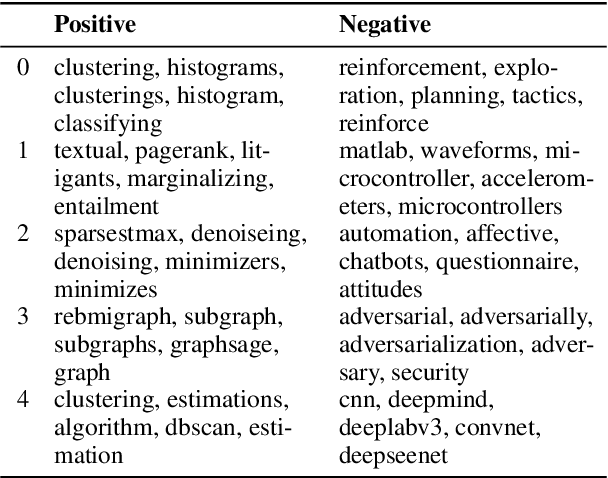
Topic models are useful tools for discovering latent semantic structures in large textual corpora. Topic modeling historically relied on bag-of-words representations of language. This approach makes models sensitive to the presence of stop words and noise, and does not utilize potentially useful contextual information. Recent efforts have been oriented at incorporating contextual neural representations in topic modeling and have been shown to outperform classical topic models. These approaches are, however, typically slow, volatile and still require preprocessing for optimal results. We present Semantic Signal Separation ($S^3$), a theory-driven topic modeling approach in neural embedding spaces. $S^3$ conceptualizes topics as independent axes of semantic space, and uncovers these with blind-source separation. Our approach provides the most diverse, highly coherent topics, requires no preprocessing, and is demonstrated to be the fastest contextually sensitive topic model to date. We offer an implementation of $S^3$, among other approaches, in the Turftopic Python package.