 Add to Chrome
 Add to Firefox
 Add to Edge
SGD at the Edge of Stability: Stochastic Stabilization with Large Learning Rates
Jun 29, 2026
Modern deep learning has been shown to operate at the edge of stability, routinely using learning rates far larger than those justified by classical optimization theory. Most prior analyses of the edge of stability phenomenon focus on deterministic gradient descent, leaving the stochastic setting largely unexplored. In this work, we provide sharp convergence guarantees for Stochastic Gradient Descent (SGD) applied to the multiclass cross-entropy loss, for both linear classifiers and two-layer neural networks. We show that the stochasticity of SGD may cause the dynamics to alternate between an edge-of-stability regime that is dominated by curvature-driven oscillations, and a stable regime in which the expected loss decreases at a controlled rate. Despite that, we prove that SGD self-stabilizes the dynamics, ensuring that the iterates return to stability in a fixed number of iterations and allowing convergence in the best-iterate sense even with large learning rates. Experiments validate our theoretical findings and illustrate the benefits of SGD in the large-stepsize regime.

Transformers Learn the Optimal DDPM Denoiser for Multi-Token GMMs
Apr 11, 2026Transformer-based diffusion models have demonstrated remarkable performance at generating high-quality samples. However, our theoretical understanding of the reasons for this success remains limited. For instance, existing models are typically trained by minimizing a denoising objective, which is equivalent to fitting the score function of the training data. However, we do not know why transformer-based models can match the score function for denoising, or why gradient-based methods converge to the optimal denoising model despite the non-convex loss landscape. To the best of our knowledge, this paper provides the first convergence analysis for training transformer-based diffusion models. More specifically, we consider the population Denoising Diffusion Probabilistic Model (DDPM) objective for denoising data that follow a multi-token Gaussian mixture distribution. We theoretically quantify the required number of tokens per data point and training iterations for the global convergence towards the Bayes optimal risk of the denoising objective, thereby achieving a desired score matching error. A deeper investigation reveals that the self-attention module of the trained transformer implements a mean denoising mechanism that enables the trained model to approximate the oracle Minimum Mean Squared Error (MMSE) estimator of the injected noise in the diffusion steps. Numerical experiments validate these findings.
Shuffling the Data, Stretching the Step-size: Sharper Bias in constant step-size SGD
Apr 11, 2026From adversarial robustness to multi-agent learning, many machine learning tasks can be cast as finite-sum min-max optimization or, more generally, as variational inequality problems (VIPs). Owing to their simplicity and scalability, stochastic gradient methods with constant step size are widely used, despite the fact that they converge only up to a constant term. Among the many heuristics adopted in practice, two classical techniques have recently attracted attention to mitigate this issue: \emph{Random Reshuffling} of data and \emph{Richardson--Romberg extrapolation} across iterates. Random Reshuffling sharpens the mean-squared error (MSE) of the estimated solution, while Richardson-Romberg extrapolation acts orthogonally, providing a second-order reduction in its bias. In this work, we show that their composition is strictly better than both, not only maintaining the enhanced MSE guarantees but also yielding an even greater cubic refinement in the bias. To the best of our knowledge, our work provides the first theoretical guarantees for such a synergy in structured non-monotone VIPs. Our analysis proceeds in two steps: (i) we smooth the discrete noise induced by reshuffling and leverage tools from continuous-state Markov chain theory to establish a novel law of large numbers and a central limit theorem for its iterates; and (ii) we employ spectral tensor techniques to prove that extrapolation debiases and sharpens the asymptotic behavior even under the biased gradient oracle induced by reshuffling. Finally, extensive experiments validate our theory, consistently demonstrating substantial speedups in practice.
Reliable and Responsible Foundation Models: A Comprehensive Survey
Feb 04, 2026Foundation models, including Large Language Models (LLMs), Multimodal Large Language Models (MLLMs), Image Generative Models (i.e, Text-to-Image Models and Image-Editing Models), and Video Generative Models, have become essential tools with broad applications across various domains such as law, medicine, education, finance, science, and beyond. As these models see increasing real-world deployment, ensuring their reliability and responsibility has become critical for academia, industry, and government. This survey addresses the reliable and responsible development of foundation models. We explore critical issues, including bias and fairness, security and privacy, uncertainty, explainability, and distribution shift. Our research also covers model limitations, such as hallucinations, as well as methods like alignment and Artificial Intelligence-Generated Content (AIGC) detection. For each area, we review the current state of the field and outline concrete future research directions. Additionally, we discuss the intersections between these areas, highlighting their connections and shared challenges. We hope our survey fosters the development of foundation models that are not only powerful but also ethical, trustworthy, reliable, and socially responsible.
A Local Polyak-Lojasiewicz and Descent Lemma of Gradient Descent For Overparametrized Linear Models
May 16, 2025Most prior work on the convergence of gradient descent (GD) for overparameterized neural networks relies on strong assumptions on the step size (infinitesimal), the hidden-layer width (infinite), or the initialization (large, spectral, balanced). Recent efforts to relax these assumptions focus on two-layer linear networks trained with the squared loss. In this work, we derive a linear convergence rate for training two-layer linear neural networks with GD for general losses and under relaxed assumptions on the step size, width, and initialization. A key challenge in deriving this result is that classical ingredients for deriving convergence rates for nonconvex problems, such as the Polyak-{\L}ojasiewicz (PL) condition and Descent Lemma, do not hold globally for overparameterized neural networks. Here, we prove that these two conditions hold locally with local constants that depend on the weights. Then, we provide bounds on these local constants, which depend on the initialization of the weights, the current loss, and the global PL and smoothness constants of the non-overparameterized model. Based on these bounds, we derive a linear convergence rate for GD. Our convergence analysis not only improves upon prior results but also suggests a better choice for the step size, as verified through our numerical experiments.
Understanding the Learning Dynamics of LoRA: A Gradient Flow Perspective on Low-Rank Adaptation in Matrix Factorization
Mar 10, 2025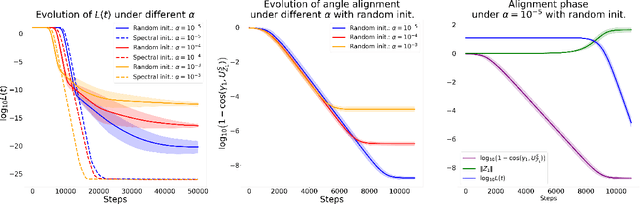
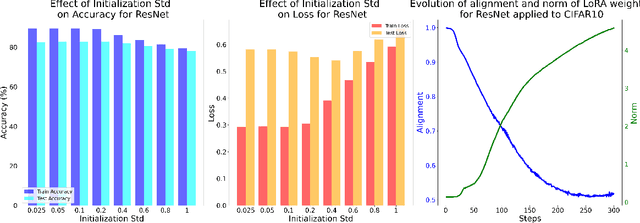
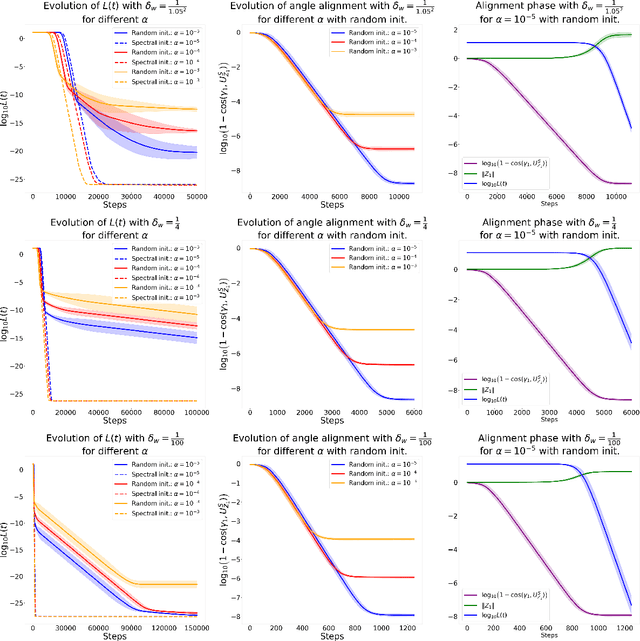
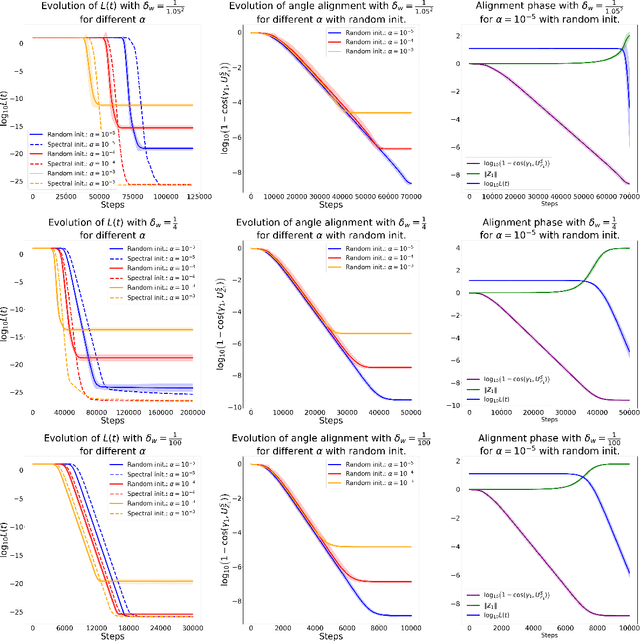
Despite the empirical success of Low-Rank Adaptation (LoRA) in fine-tuning pre-trained models, there is little theoretical understanding of how first-order methods with carefully crafted initialization adapt models to new tasks. In this work, we take the first step towards bridging this gap by theoretically analyzing the learning dynamics of LoRA for matrix factorization (MF) under gradient flow (GF), emphasizing the crucial role of initialization. For small initialization, we theoretically show that GF converges to a neighborhood of the optimal solution, with smaller initialization leading to lower final error. Our analysis shows that the final error is affected by the misalignment between the singular spaces of the pre-trained model and the target matrix, and reducing the initialization scale improves alignment. To address this misalignment, we propose a spectral initialization for LoRA in MF and theoretically prove that GF with small spectral initialization converges to the fine-tuning task with arbitrary precision. Numerical experiments from MF and image classification validate our findings.
Disentangling Safe and Unsafe Corruptions via Anisotropy and Locality
Jan 30, 2025


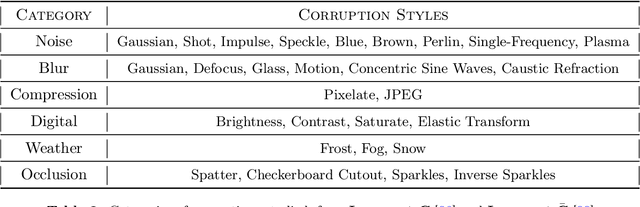
State-of-the-art machine learning systems are vulnerable to small perturbations to their input, where ``small'' is defined according to a threat model that assigns a positive threat to each perturbation. Most prior works define a task-agnostic, isotropic, and global threat, like the $\ell_p$ norm, where the magnitude of the perturbation fully determines the degree of the threat and neither the direction of the attack nor its position in space matter. However, common corruptions in computer vision, such as blur, compression, or occlusions, are not well captured by such threat models. This paper proposes a novel threat model called \texttt{Projected Displacement} (PD) to study robustness beyond existing isotropic and global threat models. The proposed threat model measures the threat of a perturbation via its alignment with \textit{unsafe directions}, defined as directions in the input space along which a perturbation of sufficient magnitude changes the ground truth class label. Unsafe directions are identified locally for each input based on observed training data. In this way, the PD threat model exhibits anisotropy and locality. Experiments on Imagenet-1k data indicate that, for any input, the set of perturbations with small PD threat includes \textit{safe} perturbations of large $\ell_p$ norm that preserve the true label, such as noise, blur and compression, while simultaneously excluding \textit{unsafe} perturbations that alter the true label. Unlike perceptual threat models based on embeddings of large-vision models, the PD threat model can be readily computed for arbitrary classification tasks without pre-training or finetuning. Further additional task annotation such as sensitivity to image regions or concept hierarchies can be easily integrated into the assessment of threat and thus the PD threat model presents practitioners with a flexible, task-driven threat specification.
Guarantees of a Preconditioned Subgradient Algorithm for Overparameterized Asymmetric Low-rank Matrix Recovery
Oct 22, 2024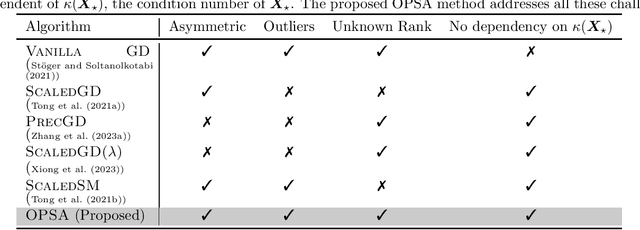
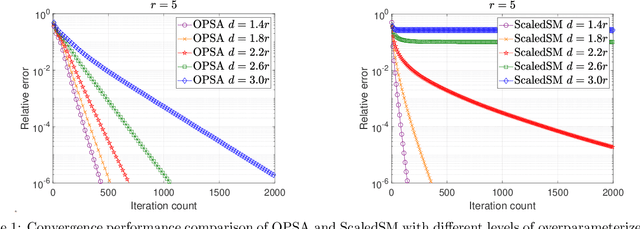
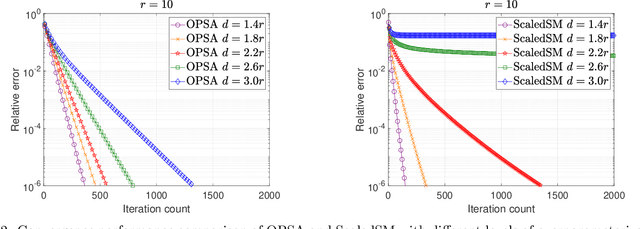

In this paper, we focus on a matrix factorization-based approach for robust low-rank and asymmetric matrix recovery from corrupted measurements. We address the challenging scenario where the rank of the sought matrix is unknown and employ an overparameterized approach using the variational form of the nuclear norm as a regularizer. We propose a subgradient algorithm that inherits the merits of preconditioned algorithms, whose rate of convergence does not depend on the condition number of the sought matrix, and addresses their current limitation, i.e., the lack of convergence guarantees in the case of asymmetric matrices with unknown rank. In this setting, we provide, for the first time in the literature, linear convergence guarantees for the derived overparameterized preconditioned subgradient algorithm in the presence of gross corruptions. Additionally, by applying our approach to matrix sensing, we highlight its merits when the measurement operator satisfies the mixed-norm restricted isometry properties. Lastly, we present numerical experiments that validate our theoretical results and demonstrate the effectiveness of our approach.
Multi-modal Generative Models in Recommendation System
Sep 17, 2024


Many recommendation systems limit user inputs to text strings or behavior signals such as clicks and purchases, and system outputs to a list of products sorted by relevance. With the advent of generative AI, users have come to expect richer levels of interactions. In visual search, for example, a user may provide a picture of their desired product along with a natural language modification of the content of the picture (e.g., a dress like the one shown in the picture but in red color). Moreover, users may want to better understand the recommendations they receive by visualizing how the product fits their use case, e.g., with a representation of how a garment might look on them, or how a furniture item might look in their room. Such advanced levels of interaction require recommendation systems that are able to discover both shared and complementary information about the product across modalities, and visualize the product in a realistic and informative way. However, existing systems often treat multiple modalities independently: text search is usually done by comparing the user query to product titles and descriptions, while visual search is typically done by comparing an image provided by the customer to product images. We argue that future recommendation systems will benefit from a multi-modal understanding of the products that leverages the rich information retailers have about both customers and products to come up with the best recommendations. In this chapter we review recommendation systems that use multiple data modalities simultaneously.
Large Language Model Driven Recommendation
Aug 20, 2024


While previous chapters focused on recommendation systems (RSs) based on standardized, non-verbal user feedback such as purchases, views, and clicks -- the advent of LLMs has unlocked the use of natural language (NL) interactions for recommendation. This chapter discusses how LLMs' abilities for general NL reasoning present novel opportunities to build highly personalized RSs -- which can effectively connect nuanced and diverse user preferences to items, potentially via interactive dialogues. To begin this discussion, we first present a taxonomy of the key data sources for language-driven recommendation, covering item descriptions, user-system interactions, and user profiles. We then proceed to fundamental techniques for LLM recommendation, reviewing the use of encoder-only and autoregressive LLM recommendation in both tuned and untuned settings. Afterwards, we move to multi-module recommendation architectures in which LLMs interact with components such as retrievers and RSs in multi-stage pipelines. This brings us to architectures for conversational recommender systems (CRSs), in which LLMs facilitate multi-turn dialogues where each turn presents an opportunity not only to make recommendations, but also to engage with the user in interactive preference elicitation, critiquing, and question-answering.