 Add to Chrome
 Add to Firefox
 Add to Edge
Towards Accurate and Fast Clinical Body Composition: A Resource-Efficient Hierarchical Segmentation Framework for Multi-Source CT
Jul 08, 2026
Background: Automated 3D segmentation of muscles and adipose tissue from CT is vital for body composition analysis, but multi-source data heterogeneity and high CPU memory demands hinder clinical deployment. Methods: We propose a coarse-to-fine hierarchical framework to segment ten tissue structures. Efficiency is optimized using Dynamic Spacing and Anisotropic Patching, a Group Inference mechanism for low-memory sliding-window processing, and Topology-Aware Asymmetric Resampling for fast post-processing. Results: The framework was trained on 1,558 CT volumes from seven public and two private datasets, and evaluated on an independent test cohort (N=105), per-structure Dice coefficients ranged from 0.924 to 0.982. Eight major structures met the +-10% relative error clinical acceptance limit. On a 12-core CPU workstation, the GPU-free pipeline averaged 44.5 seconds per volume with 4.73 GB peak memory. Conclusion: This framework balances accuracy and efficiency, enabling robust, large-scale body composition analysis on standard CPU workstations.

A Lossless Intra Reference Block Recompression Scheme for Bandwidth Reduction in HEVC-IBC
Apr 05, 2021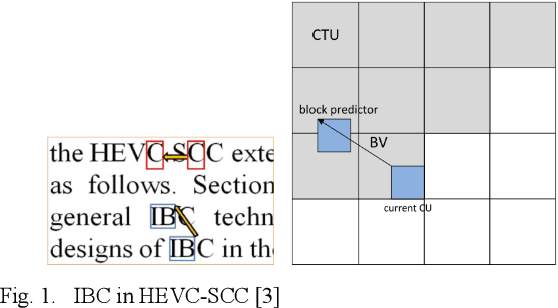
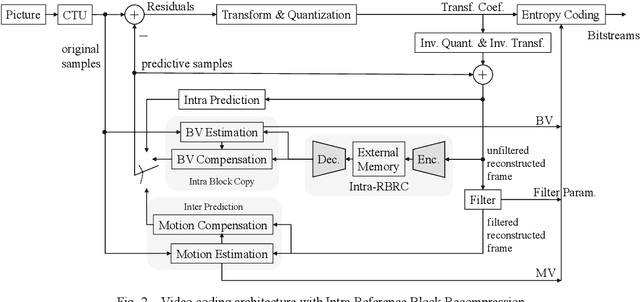
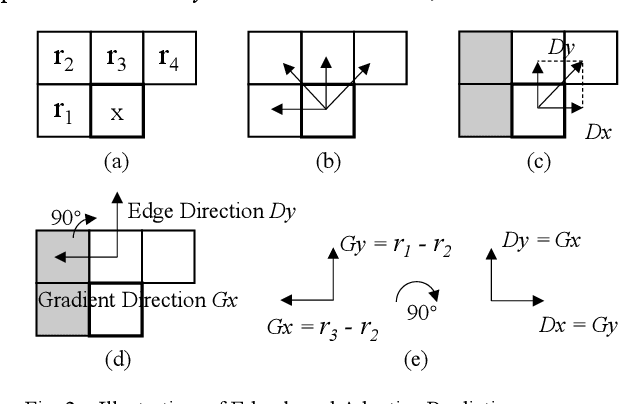
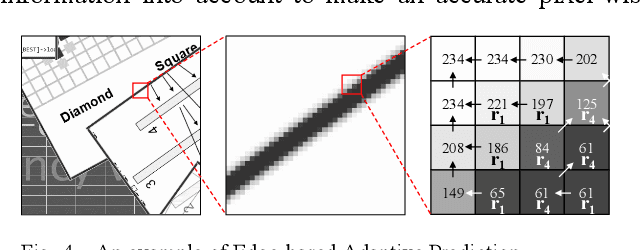
The reference frame memory accesses in inter prediction result in high DRAM bandwidth requirement and power consumption. This problem is more intensive by the adoption of intra block copy (IBC), a new coding tool in the screen content coding (SCC) extension to High Efficiency Video Coding (HEVC). In this paper, we propose a lossless recompression scheme that compresses the reference blocks in intra prediction, i.e., intra block copy, before storing them into DRAM to alleviate this problem. The proposal performs pixel-wise texture analysis with an edge-based adaptive prediction method yet no signaling for direction in bitstreams, thus achieves a high gain for compression. Experimental results demonstrate that the proposed scheme shows a 72% data reduction rate on average, which solves the memory bandwidth problem.
Co-active Learning to Adapt Humanoid Movement for Manipulation
Sep 12, 2016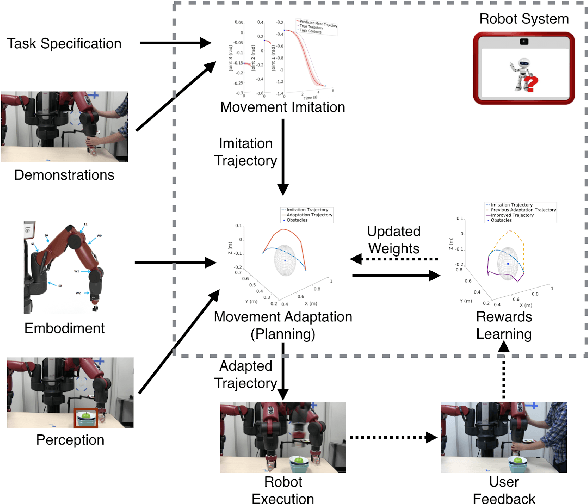
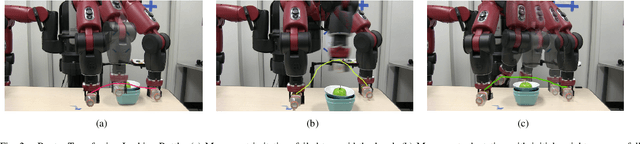
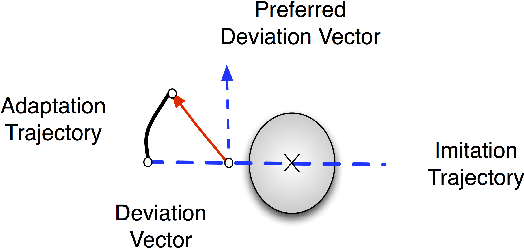
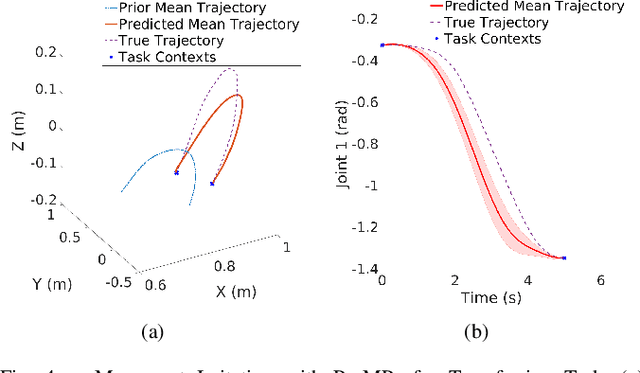
In this paper we address the problem of robot movement adaptation under various environmental constraints interactively. Motion primitives are generally adopted to generate target motion from demonstrations. However, their generalization capability is weak while facing novel environments. Additionally, traditional motion generation methods do not consider the versatile constraints from various users, tasks, and environments. In this work, we propose a co-active learning framework for learning to adapt robot end-effector's movement for manipulation tasks. It is designed to adapt the original imitation trajectories, which are learned from demonstrations, to novel situations with various constraints. The framework also considers user's feedback towards the adapted trajectories, and it learns to adapt movement through human-in-the-loop interactions. The implemented system generalizes trained motion primitives to various situations with different constraints considering user preferences. Experiments on a humanoid platform validate the effectiveness of our approach.