 Add to Chrome
 Add to Firefox
 Add to Edge
Towards Accurate and Fast Clinical Body Composition: A Resource-Efficient Hierarchical Segmentation Framework for Multi-Source CT
Jul 08, 2026
Background: Automated 3D segmentation of muscles and adipose tissue from CT is vital for body composition analysis, but multi-source data heterogeneity and high CPU memory demands hinder clinical deployment. Methods: We propose a coarse-to-fine hierarchical framework to segment ten tissue structures. Efficiency is optimized using Dynamic Spacing and Anisotropic Patching, a Group Inference mechanism for low-memory sliding-window processing, and Topology-Aware Asymmetric Resampling for fast post-processing. Results: The framework was trained on 1,558 CT volumes from seven public and two private datasets, and evaluated on an independent test cohort (N=105), per-structure Dice coefficients ranged from 0.924 to 0.982. Eight major structures met the +-10% relative error clinical acceptance limit. On a 12-core CPU workstation, the GPU-free pipeline averaged 44.5 seconds per volume with 4.73 GB peak memory. Conclusion: This framework balances accuracy and efficiency, enabling robust, large-scale body composition analysis on standard CPU workstations.

Image Aesthetics Assessment Using Composite Features from off-the-Shelf Deep Models
Feb 22, 2019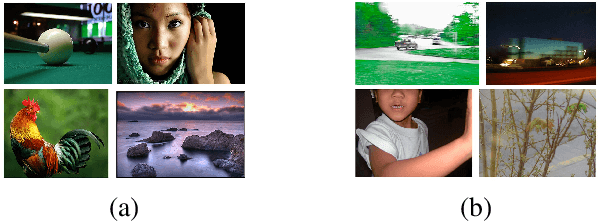
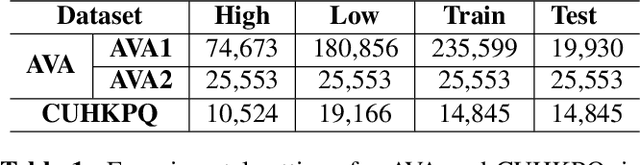
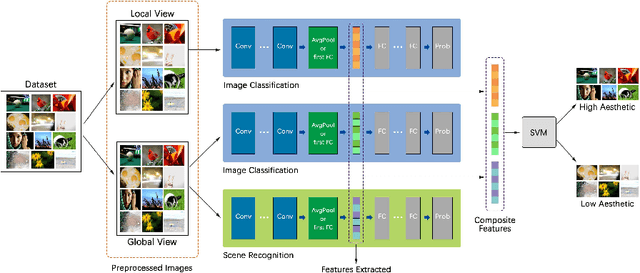
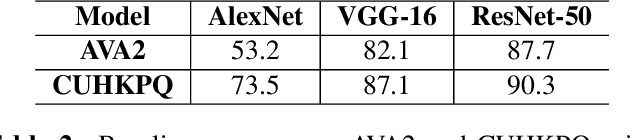
Deep convolutional neural networks have recently achieved great success on image aesthetics assessment task. In this paper, we propose an efficient method which takes the global, local and scene-aware information of images into consideration and exploits the composite features extracted from corresponding pretrained deep learning models to classify the derived features with support vector machine. Contrary to popular methods that require fine-tuning or training a new model from scratch, our training-free method directly takes the deep features generated by off-the-shelf models for image classification and scene recognition. Also, we analyzed the factors that could influence the performance from two aspects: the architecture of the deep neural network and the contribution of local and scene-aware information. It turns out that deep residual network could produce more aesthetics-aware image representation and composite features lead to the improvement of overall performance. Experiments on common large-scale aesthetics assessment benchmarks demonstrate that our method outperforms the state-of-the-art results in photo aesthetics assessment.