 Add to Chrome
 Add to Firefox
 Add to Edge
HumanSplatHMR: Closing the Loop Between Human Mesh Recovery and Gaussian Splatting Avatar
May 04, 2026
Accurately recovering human pose and appearance from video is an essential component of scene reconstruction, with applications to motion capture, motion prediction, virtual reality, and digital twinning. Despite significant interest in building realistic human avatars from video, this paper demonstrates that existing methods do not accurately recover the 3D geometry of humans. ViT-based approaches are not consistently reliable and can overfit to 2D views, while NeRF- and Gaussian Splatting-based avatars treat pose and appearance separately, limiting rendering generalization to new poses. To resolve these shortcomings, this paper proposes HumanSplatHMR, a joint optimization framework that refines 3D human poses while simultaneously learning a high-fidelity avatar for novel-view and novel-pose synthesis. Our key insight is to close the loop between geometric pose estimation and differentiable rendering. Unlike prior human avatar methods that rely on accurate human pose obtained through motion capture systems or offline refinement, which are impractical in in-the-wild scenarios, our approach uses only human mesh estimates from a state-of-the-art human pose estimator to better reflect real-world conditions. Therefore, instead of using the human pose only as a deformation prior, HumanSplatHMR backpropagates photometric, segmentation, and depth losses through a differentiable renderer to the pose parameters and global position. This coupling refines the global 3D pose over time, improving accuracy and alignment while producing better renderings from novel views. Experiments show consistent improvements over pose recovery baselines that omit image-level refinement and avatar baselines that decouple pose estimation from avatar reconstruction.

TrackDeform3D: Markerless and Autonomous 3D Keypoint Tracking and Dataset Collection for Deformable Objects
Mar 17, 2026Structured 3D representations such as keypoints and meshes offer compact, expressive descriptions of deformable objects, jointly capturing geometric and topological information useful for downstream tasks such as dynamics modeling and motion planning. However, robustly extracting such representations remains challenging, as current perception methods struggle to handle complex deformations. Moreover, large-scale 3D data collection remains a bottleneck: existing approaches either require prohibitive data collection efforts, such as labor-intensive annotation or expensive motion capture setups, or rely on simplifying assumptions that break down in unstructured environments. As a result, large-scale 3D datasets and benchmarks for deformable objects remain scarce. To address these challenges, this paper presents an affordable and autonomous framework for collecting 3D datasets of deformable objects using only RGB-D cameras. The proposed method identifies 3D keypoints and robustly tracks their trajectories, incorporating motion consistency constraints to produce temporally smooth and geometrically coherent data. TrackDeform3D is evaluated against several state-of-the-art tracking methods across diverse object categories and demonstrates consistent improvements in both geometric and tracking accuracy. Using this framework, this paper presents a high-quality, large-scale dataset consisting of 6 deformable objects, totaling 110 minutes of trajectory data.
DEFT: Differentiable Branched Discrete Elastic Rods for Modeling Furcated DLOs in Real-Time
Feb 20, 2025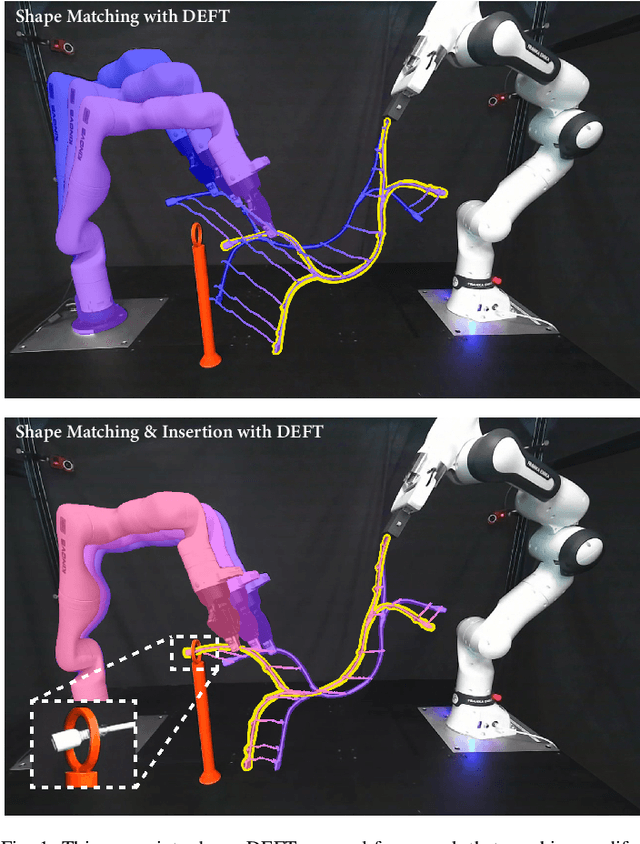
Autonomous wire harness assembly requires robots to manipulate complex branched cables with high precision and reliability. A key challenge in automating this process is predicting how these flexible and branched structures behave under manipulation. Without accurate predictions, it is difficult for robots to reliably plan or execute assembly operations. While existing research has made progress in modeling single-threaded Deformable Linear Objects (DLOs), extending these approaches to Branched Deformable Linear Objects (BDLOs) presents fundamental challenges. The junction points in BDLOs create complex force interactions and strain propagation patterns that cannot be adequately captured by simply connecting multiple single-DLO models. To address these challenges, this paper presents Differentiable discrete branched Elastic rods for modeling Furcated DLOs in real-Time (DEFT), a novel framework that combines a differentiable physics-based model with a learning framework to: 1) accurately model BDLO dynamics, including dynamic propagation at junction points and grasping in the middle of a BDLO, 2) achieve efficient computation for real-time inference, and 3) enable planning to demonstrate dexterous BDLO manipulation. A comprehensive series of real-world experiments demonstrates DEFT's efficacy in terms of accuracy, computational speed, and generalizability compared to state-of-the-art alternatives. Project page:https://roahmlab.github.io/DEFT/.