 Add to Chrome
 Add to Firefox
 Add to Edge
CRAG: Can 3D Generative Models Help 3D Assembly?
Feb 26, 2026
Most existing 3D assembly methods treat the problem as pure pose estimation, rearranging observed parts via rigid transformations. In contrast, human assembly naturally couples structural reasoning with holistic shape inference. Inspired by this intuition, we reformulate 3D assembly as a joint problem of assembly and generation. We show that these two processes are mutually reinforcing: assembly provides part-level structural priors for generation, while generation injects holistic shape context that resolves ambiguities in assembly. Unlike prior methods that cannot synthesize missing geometry, we propose CRAG, which simultaneously generates plausible complete shapes and predicts poses for input parts. Extensive experiments demonstrate state-of-the-art performance across in-the-wild objects with diverse geometries, varying part counts, and missing pieces. Our code and models will be released.

GARF: Learning Generalizable 3D Reassembly for Real-World Fractures
Apr 07, 20253D reassembly is a challenging spatial intelligence task with broad applications across scientific domains. While large-scale synthetic datasets have fueled promising learning-based approaches, their generalizability to different domains is limited. Critically, it remains uncertain whether models trained on synthetic datasets can generalize to real-world fractures where breakage patterns are more complex. To bridge this gap, we propose GARF, a generalizable 3D reassembly framework for real-world fractures. GARF leverages fracture-aware pretraining to learn fracture features from individual fragments, with flow matching enabling precise 6-DoF alignments. At inference time, we introduce one-step preassembly, improving robustness to unseen objects and varying numbers of fractures. In collaboration with archaeologists, paleoanthropologists, and ornithologists, we curate Fractura, a diverse dataset for vision and learning communities, featuring real-world fracture types across ceramics, bones, eggshells, and lithics. Comprehensive experiments have shown our approach consistently outperforms state-of-the-art methods on both synthetic and real-world datasets, achieving 82.87\% lower rotation error and 25.15\% higher part accuracy. This sheds light on training on synthetic data to advance real-world 3D puzzle solving, demonstrating its strong generalization across unseen object shapes and diverse fracture types.
LUWA Dataset: Learning Lithic Use-Wear Analysis on Microscopic Images
Mar 27, 2024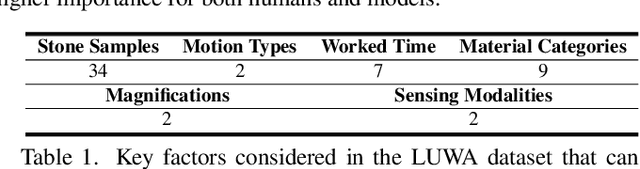
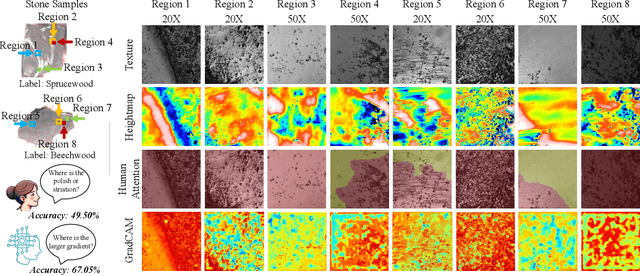
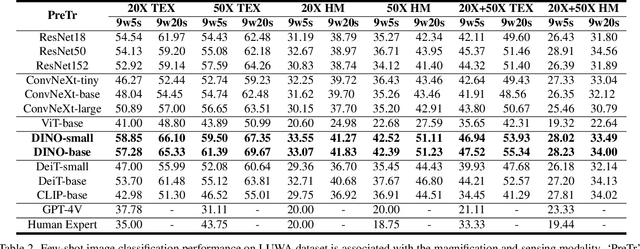
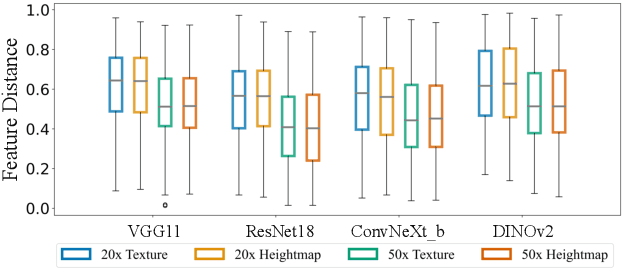
Lithic Use-Wear Analysis (LUWA) using microscopic images is an underexplored vision-for-science research area. It seeks to distinguish the worked material, which is critical for understanding archaeological artifacts, material interactions, tool functionalities, and dental records. However, this challenging task goes beyond the well-studied image classification problem for common objects. It is affected by many confounders owing to the complex wear mechanism and microscopic imaging, which makes it difficult even for human experts to identify the worked material successfully. In this paper, we investigate the following three questions on this unique vision task for the first time:(i) How well can state-of-the-art pre-trained models (like DINOv2) generalize to the rarely seen domain? (ii) How can few-shot learning be exploited for scarce microscopic images? (iii) How do the ambiguous magnification and sensing modality influence the classification accuracy? To study these, we collaborated with archaeologists and built the first open-source and the largest LUWA dataset containing 23,130 microscopic images with different magnifications and sensing modalities. Extensive experiments show that existing pre-trained models notably outperform human experts but still leave a large gap for improvements. Most importantly, the LUWA dataset provides an underexplored opportunity for vision and learning communities and complements existing image classification problems on common objects.