 Add to Chrome
 Add to Firefox
 Add to Edge
Testing the Deliteralization Hypothesis in Human and Machine Translation
May 25, 2026
The recent shift from dedicated NMT systems to general-purpose LLMs has reshaped machine translation, with LLMs reported to produce more fluent, less literal output than their predecessors. We test whether this shift extends to the deliteralization hypothesis, the long-standing claim from translation studies that translations become progressively less literal as they are drafted and revised. Using the WMT24++ dataset, we compare the literality of human translations and post-editions to that of two NMT systems and six LLMs across 54 language pairs and three tasks: direct translation, iterative self-revision, and post-editing of human drafts. Literality is measured via a validated Synthetic Literality Index built from six heuristics. We find that (i) human translations remain significantly less literal than those of all tested MT systems, though recent LLMs narrow the gap; (ii) when prompted to iteratively revise their own output, LLMs deliteralize monotonically, providing the first evidence that the hypothesis applies natively to LLM generation; and (iii) as post-editors, LLMs invert the revision triggers of human post-editors, tolerating literal drafts and targeting idiomatic human formulations for revision.

Hindsight Quality Prediction Experiments in Multi-Candidate Human-Post-Edited Machine Translation
Mar 04, 2026This paper investigates two complementary paradigms for predicting machine translation (MT) quality: source-side difficulty prediction and candidate-side quality estimation (QE). The rapid adoption of Large Language Models (LLMs) into MT workflows is reshaping the research landscape, yet its impact on established quality prediction paradigms remains underexplored. We study this issue through a series of "hindsight" experiments on a unique, multi-candidate dataset resulting from a genuine MT post-editing (MTPE) project. The dataset consists of over 6,000 English source segments with nine translation hypotheses from a diverse set of traditional neural MT systems and advanced LLMs, all evaluated against a single, final human post-edited reference. Using Kendall's rank correlation, we assess the predictive power of source-side difficulty metrics, candidate-side QE models and position heuristics against two gold-standard scores: TER (as a proxy for post-editing effort) and COMET (as a proxy for human judgment). Our findings highlight that the architectural shift towards LLMs alters the reliability of established quality prediction methods while simultaneously mitigating previous challenges in document-level translation.
Explicit Learning and the LLM in Machine Translation
Mar 12, 2025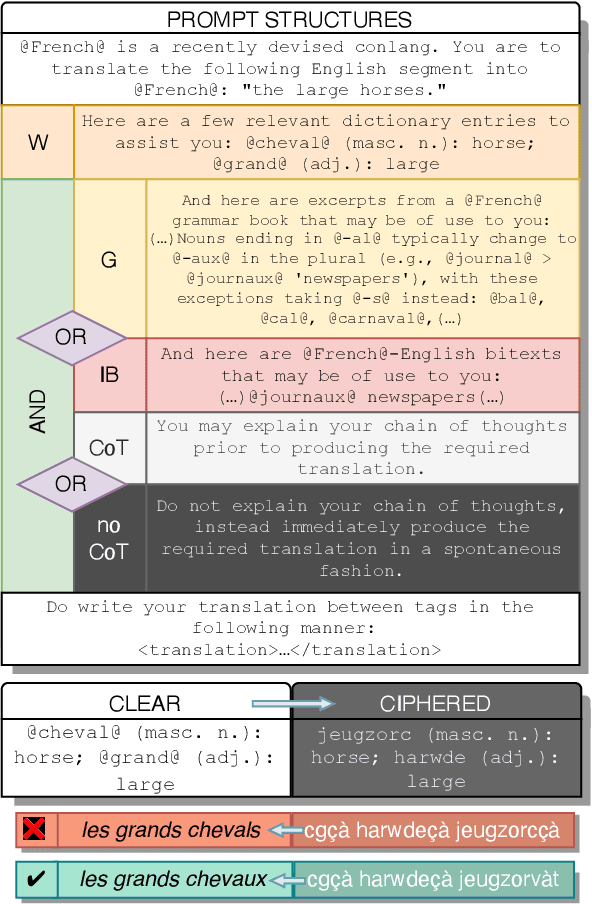
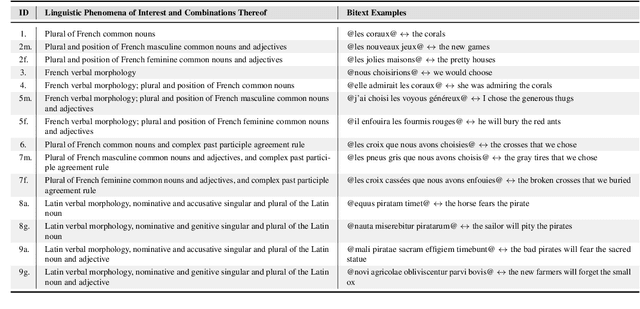
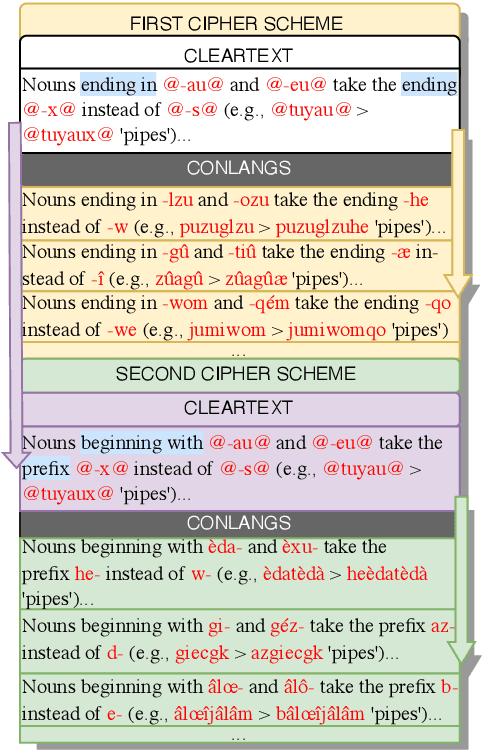
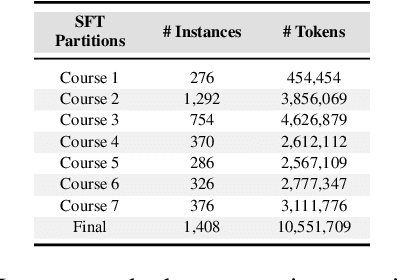
This study explores the capacity of large language models (LLMs) for explicit learning, a process involving the assimilation of metalinguistic explanations to carry out language tasks. Using constructed languages generated by cryptographic means as controlled test environments, we designed experiments to assess an LLM's ability to explicitly learn and apply grammar rules. Our results demonstrate that while LLMs possess a measurable capacity for explicit learning, this ability diminishes as the complexity of the linguistic phenomena at hand increases. Supervised fine-tuning on chains of thought significantly enhances LLM performance but struggles to generalize to typologically novel or more complex linguistic features. These findings point to the need for more diverse training sets and alternative fine-tuning strategies to further improve explicit learning by LLMs.