 Add to Chrome
 Add to Firefox
 Add to Edge
Learning fMRI activations dictionaries across individual geometries via optimal transport
May 20, 2026
Dictionary learning is a powerful tool for creating interpretable representations. When applied to functional magnetic resonance imaging (fMRI) data, the resulting patterns of brain activity can be used for various downstream tasks, such as brain state classification or population-level analysis. However, a major challenge is the variability in brain geometry across individuals. This is usually addressed by projecting each individual brain geometry onto a common template, which removes subject-specific information. In this work, we introduce a novel approach to dictionary learning on fMRI data that explicitly accounts for this variability. We use the optimal transport-based Fused Gromov-Wasserstein (FGW) distance to compare graphs with different geometries and features. To address the challenge of computing multiple FGW distances for large graphs such as those arising from fMRI data, we rely on amortized optimization to learn a neural network that predicts an approximation of the optimal transport plans, which substantially reduces the computational cost. Additionally, we learn dictionary atoms that depend on the FGW trade-off parameter, which controls the balance between feature alignment and structural consistency. Numerical experiments on the HCP dataset demonstrate that the proposed approach captures different levels of geometric variability in the data and provides representations that preserve essential information.

MSAlign: Aligning Molecule and Mass Spectra Foundation Models for Metabolite Identification
May 19, 2026Accurately identifying metabolites i.e. small molecules from mass spectrometry data remains a core challenge in metabolomics, with broad applications in drug discovery, environmental analysis, and clinical research. We address the Molecule Retrieval task, which consists in recovering the chemical structure of a metabolite from its MS/MS spectrum given a set of candidate molecules. While the recent release of benchmark datasets such as MassSpecGym and Spectraverse has considerably accelerated the development of novel machine learning approaches, the complexity of data preprocessing pipelines and the lack of unified implementations make methods and results difficult to reproduce and compare. We make three contributions. First, we propose a unified framework encompassing recent approaches based on representation alignment and contrastive learning. Second, we introduce MSAlign, inspired by multimodal alignment in vision-language models, which learns a shared representation space by aligning two frozen foundation models (DreaMS for mass spectra and ChemBERTa for molecules) through lightweight MLP projections trained with a candidate-based contrastive objective. MSAlign is simple to implement, fast to train and consistently outperforms existing approaches across all benchmarks. Third, we investigate a long-standing evaluation problem: data splitting strategies in molecule retrieval implicitly trade off data leakage against domain shift. We formalize this tension by introducing a quantitative measure of distribution shift, and use it to evaluate splitting strategies in existing benchmarks. All datasets, splits, candidate sets, and a unified implementation of MSAlign and baselines are publicly released to support reproducible research.
Geometric Dictionary Learning of Dynamical Systems with Optimal Transport
May 18, 2026Learning dynamical systems through operator-theoretic representations provides a powerful framework for analyzing complex dynamics, as spectral quantities such as eigenvalues and invariant structures encode characteristic time scales and long-term behavior. However, dynamical operators are typically estimated independently for each system, preventing the discovery of shared structure across related dynamics. To address this limitation, we posit that related dynamical systems lie near a low-dimensional manifold in spectral operator space. Based on this hypothesis, we introduce DOODL (Dynamical OperatOr Dictionary Learning), a framework that learns a dictionary of characteristic spectral dynamics whose combinations approximate this manifold and yield compact, interpretable embeddings of individual systems. Beyond representation learning, DOODL enables fast and interpretable operator estimation from short and partially observed trajectories by constraining the estimation to the learned operator manifold. Experiments on metastable Langevin dynamics and turbulent plasma simulations demonstrate that DOODL scales to highly complex multiscale regimes while capturing characteristic spectral structure governing the dynamics rather than merely fitting trajectories, achieving errors one to two orders of magnitude lower than independent operator estimation methods in challenging low-data regimes.
The quest for the GRAph Level autoEncoder (GRALE)
May 28, 2025Although graph-based learning has attracted a lot of attention, graph representation learning is still a challenging task whose resolution may impact key application fields such as chemistry or biology. To this end, we introduce GRALE, a novel graph autoencoder that encodes and decodes graphs of varying sizes into a shared embedding space. GRALE is trained using an Optimal Transport-inspired loss that compares the original and reconstructed graphs and leverages a differentiable node matching module, which is trained jointly with the encoder and decoder. The proposed attention-based architecture relies on Evoformer, the core component of AlphaFold, which we extend to support both graph encoding and decoding. We show, in numerical experiments on simulated and molecular data, that GRALE enables a highly general form of pre-training, applicable to a wide range of downstream tasks, from classification and regression to more complex tasks such as graph interpolation, editing, matching, and prediction.
PSDNorm: Test-Time Temporal Normalization for Deep Learning on EEG Signals
Mar 06, 2025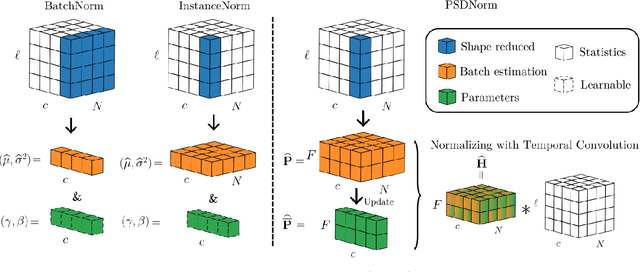
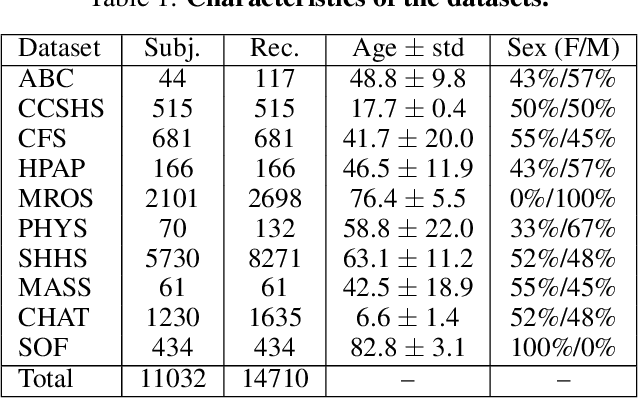
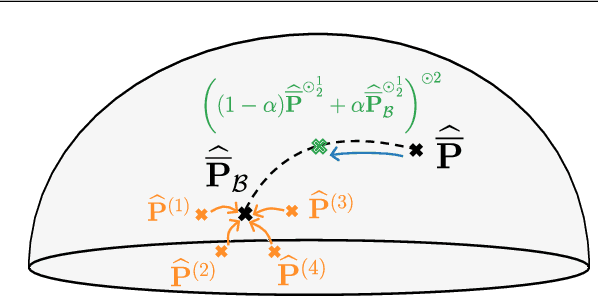
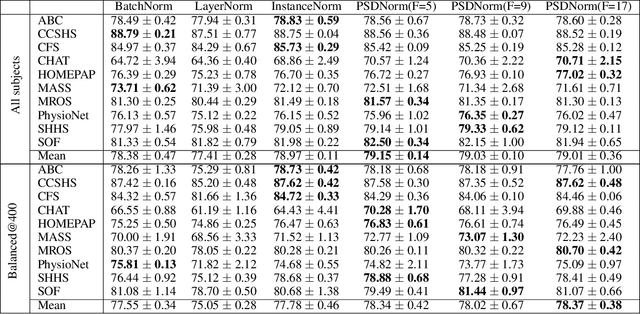
Distribution shift poses a significant challenge in machine learning, particularly in biomedical applications such as EEG signals collected across different subjects, institutions, and recording devices. While existing normalization layers, Batch-Norm, LayerNorm and InstanceNorm, help address distribution shifts, they fail to capture the temporal dependencies inherent in temporal signals. In this paper, we propose PSDNorm, a layer that leverages Monge mapping and temporal context to normalize feature maps in deep learning models. Notably, the proposed method operates as a test-time domain adaptation technique, addressing distribution shifts without additional training. Evaluations on 10 sleep staging datasets using the U-Time model demonstrate that PSDNorm achieves state-of-the-art performance at test time on datasets not seen during training while being 4x more data-efficient than the best baseline. Additionally, PSDNorm provides a significant improvement in robustness, achieving markedly higher F1 scores for the 20% hardest subjects.
Multi-Source and Test-Time Domain Adaptation on Multivariate Signals using Spatio-Temporal Monge Alignment
Jul 19, 2024Machine learning applications on signals such as computer vision or biomedical data often face significant challenges due to the variability that exists across hardware devices or session recordings. This variability poses a Domain Adaptation (DA) problem, as training and testing data distributions often differ. In this work, we propose Spatio-Temporal Monge Alignment (STMA) to mitigate these variabilities. This Optimal Transport (OT) based method adapts the cross-power spectrum density (cross-PSD) of multivariate signals by mapping them to the Wasserstein barycenter of source domains (multi-source DA). Predictions for new domains can be done with a filtering without the need for retraining a model with source data (test-time DA). We also study and discuss two special cases of the method, Temporal Monge Alignment (TMA) and Spatial Monge Alignment (SMA). Non-asymptotic concentration bounds are derived for the mappings estimation, which reveals a bias-plus-variance error structure with a variance decay rate of $\mathcal{O}(n_\ell^{-1/2})$ with $n_\ell$ the signal length. This theoretical guarantee demonstrates the efficiency of the proposed computational schema. Numerical experiments on multivariate biosignals and image data show that STMA leads to significant and consistent performance gains between datasets acquired with very different settings. Notably, STMA is a pre-processing step complementary to state-of-the-art deep learning methods.
SKADA-Bench: Benchmarking Unsupervised Domain Adaptation Methods with Realistic Validation
Jul 16, 2024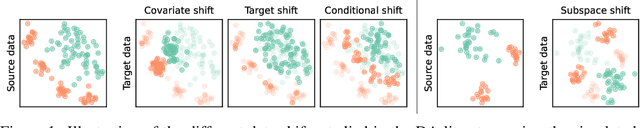
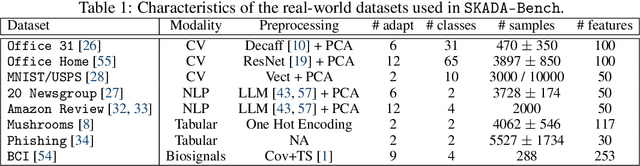
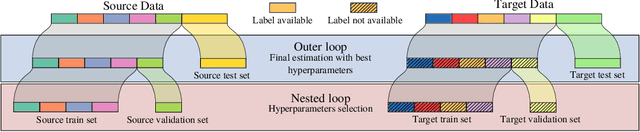
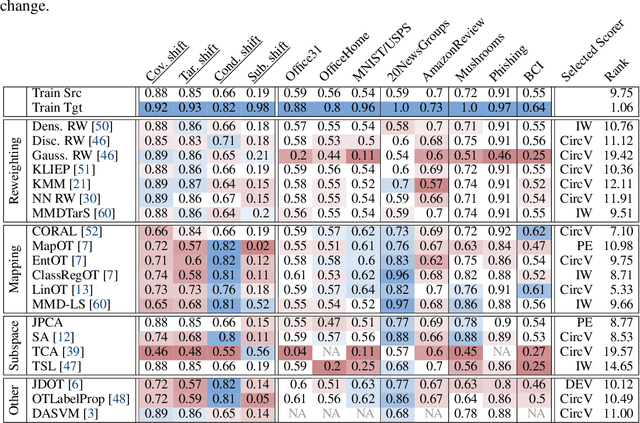
Unsupervised Domain Adaptation (DA) consists of adapting a model trained on a labeled source domain to perform well on an unlabeled target domain with some data distribution shift. While many methods have been proposed in the literature, fair and realistic evaluation remains an open question, particularly due to methodological difficulties in selecting hyperparameters in the unsupervised setting. With SKADA-Bench, we propose a framework to evaluate DA methods and present a fair evaluation of existing shallow algorithms, including reweighting, mapping, and subspace alignment. Realistic hyperparameter selection is performed with nested cross-validation and various unsupervised model selection scores, on both simulated datasets with controlled shifts and real-world datasets across diverse modalities, such as images, text, biomedical, and tabular data with specific feature extraction. Our benchmark highlights the importance of realistic validation and provides practical guidance for real-life applications, with key insights into the choice and impact of model selection approaches. SKADA-Bench is open-source, reproducible, and can be easily extended with novel DA methods, datasets, and model selection criteria without requiring re-evaluating competitors. SKADA-Bench is available on GitHub at https://github.com/scikit-adaptation/skada-bench.
End-to-end Supervised Prediction of Arbitrary-size Graphs with Partially-Masked Fused Gromov-Wasserstein Matching
Feb 23, 2024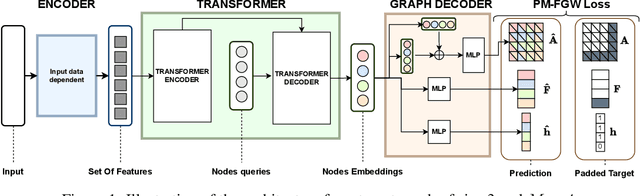
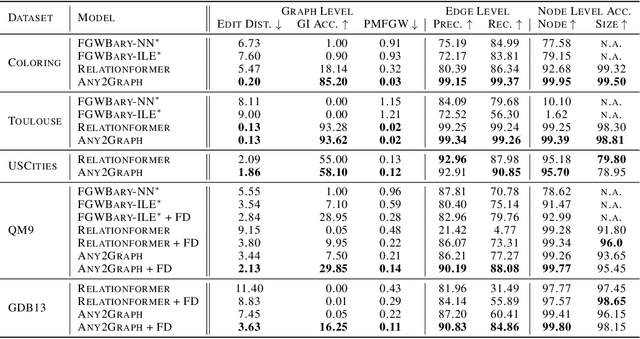
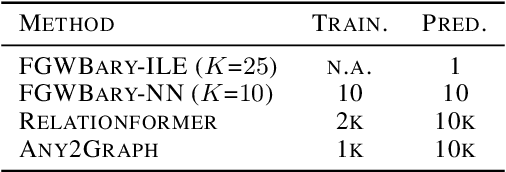
We present a novel end-to-end deep learning-based approach for Supervised Graph Prediction (SGP). We introduce an original Optimal Transport (OT)-based loss, the Partially-Masked Fused Gromov-Wasserstein loss (PM-FGW), that allows to directly leverage graph representations such as adjacency and feature matrices. PM-FGW exhibits all the desirable properties for SGP: it is node permutation invariant, sub-differentiable and handles graphs of different sizes by comparing their padded representations as well as their masking vectors. Moreover, we present a flexible transformer-based architecture that easily adapts to different types of input data. In the experimental section, three different tasks, a novel and challenging synthetic dataset (image2graph) and two real-world tasks, image2map and fingerprint2molecule - showcase the efficiency and versatility of the approach compared to competitors.
Distributional Reduction: Unifying Dimensionality Reduction and Clustering with Gromov-Wasserstein Projection
Feb 03, 2024Unsupervised learning aims to capture the underlying structure of potentially large and high-dimensional datasets. Traditionally, this involves using dimensionality reduction methods to project data onto interpretable spaces or organizing points into meaningful clusters. In practice, these methods are used sequentially, without guaranteeing that the clustering aligns well with the conducted dimensionality reduction. In this work, we offer a fresh perspective: that of distributions. Leveraging tools from optimal transport, particularly the Gromov-Wasserstein distance, we unify clustering and dimensionality reduction into a single framework called distributional reduction. This allows us to jointly address clustering and dimensionality reduction with a single optimization problem. Through comprehensive experiments, we highlight the versatility and interpretability of our method and show that it outperforms existing approaches across a variety of image and genomics datasets.
Weakly supervised covariance matrices alignment through Stiefel matrices estimation for MEG applications
Jan 24, 2024This paper introduces a novel domain adaptation technique for time series data, called Mixing model Stiefel Adaptation (MSA), specifically addressing the challenge of limited labeled signals in the target dataset. Leveraging a domain-dependent mixing model and the optimal transport domain adaptation assumption, we exploit abundant unlabeled data in the target domain to ensure effective prediction by establishing pairwise correspondence with equivalent signal variances between domains. Theoretical foundations are laid for identifying crucial Stiefel matrices, essential for recovering underlying signal variances from a Riemannian representation of observed signal covariances. We propose an integrated cost function that simultaneously learns these matrices, pairwise domain relationships, and a predictor, classifier, or regressor, depending on the task. Applied to neuroscience problems, MSA outperforms recent methods in brain-age regression with task variations using magnetoencephalography (MEG) signals from the Cam-CAN dataset.