 Add to Chrome
 Add to Firefox
 Add to Edge
Learning fMRI activations dictionaries across individual geometries via optimal transport
May 20, 2026
Dictionary learning is a powerful tool for creating interpretable representations. When applied to functional magnetic resonance imaging (fMRI) data, the resulting patterns of brain activity can be used for various downstream tasks, such as brain state classification or population-level analysis. However, a major challenge is the variability in brain geometry across individuals. This is usually addressed by projecting each individual brain geometry onto a common template, which removes subject-specific information. In this work, we introduce a novel approach to dictionary learning on fMRI data that explicitly accounts for this variability. We use the optimal transport-based Fused Gromov-Wasserstein (FGW) distance to compare graphs with different geometries and features. To address the challenge of computing multiple FGW distances for large graphs such as those arising from fMRI data, we rely on amortized optimization to learn a neural network that predicts an approximation of the optimal transport plans, which substantially reduces the computational cost. Additionally, we learn dictionary atoms that depend on the FGW trade-off parameter, which controls the balance between feature alignment and structural consistency. Numerical experiments on the HCP dataset demonstrate that the proposed approach captures different levels of geometric variability in the data and provides representations that preserve essential information.

SOTAlign: Semi-Supervised Alignment of Unimodal Vision and Language Models via Optimal Transport
Feb 26, 2026The Platonic Representation Hypothesis posits that neural networks trained on different modalities converge toward a shared statistical model of the world. Recent work exploits this convergence by aligning frozen pretrained vision and language models with lightweight alignment layers, but typically relies on contrastive losses and millions of paired samples. In this work, we ask whether meaningful alignment can be achieved with substantially less supervision. We introduce a semi-supervised setting in which pretrained unimodal encoders are aligned using a small number of image-text pairs together with large amounts of unpaired data. To address this challenge, we propose SOTAlign, a two-stage framework that first recovers a coarse shared geometry from limited paired data using a linear teacher, then refines the alignment on unpaired samples via an optimal-transport-based divergence that transfers relational structure without overconstraining the target space. Unlike existing semi-supervised methods, SOTAlign effectively leverages unpaired images and text, learning robust joint embeddings across datasets and encoder pairs, and significantly outperforming supervised and semi-supervised baselines.
Binding in hippocampal-entorhinal circuits enables compositionality in cognitive maps
Jun 27, 2024We propose a normative model for spatial representation in the hippocampal formation that combines optimality principles, such as maximizing coding range and spatial information per neuron, with an algebraic framework for computing in distributed representation. Spatial position is encoded in a residue number system, with individual residues represented by high-dimensional, complex-valued vectors. These are composed into a single vector representing position by a similarity-preserving, conjunctive vector-binding operation. Self-consistency between the representations of the overall position and of the individual residues is enforced by a modular attractor network whose modules correspond to the grid cell modules in entorhinal cortex. The vector binding operation can also associate different contexts to spatial representations, yielding a model for entorhinal cortex and hippocampus. We show that the model achieves normative desiderata including superlinear scaling of patterns with dimension, robust error correction, and hexagonal, carry-free encoding of spatial position. These properties in turn enable robust path integration and association with sensory inputs. More generally, the model formalizes how compositional computations could occur in the hippocampal formation and leads to testable experimental predictions.
Compositional Factorization of Visual Scenes with Convolutional Sparse Coding and Resonator Networks
Apr 29, 2024

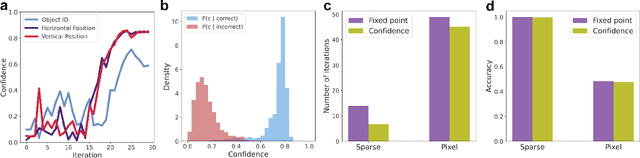
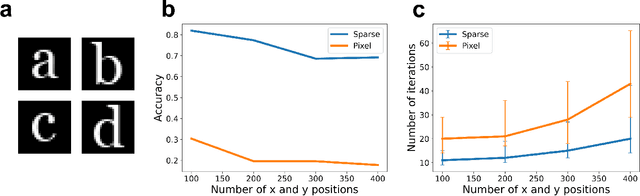
We propose a system for visual scene analysis and recognition based on encoding the sparse, latent feature-representation of an image into a high-dimensional vector that is subsequently factorized to parse scene content. The sparse feature representation is learned from image statistics via convolutional sparse coding, while scene parsing is performed by a resonator network. The integration of sparse coding with the resonator network increases the capacity of distributed representations and reduces collisions in the combinatorial search space during factorization. We find that for this problem the resonator network is capable of fast and accurate vector factorization, and we develop a confidence-based metric that assists in tracking the convergence of the resonator network.