 Add to Chrome
 Add to Firefox
 Add to Edge
Learning Ergodic Dynamical Systems from a Finite Trajectory
Jul 24, 2026
We consider the problem of learning from a single finite trajectory of an ergodic stochastic dynamical system. More precisely, we study discrete-time autonomous stochastic systems defining time-homogeneous Markov processes. We first focus on estimating the optimal one-step prediction function by nonlinear least squares, and derive high-probability guarantees measured with respect to the invariant measure of the process. These results make explicit how the non-independent and non-identically distributed nature of trajectory data modifies the classical statistical learning analysis. We then extend the framework to higher-order systems and finite-state spaces. Finally, we show that the same least squares and concentration arguments naturally extend to learning Koopman operators. Our approach combines tools from statistical learning theory and quantitative ergodic theory for Markov chains. It relies, in particular, on a concentration inequality for Hilbert-space-valued additive functionals of uniformly geometrically ergodic Markov chains.

Learning to control switching nonlinear systems with Koopman operator regression
Jul 13, 2026In this work, we consider the identification and control of nonlinear systems with finite action spaces. The unknown dynamics are estimated from finite samples with Koopman operator regression in a reproducing kernel Hilbert space, yielding a linear switching predictive model, the switches governed by the value of the control variable. In order to perform control in closed-loop, the learned dynamics are employed in an infinite-horizon optimal control problem with time-varying stage cost, which is solved by means of model predictive control. In a theoretical analysis, we derive learning rates for the Koopman dynamics approximation. We further quantify, under suitable assumptions, the sub-optimality of the model predictive control strategy, both in the case of exact Koopman dynamics, and in the case of learned ones. Numerical simulations on the Duffing oscillator complement our theoretical findings.
Learning to Embed Distributions via Maximum Kernel Entropy
Aug 01, 2024Empirical data can often be considered as samples from a set of probability distributions. Kernel methods have emerged as a natural approach for learning to classify these distributions. Although numerous kernels between distributions have been proposed, applying kernel methods to distribution regression tasks remains challenging, primarily because selecting a suitable kernel is not straightforward. Surprisingly, the question of learning a data-dependent distribution kernel has received little attention. In this paper, we propose a novel objective for the unsupervised learning of data-dependent distribution kernel, based on the principle of entropy maximization in the space of probability measure embeddings. We examine the theoretical properties of the latent embedding space induced by our objective, demonstrating that its geometric structure is well-suited for solving downstream discriminative tasks. Finally, we demonstrate the performance of the learned kernel across different modalities.
SKADA-Bench: Benchmarking Unsupervised Domain Adaptation Methods with Realistic Validation
Jul 16, 2024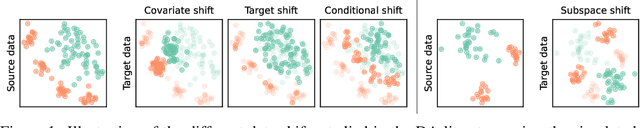
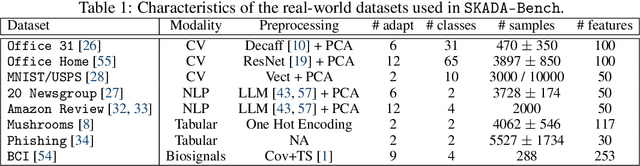
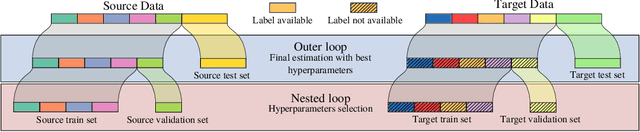
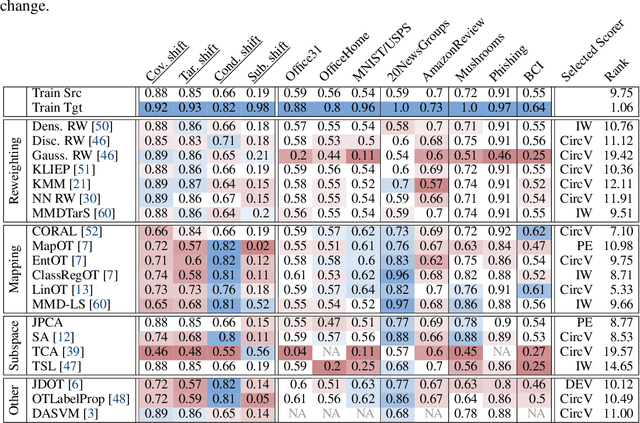
Unsupervised Domain Adaptation (DA) consists of adapting a model trained on a labeled source domain to perform well on an unlabeled target domain with some data distribution shift. While many methods have been proposed in the literature, fair and realistic evaluation remains an open question, particularly due to methodological difficulties in selecting hyperparameters in the unsupervised setting. With SKADA-Bench, we propose a framework to evaluate DA methods and present a fair evaluation of existing shallow algorithms, including reweighting, mapping, and subspace alignment. Realistic hyperparameter selection is performed with nested cross-validation and various unsupervised model selection scores, on both simulated datasets with controlled shifts and real-world datasets across diverse modalities, such as images, text, biomedical, and tabular data with specific feature extraction. Our benchmark highlights the importance of realistic validation and provides practical guidance for real-life applications, with key insights into the choice and impact of model selection approaches. SKADA-Bench is open-source, reproducible, and can be easily extended with novel DA methods, datasets, and model selection criteria without requiring re-evaluating competitors. SKADA-Bench is available on GitHub at https://github.com/scikit-adaptation/skada-bench.