 Add to Chrome
 Add to Firefox
 Add to Edge
Geometric Dictionary Learning of Dynamical Systems with Optimal Transport
May 18, 2026
Learning dynamical systems through operator-theoretic representations provides a powerful framework for analyzing complex dynamics, as spectral quantities such as eigenvalues and invariant structures encode characteristic time scales and long-term behavior. However, dynamical operators are typically estimated independently for each system, preventing the discovery of shared structure across related dynamics. To address this limitation, we posit that related dynamical systems lie near a low-dimensional manifold in spectral operator space. Based on this hypothesis, we introduce DOODL (Dynamical OperatOr Dictionary Learning), a framework that learns a dictionary of characteristic spectral dynamics whose combinations approximate this manifold and yield compact, interpretable embeddings of individual systems. Beyond representation learning, DOODL enables fast and interpretable operator estimation from short and partially observed trajectories by constraining the estimation to the learned operator manifold. Experiments on metastable Langevin dynamics and turbulent plasma simulations demonstrate that DOODL scales to highly complex multiscale regimes while capturing characteristic spectral structure governing the dynamics rather than merely fitting trajectories, achieving errors one to two orders of magnitude lower than independent operator estimation methods in challenging low-data regimes.

Toeplitz Based Spectral Methods for Data-driven Dynamical Systems
Feb 10, 2026We introduce a Toeplitz-based framework for data-driven spectral estimation of linear evolution operators in dynamical systems. Focusing on transfer and Koopman operators from equilibrium trajectories without access to the underlying equations of motion, our method applies Toeplitz filters to the infinitesimal generator to extract eigenvalues, eigenfunctions, and spectral measures. Structural prior knowledge, such as self-adjointness or skew-symmetry, can be incorporated by design. The approach is statistically consistent and computationally efficient, leveraging both primal and dual algorithms commonly used in statistical learning. Numerical experiments on deterministic and chaotic systems demonstrate that the framework can recover spectral properties beyond the reach of standard data-driven methods.
VertCoHiRF: Decentralized Vertical Clustering Beyond k-means
Feb 07, 2026Vertical Federated Learning (VFL) enables collaborative analysis across parties holding complementary feature views of the same samples, yet existing approaches are largely restricted to distributed variants of $k$-means, requiring centralized coordination or the exchange of feature-dependent numerical statistics, and exhibiting limited robustness under heterogeneous views or adversarial behavior. We introduce VertCoHiRF, a fully decentralized framework for vertical federated clustering based on structural consensus across heterogeneous views, allowing each agent to apply a base clustering method adapted to its local feature space in a peer-to-peer manner. Rather than exchanging feature-dependent statistics or relying on noise injection for privacy, agents cluster their local views independently and reconcile their proposals through identifier-level consensus. Consensus is achieved via decentralized ordinal ranking to select representative medoids, progressively inducing a shared hierarchical clustering across agents. Communication is limited to sample identifiers, cluster labels, and ordinal rankings, providing privacy by design while supporting overlapping feature partitions and heterogeneous local clustering methods, and yielding an interpretable shared Cluster Fusion Hierarchy (CFH) that captures cross-view agreement at multiple resolutions.We analyze communication complexity and robustness, and experiments demonstrate competitive clustering performance in vertical federated settings.
kooplearn: A Scikit-Learn Compatible Library of Algorithms for Evolution Operator Learning
Dec 24, 2025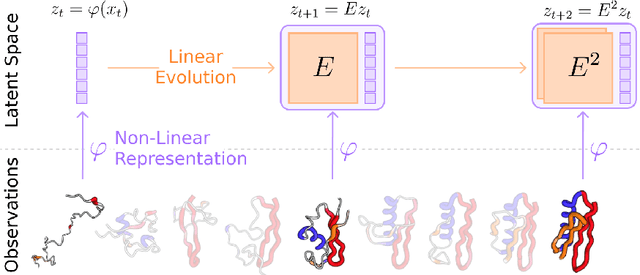
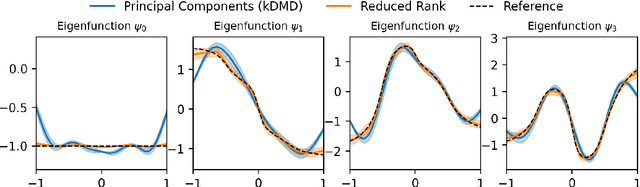
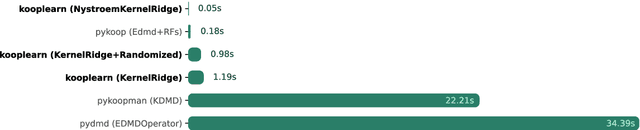
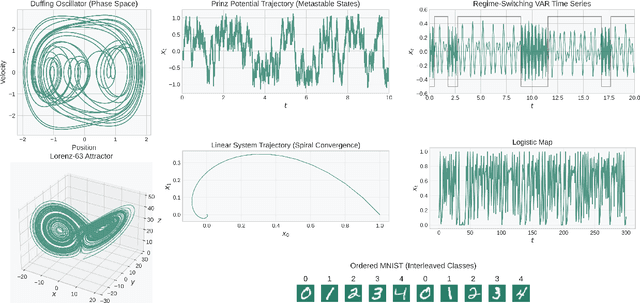
kooplearn is a machine-learning library that implements linear, kernel, and deep-learning estimators of dynamical operators and their spectral decompositions. kooplearn can model both discrete-time evolution operators (Koopman/Transfer) and continuous-time infinitesimal generators. By learning these operators, users can analyze dynamical systems via spectral methods, derive data-driven reduced-order models, and forecast future states and observables. kooplearn's interface is compliant with the scikit-learn API, facilitating its integration into existing machine learning and data science workflows. Additionally, kooplearn includes curated benchmark datasets to support experimentation, reproducibility, and the fair comparison of learning algorithms. The software is available at https://github.com/Machine-Learning-Dynamical-Systems/kooplearn.
Toward Scalable and Valid Conditional Independence Testing with Spectral Representations
Dec 22, 2025Conditional independence (CI) is central to causal inference, feature selection, and graphical modeling, yet it is untestable in many settings without additional assumptions. Existing CI tests often rely on restrictive structural conditions, limiting their validity on real-world data. Kernel methods using the partial covariance operator offer a more principled approach but suffer from limited adaptivity, slow convergence, and poor scalability. In this work, we explore whether representation learning can help address these limitations. Specifically, we focus on representations derived from the singular value decomposition of the partial covariance operator and use them to construct a simple test statistic, reminiscent of the Hilbert-Schmidt Independence Criterion (HSIC). We also introduce a practical bi-level contrastive algorithm to learn these representations. Our theory links representation learning error to test performance and establishes asymptotic validity and power guarantees. Preliminary experiments suggest that this approach offers a practical and statistically grounded path toward scalable CI testing, bridging kernel-based theory with modern representation learning.
Laplace Transform Based Low-Complexity Learning of Continuous Markov Semigroups
Oct 18, 2024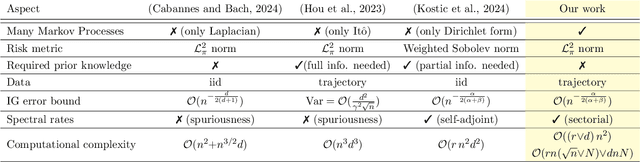
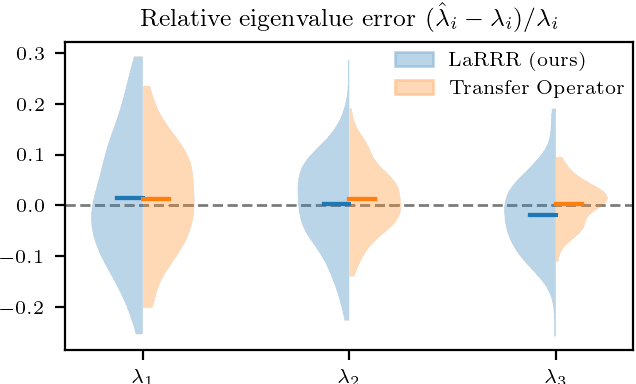
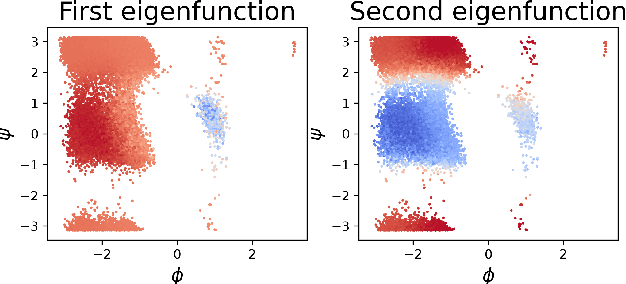
Markov processes serve as a universal model for many real-world random processes. This paper presents a data-driven approach for learning these models through the spectral decomposition of the infinitesimal generator (IG) of the Markov semigroup. The unbounded nature of IGs complicates traditional methods such as vector-valued regression and Hilbert-Schmidt operator analysis. Existing techniques, including physics-informed kernel regression, are computationally expensive and limited in scope, with no recovery guarantees for transfer operator methods when the time-lag is small. We propose a novel method that leverages the IG's resolvent, characterized by the Laplace transform of transfer operators. This approach is robust to time-lag variations, ensuring accurate eigenvalue learning even for small time-lags. Our statistical analysis applies to a broader class of Markov processes than current methods while reducing computational complexity from quadratic to linear in the state dimension. Finally, we illustrate the behaviour of our method in two experiments.
Multi-Source and Test-Time Domain Adaptation on Multivariate Signals using Spatio-Temporal Monge Alignment
Jul 19, 2024Machine learning applications on signals such as computer vision or biomedical data often face significant challenges due to the variability that exists across hardware devices or session recordings. This variability poses a Domain Adaptation (DA) problem, as training and testing data distributions often differ. In this work, we propose Spatio-Temporal Monge Alignment (STMA) to mitigate these variabilities. This Optimal Transport (OT) based method adapts the cross-power spectrum density (cross-PSD) of multivariate signals by mapping them to the Wasserstein barycenter of source domains (multi-source DA). Predictions for new domains can be done with a filtering without the need for retraining a model with source data (test-time DA). We also study and discuss two special cases of the method, Temporal Monge Alignment (TMA) and Spatial Monge Alignment (SMA). Non-asymptotic concentration bounds are derived for the mappings estimation, which reveals a bias-plus-variance error structure with a variance decay rate of $\mathcal{O}(n_\ell^{-1/2})$ with $n_\ell$ the signal length. This theoretical guarantee demonstrates the efficiency of the proposed computational schema. Numerical experiments on multivariate biosignals and image data show that STMA leads to significant and consistent performance gains between datasets acquired with very different settings. Notably, STMA is a pre-processing step complementary to state-of-the-art deep learning methods.
Neural Conditional Probability for Inference
Jul 01, 2024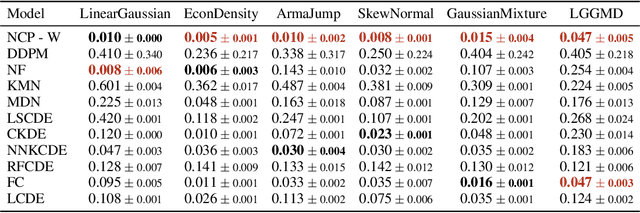
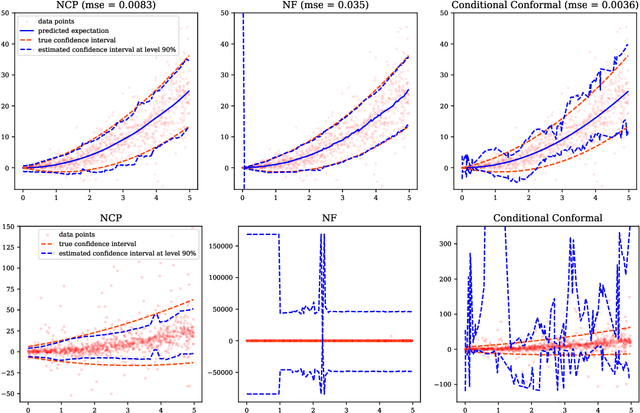

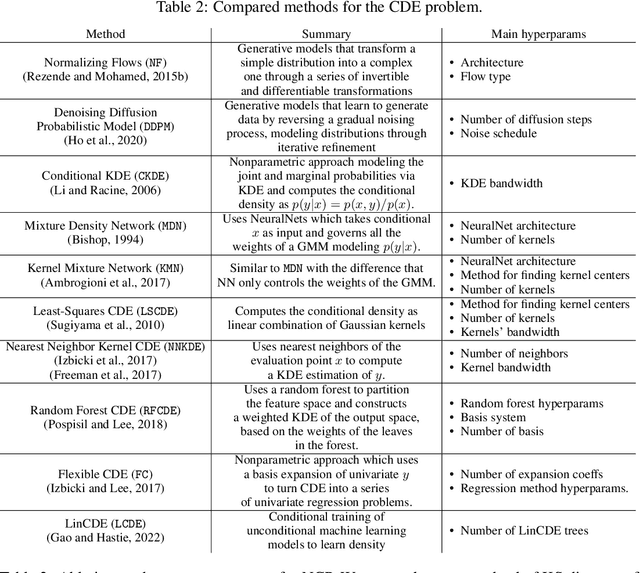
We introduce NCP (Neural Conditional Probability), a novel operator-theoretic approach for learning conditional distributions with a particular focus on inference tasks. NCP can be used to build conditional confidence regions and extract important statistics like conditional quantiles, mean, and covariance. It offers streamlined learning through a single unconditional training phase, facilitating efficient inference without the need for retraining even when conditioning changes. By tapping into the powerful approximation capabilities of neural networks, our method efficiently handles a wide variety of complex probability distributions, effectively dealing with nonlinear relationships between input and output variables. Theoretical guarantees ensure both optimization consistency and statistical accuracy of the NCP method. Our experiments show that our approach matches or beats leading methods using a simple Multi-Layer Perceptron (MLP) with two hidden layers and GELU activations. This demonstrates that a minimalistic architecture with a theoretically grounded loss function can achieve competitive results without sacrificing performance, even in the face of more complex architectures.
Contextual Continuum Bandits: Static Versus Dynamic Regret
Jun 09, 2024We study the contextual continuum bandits problem, where the learner sequentially receives a side information vector and has to choose an action in a convex set, minimizing a function associated to the context. The goal is to minimize all the underlying functions for the received contexts, leading to a dynamic (contextual) notion of regret, which is stronger than the standard static regret. Assuming that the objective functions are H\"older with respect to the contexts, we demonstrate that any algorithm achieving a sub-linear static regret can be extended to achieve a sub-linear dynamic regret. We further study the case of strongly convex and smooth functions when the observations are noisy. Inspired by the interior point method and employing self-concordant barriers, we propose an algorithm achieving a sub-linear dynamic regret. Lastly, we present a minimax lower bound, implying two key facts. First, no algorithm can achieve sub-linear dynamic regret over functions that are not continuous with respect to the context. Second, for strongly convex and smooth functions, the algorithm that we propose achieves, up to a logarithmic factor, the minimax optimal rate of dynamic regret as a function of the number of queries.
Learning the Infinitesimal Generator of Stochastic Diffusion Processes
May 21, 2024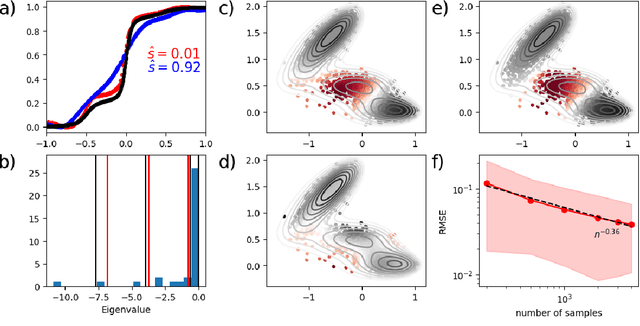
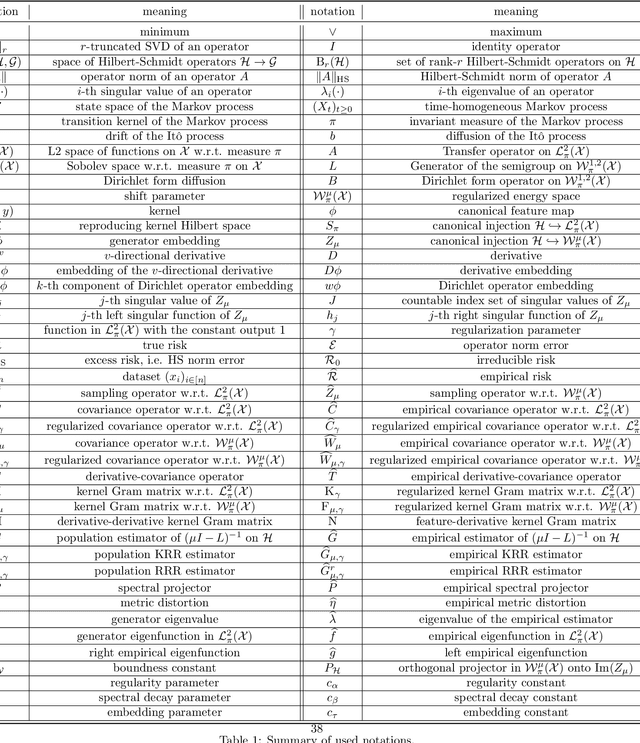
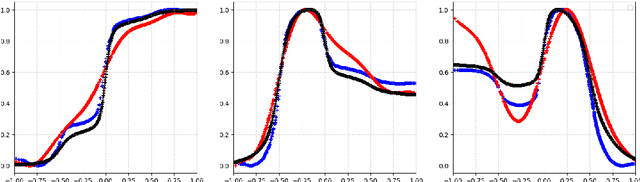
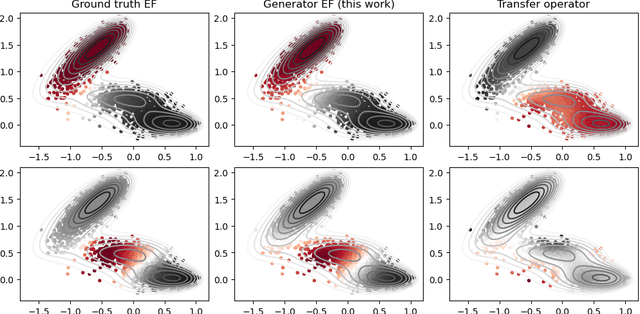
We address data-driven learning of the infinitesimal generator of stochastic diffusion processes, essential for understanding numerical simulations of natural and physical systems. The unbounded nature of the generator poses significant challenges, rendering conventional analysis techniques for Hilbert-Schmidt operators ineffective. To overcome this, we introduce a novel framework based on the energy functional for these stochastic processes. Our approach integrates physical priors through an energy-based risk metric in both full and partial knowledge settings. We evaluate the statistical performance of a reduced-rank estimator in reproducing kernel Hilbert spaces (RKHS) in the partial knowledge setting. Notably, our approach provides learning bounds independent of the state space dimension and ensures non-spurious spectral estimation. Additionally, we elucidate how the distortion between the intrinsic energy-induced metric of the stochastic diffusion and the RKHS metric used for generator estimation impacts the spectral learning bounds.