 Add to Chrome
 Add to Firefox
 Add to Edge
GLI-AL: A Multi-Modal Glioma MRI Label Resource with Unified Anatomy-Lesion Labels
Jul 27, 2026
Existing BraTS-GLI datasets provide a widely used benchmark for adult glioma MRI segmentation, but their task definition focuses on tumor subregions and does not systematically represent coexisting white matter hyperintensities (WMH). In joint segmentation settings, such unlabeled abnormalities introduce task-specific label noise by treating pathological regions as normal tissue. To address this limitation, we introduce BraTS-GLI Anatomy-Lesion, a controlled-access, labels-only derived resource built from the BraTS 2023-GLI training cohort. The resource provides 1,251 unified eight-class anatomy-lesion label sets aligned with the original four-modal MRI cases, including image-repair labels for 116 cases requiring repaired imaging inputs. The cohort is organized into a 394-case purified subset and an 857-case extended subset, with case-level metadata covering label source, image-repair requirements, quality-control status, access conditions, checksums, and release boundaries. Compared with the original BraTS-GLI annotations, the resource substantially expands foreground supervision by incorporating healthy brain tissues and previously unlabeled coexisting abnormalities within a unified label space. A validation study using MedNeXt and T1/FLAIR inputs suggests that WMH-aware supervision preserves healthy-tissue segmentation performance across both in-domain GLI and external WMH datasets, while improving sensitivity to coexisting lesions relative to noisy-control training. The resource is intended for scientific research and supports joint anatomy-lesion supervision, label-noise analysis, and reproducible evaluation. Data are available at https://www.synapse.org/Synapse:syn75210889/wiki/, and code is available at https://github.com/xyx200/brats-gli-anatomy-lesion-code. The data resource DOI is https://doi.org/10.7303/SYN75210889.

Toward Reliable RGB-D Semantic Segmentation: Handling Missing Modalities via Condition Dropout
Jul 22, 2026RGB-D semantic segmentation has achieved remarkable progress, yet most models assume that RGB and depth are always available. In practice, failures or occlusions of surveillance sensors often remove one modality. Although RGB or depth alone can contain sufficient cues, models trained only on full-modality inputs fail to exploit the remaining modality once one is missing, causing severe degradation. We tackle this issue with a simple continued-training paradigm, \emph{Condition Dropout (ConD)}, which mitigates degradation while preserving full-modality accuracy. Starting from a pretrained RGB-D model, ConD adds a second stage that randomly simulates complete, RGB-missing, and depth-missing inputs, freezes the original encoders, and trains copied encoders with zero-initialized feature injection. Experiments on NYU-Depth V2 and SUN RGB-D show that ConD improves robustness under missing modalities and even yields slight gains when modalities are complete. Our code will be made publicly available upon acceptance.
SoK: Unlearnability and Unlearning for Model Dememorization
May 12, 2026Advanced model dememorization methods, including availability poisoning (unlearnability) and machine unlearning, are emerging as key safeguards against data misuse in machine learning (ML). At the training stage, unlearnability embeds imperceptible perturbations into data before release to reduce learnability. At the post-training stage, unlearning removes previously acquired information from models to prevent unauthorized disclosure or use. While both defenses aim to preserve the right to withhold knowledge, their vulnerabilities and shared foundations remain unclear. Specifically, both unlearnability and unlearning suffer from issues such as shallow dememorization, leading to falsely claimed data learnability reduction or forgetting in the presence of weight perturbations. Moreover, input perturbations may affect the effectiveness of downstream unlearning, while unlearning may inadvertently recover domain knowledge hidden by unlearnability. This interplay calls for deeper investigation. Finally, there is a lack of formal guarantees to provide theoretical insights into current defenses against shallow dememorization. In this Systematization of Knowledge, we present the first integrated analysis of model dememorization approaches leveraging unlearnability and unlearning. Our contributions are threefold: (i) a unified taxonomy of unlearnability and scalable unlearning methods; (ii) an empirical evaluation revealing the robustness, interplay, and shallow dememorization of leading methods; and (iii) the first theoretical guarantee on dememorization depth for models processed through certified unlearning. These results lay the foundation for unifying dememorization mechanisms across the ML lifecycle to achieve a deeper immemor state for sensitive knowledge.
OwlCap: Harmonizing Motion-Detail for Video Captioning via HMD-270K and Caption Set Equivalence Reward
Aug 27, 2025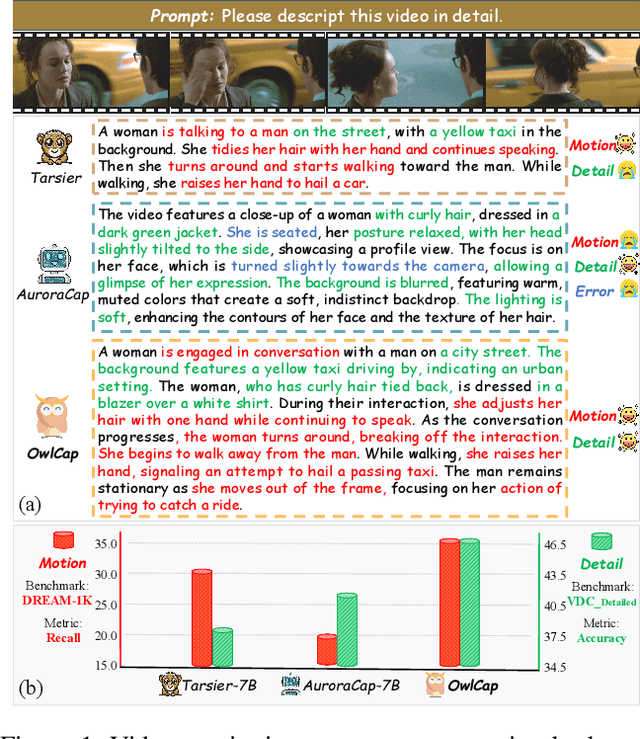
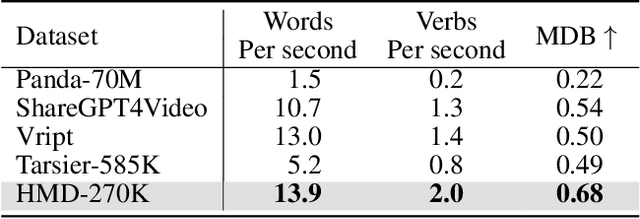
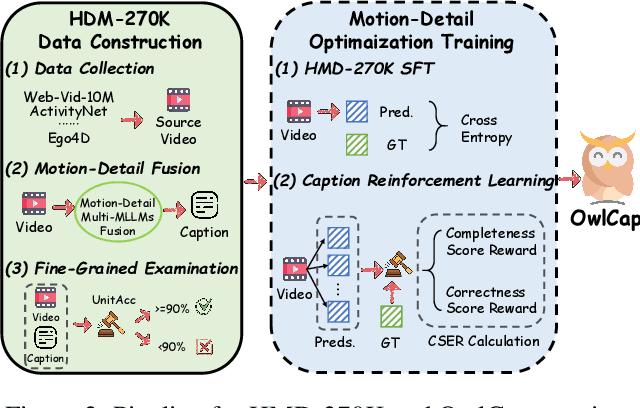

Video captioning aims to generate comprehensive and coherent descriptions of the video content, contributing to the advancement of both video understanding and generation. However, existing methods often suffer from motion-detail imbalance, as models tend to overemphasize one aspect while neglecting the other. This imbalance results in incomplete captions, which in turn leads to a lack of consistency in video understanding and generation. To address this issue, we propose solutions from two aspects: 1) Data aspect: We constructed the Harmonizing Motion-Detail 270K (HMD-270K) dataset through a two-stage pipeline: Motion-Detail Fusion (MDF) and Fine-Grained Examination (FGE). 2) Optimization aspect: We introduce the Caption Set Equivalence Reward (CSER) based on Group Relative Policy Optimization (GRPO). CSER enhances completeness and accuracy in capturing both motion and details through unit-to-set matching and bidirectional validation. Based on the HMD-270K supervised fine-tuning and GRPO post-training with CSER, we developed OwlCap, a powerful video captioning multi-modal large language model (MLLM) with motion-detail balance. Experimental results demonstrate that OwlCap achieves significant improvements compared to baseline models on two benchmarks: the detail-focused VDC (+4.2 Acc) and the motion-focused DREAM-1K (+4.6 F1). The HMD-270K dataset and OwlCap model will be publicly released to facilitate video captioning research community advancements.
PathVG: A New Benchmark and Dataset for Pathology Visual Grounding
Feb 28, 2025


With the rapid development of computational pathology, many AI-assisted diagnostic tasks have emerged. Cellular nuclei segmentation can segment various types of cells for downstream analysis, but it relies on predefined categories and lacks flexibility. Moreover, pathology visual question answering can perform image-level understanding but lacks region-level detection capability. To address this, we propose a new benchmark called Pathology Visual Grounding (PathVG), which aims to detect regions based on expressions with different attributes. To evaluate PathVG, we create a new dataset named RefPath which contains 27,610 images with 33,500 language-grounded boxes. Compared to visual grounding in other domains, PathVG presents pathological images at multi-scale and contains expressions with pathological knowledge. In the experimental study, we found that the biggest challenge was the implicit information underlying the pathological expressions. Based on this, we proposed Pathology Knowledge-enhanced Network (PKNet) as the baseline model for PathVG. PKNet leverages the knowledge-enhancement capabilities of Large Language Models (LLMs) to convert pathological terms with implicit information into explicit visual features, and fuses knowledge features with expression features through the designed Knowledge Fusion Module (KFM). The proposed method achieves state-of-the-art performance on the PathVG benchmark.
CoLA: Conditional Dropout and Language-driven Robust Dual-modal Salient Object Detection
Jul 09, 2024The depth/thermal information is beneficial for detecting salient object with conventional RGB images. However, in dual-modal salient object detection (SOD) model, the robustness against noisy inputs and modality missing is crucial but rarely studied. To tackle this problem, we introduce \textbf{Co}nditional Dropout and \textbf{LA}nguage-driven(\textbf{CoLA}) framework comprising two core components. 1) Language-driven Quality Assessment (LQA): Leveraging a pretrained vision-language model with a prompt learner, the LQA recalibrates image contributions without requiring additional quality annotations. This approach effectively mitigates the impact of noisy inputs. 2) Conditional Dropout (CD): A learning method to strengthen the model's adaptability in scenarios with missing modalities, while preserving its performance under complete modalities. The CD serves as a plug-in training scheme that treats modality-missing as conditions, strengthening the overall robustness of various dual-modal SOD models. Extensive experiments demonstrate that the proposed method outperforms state-of-the-art dual-modal SOD models, under both modality-complete and modality-missing conditions. We will release source code upon acceptance.
Synthetic Data in AI: Challenges, Applications, and Ethical Implications
Jan 03, 2024In the rapidly evolving field of artificial intelligence, the creation and utilization of synthetic datasets have become increasingly significant. This report delves into the multifaceted aspects of synthetic data, particularly emphasizing the challenges and potential biases these datasets may harbor. It explores the methodologies behind synthetic data generation, spanning traditional statistical models to advanced deep learning techniques, and examines their applications across diverse domains. The report also critically addresses the ethical considerations and legal implications associated with synthetic datasets, highlighting the urgent need for mechanisms to ensure fairness, mitigate biases, and uphold ethical standards in AI development.